





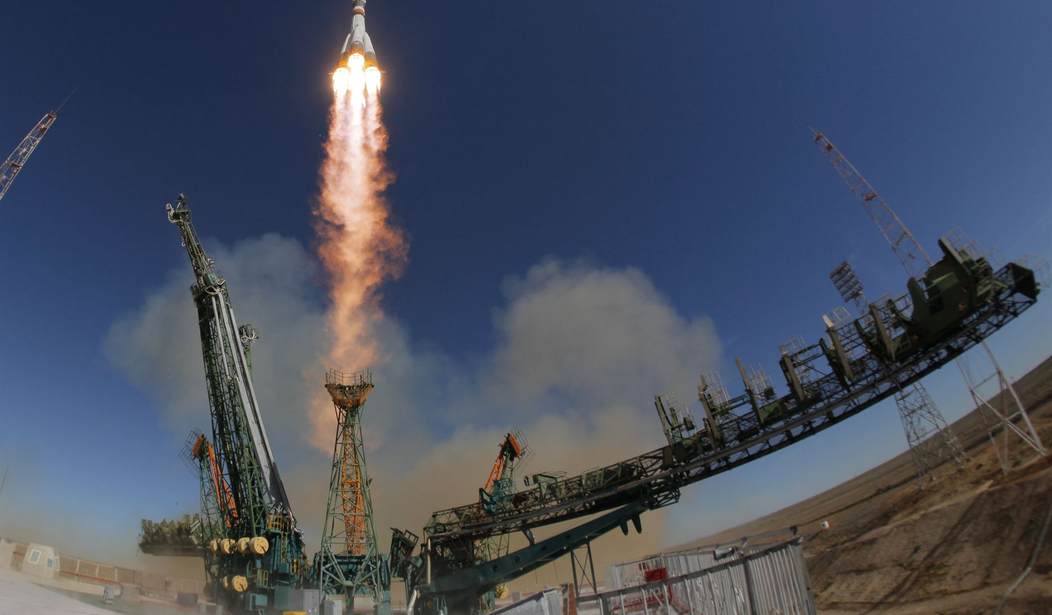
A Russian Soyuz launch mishap late last week left the country without a manned space program until vital launch infrastructure can be replaced or repaired.
While Americans were celebrating Thanksgiving, an unexplained "accident occurred on the launch pad at Site 31/6 at the Baikonur Cosmodrome," according to a NASA Spaceflight report on Sunday, sending the site's mobile maintenance cabin flying and "lying upside down in the flame trench."
Site 31/6 is currently Russia's only site rated for manned and cargo launches to the International Space Station (ISS).
The good news is that the launch itself was a success, and cosmonauts Sergey Kud-Sverchkov and Sergei Mikayev, along with NASA astronaut Christopher Williams, all arrived at the ISS hours later, safely and according to plan.
Whew — but that's where the good news ends.
The bad news is that this might be it for Russia's Soyuz launches for a while, and the ISS still depends on Russia doing its share of the heavy lifting.
"Photos of the accident showed significant damage to the maintenance cabin, which, according to experts, is too extensive to allow for repairs," NSF. "The only way to resume launches from Site 31/6 is to install a spare maintenance cabin or construct a new one."
This isn't some pre-fab shed. It's a 63-foot by 56-foot beast weighing144 tons, where ground crews conduct "all pre-launch operations with the lower part of the rocket, including removing protective covers and installing pyrotechnic devices (the famous 'matches') on the rocket engines."
Tight-lipped as ever, Moscow hasn't said who screwed up or what went wrong.
Roscosmos, the Russian space agency, claims to have all the spare parts it needs, but did not say how long repairs or replacement might take — or how much it might cost the agency that's already facing severe economic difficulties. Earlier this year, RSC Energia CEO Igor Maltsev — who runs Roscosmos’s primary spacecraft contractor — described his company's financial condition as "critical."
Four weeks ago, Russia's Vostochny Cosmodrome had its power cut off for failure to pay its electricity bills. Roscosmos can't afford to pay its contractors, and the ripple effects are felt throughout the country's once-fabled space program.
Ars Technica's senior space editor Eric Berger said the launch damage will "test the current leaders of Russia" over "how committed are they to the International Space Station partnership with NASA." Before last week, "they were willing to play out the string to 2030 and the end of the station’s lifetime, but that required minimal investment in new capabilities."
Berger also pointed out that Russia had already cut its crewed ISS missions by 25%, from four every two years to just three, to save money. "Now they must devote significant resources to the Soyuz program critical to the ISS," Jeff Manber, a senior space exec with years of expertise with Russia’s space program, told Berger, "We are going to learn just how important the ISS is to leadership there."
Left unsaid is whether sanctions, labor shortages, and fiscal constraints might mean delays or cancellations, even if Moscow and Roscosmos remain fully committed to their ISS obligations.
Unless Moscow suddenly decides to become more forthcoming than usual, we might never know for sure what actually happened at Site 31/6 last week, so there's little sense in speculating any further on that aspect of the story.
We need to ask who or what will keep ISS in orbit until 2030. The space station needs a boost every month or two to maintain orbit, which is usually provided by Russia's Progress cargo supply ship. Backup systems include Northrup's Cygnus and the SpaceX Dragon, "but long-term it is not immediately clear whether US vehicles could completely make up for the loss of Progress vehicles," according to Berger.
So in this case, Moscow's little rocket problem is everybody's problem.
But that wasn't the only rocket fail from last week. The next one is on video and it is spectacular:
New footage of the failed Russian rocket launch, possibly a UR-100N ICBM with Avangard hypersonic warhead or a Sarmat missile, according to Militarnyi and other sources. https://t.co/feHK9bQoxL pic.twitter.com/2c8cAZyE9f
— WarTranslated (@wartranslated) November 28, 2025
The rocket is believed to be either an older RS-18/UR-100N ICBM (NATO reporting name SS-19 Stiletto) on a "glory trip" operational test launch, or one of Russia's troubled RS-28 Sarmat ICBMs. The Sarmat is supposed to evade all known missile defenses, although flying it directly into the ground after launch is certainly a novel approach.
Whatever that missile was, it's interesting that it either wasn't remotely destroyed or didn't self-destruct during the failed launch.
The Kremlin remains tight-lipped on this one too, even with a couple of embarrassing videos circulating on social media.
Recommended: Venezuela Is Training for World War III and I Can't Stop Laughing


Join the Conversation
VIP members get the ability to comment on articles.