
Note: Most Thursdays, I take readers on a deep dive into a topic I hope you'll find interesting, important, or at least amusing. These essays are made possible by — and are exclusive to — our VIP supporters. If you'd like to join us, take advantage of our 74% off (!!!) promotion.
Believe me, I never expected to get choked up talking about Rob Reiner.
But there I was, struggling for a moment to get the words out during Scott Ott's Right Angle segment. The emotions finally caught me — not because of Reiner, whom I did not know — but because of the impact his movies have had on my family.
I choked up when I had to say out loud that two Reiner movies bookend my little family's crazy holiday season.
The Crazy Season starts the week or two before Halloween, which we take all too seriously. In November, my wife Melissa has a birthday week that includes a family dinner, a dinner I cook at home, and a dinner out. Then comes Thanksgiving and of course Christmas, followed almost immediately by our older son's birthday — giving us roughly 48 hours to take down all of Christmas so that his party doesn't feel like leftovers. Three days after that, we throw a massive themed New Year's party.
It's a lot, but it's filled with laughs and love. And Rob Reiner has long been part of it.
The first big event is one of those silly traditions with a sillier name that no one is quite sure how it started: Taco Bride Night.
We have old friends over for a build-them-yourself taco buffet and a movie. When the kids were still little, they'd make a nest on the living room floor with blankets and stuffed animals. Once we've settled in with food and drink, we put on The Princess Bride. We recite so many classic lines along with the actors that it's practically a midnight Rocky Horror live show.
But with tacos. And margaritas. Just because.
It's been a long time since my sons still needed tucking in, but when their old man excuses himself to bed at the end of Taco Bride Night, it's always with an "As you wish."
That's the opening bookend. The closer comes the night before New Year's, when Melissa and I enjoy one last calm before the storm and put on When Harry Met Sally... for the umpteenth time. Not just because my wife gets a little crinkle above her nose when she's looking at me like I'm nuts, but it's on the list.
It's impossible after all these years to imagine the Crazy Season without two of Reiner's best and best-loved works.
But those are just two of many, and while I'd like to discuss those and more, it's also impossible to discuss Rob Reiner the Endlessly Entertaining Movie Director without also discussing Rob Reiner the Mean-Spirited Progressive, and Rob Reiner the Loving and Desperate Father.
There really are — were, sorry — three of him.
And Another Thing: Scott's segment hasn't gone live yet, but it will be worth your time when it does — so keep an eye on Bill Whittle's YouTube page. Like today's essay, it was an honest "good, bad, and ugly" look at Reiner.
Like most everybody, I first became aware of Reiner as an actor on All in the Family. But I didn't much care for the show — I was little when it first aired — and I really didn't care for his character. Mike "Meathead" Stivic, creator Norman Lear's stand-in for himself, was supposed to come across as the most sympathetic member of the dysfunctional Bunker family. But audiences didn't like the layabout lefty nearly as much as they loved his nemesis, that crusty old conservative, Archie Bunker (Carroll O'Connor).
There's a lesson there, but it seems to have gone over Reiner's head, just like it did Lear's — and it matters later.
Reiner never gave up acting — earlier this year, he had a small but charming role on The Bear — but it was as a movie director that he "put a dent in the universe," as Steve Jobs liked to say.
He was just so good, right from the start.
Coming out of seemingly nowhere with This Is Spinal Tap in 1984, Reiner — working with fellow comic/improv geniuses Christopher Guest, Michael McKean, and Harry Shearer — made what is nothing less than one of the funniest and most quotable movies of all time. Roger Ebert said it "simply, slyly, destroys one level of rock pomposity after another," in his original review. The Baltimore Sun's Stephen Hunter called it "that rarest of birds, the sustained and nearly pitch-perfect parody."
Reiner even parodied himself, playing puffed-up director Marty DiBergi.
I'd wager that you or at least someone you love pretty much knows the movie by heart.
Underlying the parody, however, is a warmth you'll find in all of Reiner's best movies. Spinal Tap does, after all, "win" in the end — even if they're only still big in Japan.
Reiner followed that up with an unexpected teen comedy, The Sure Thing, in which he almost out-John Hughes John Hughes. Reiner's run of commercial and critical hits continued with Stand by Me, The Princess Bride, When Harry Met Sally..., Misery, and A Few Good Men. The almost decade-long streak was broken only by North in 1994.
And Another Thing: Jewish law requires that eulogies be both praiseworthy and truthful. So here's Ebert on North: "I hated this movie. Hated hated hated hated hated this movie. Hated it. Hated every simpering stupid vacant audience-insulting moment of it. Hated the sensibility that thought anyone would like it. Hated the implied insult to the audience by its belief that anyone would be entertained by it."
Look at that list again. Reiner never came close to repeating himself in any of those films. If you could say he had a style as a director, it was "quality."
In the post-Studio Era, you'd have to be Steven Spielberg to beat Reiner's 1984-1992 run. Was Reiner truly the second-best director of the last five decades? I couldn't say for sure, but I can't think of who else it might be.
But then something happened about a decade ago — you can probably guess what it was — and Reiner went from being just another Hollywood lefty to a genuine annoyance. If Reiner wasn't Patient Zero in the Trump Derangement Syndrome pandemic, he was at least one of the most prominent Typhoid Marys transmitting the infection with cruel abandon.
It got ugly.
On Twitter (now X), Reiner called President Donald Trump "a Liar, a Criminal, and... mentally ill," which was among his nicer tweets. "Each day this mentally unstable man takes a step closer to destroying 242 yrs. of self rule," Reiner said of Trump in 2018. "And though Democrats want to be restrained, impeachment is inevitable."
I'm not sure which part is most offensive, but I'd probably go with "Democrats want to be restrained."
In his 2020 endorsement of Joe Biden — who would soon go on to become arguably the most corrupt president in history — Reiner tweeted, "We either can choose a good decent man who cares about his fellow citizens and knows how to govern, or a Convicted Felon who will destroy our Democracy."
Rob Reiner, the director who gave us the subtle joys and troubles of a 15-year-marriage in The Story of Us, was a ham-fisted propagandist on social media. So while I'd rather not dwell on Reiner's TDS, in a weird way, I'm almost thankful for it. Because while Reiner was no stranger to social media, he had no clue how to use it.
It could have gone differently.
Watch him wield his mensch charm in this brief Instagram reel he did with his daughter, Romy. In this bit, Romy explains that to get taken more seriously in Hollywood, she needs Dad to pay for... well, you'll see.
Tastes may differ, but that bit slayed me.
If Reiner had used his loving-father warmth against Trump, it might have proved devastating.
Instead, Reiner hectored, insulted, and spewed. The man who understood talent and audiences so well that he was able to make Billy Crystal a romantic lead, turned menacing Andre the Giant into a lovable lug, and could turn the search for a dead body into one of the warmest and truest tween tales of all time...
...that man, politically, couldn't sell A/C in Arizona. Not to Republicans, anyway.
Of course, Reiner was a Hollywood baby, son of Dick Van Dyke Show creator (and so much more) Carl and his actress/singer wife, Estelle. There's something about growing up inside that Hollywood bubble that the concerns and attitudes of everyday Americans just can't pierce.
And Another Thing: When I was too young for the intricacies of Jewish law and tradition — and also not being raised Jewish — my grandfather explained the rule about eulogies to me like so: "If you don't speak the truth during the service, they won't be recognized in the afterlife." Isn't that lovely?
If Reiner never had another run like 1984-1992, he still knew how to treat audiences to the occasional gem like Ghosts of Mississippi, The Bucket List, and Being Charlie. Being Charlie... good lord... that one was co-written by Reiner's son, Nick. It explores the relationship between a famous father and his son, as the troubled young man struggles with addiction.
I thought the film was underrated when I first watched it almost a decade ago, in no small part because I grew up witness to my mother's issues with drugs and alcohol. Some of Charlie's dynamic, reversed though it was, hit me in raw spots that I'd thought were safely scarred over. Now that I know how the real-life version of Charlie ends, I'm sure I'll never bring myself to watch it again.
So here comes the bad part, the Loving and Desperate Father who struggled with his son's addictions just as badly as Nick did.
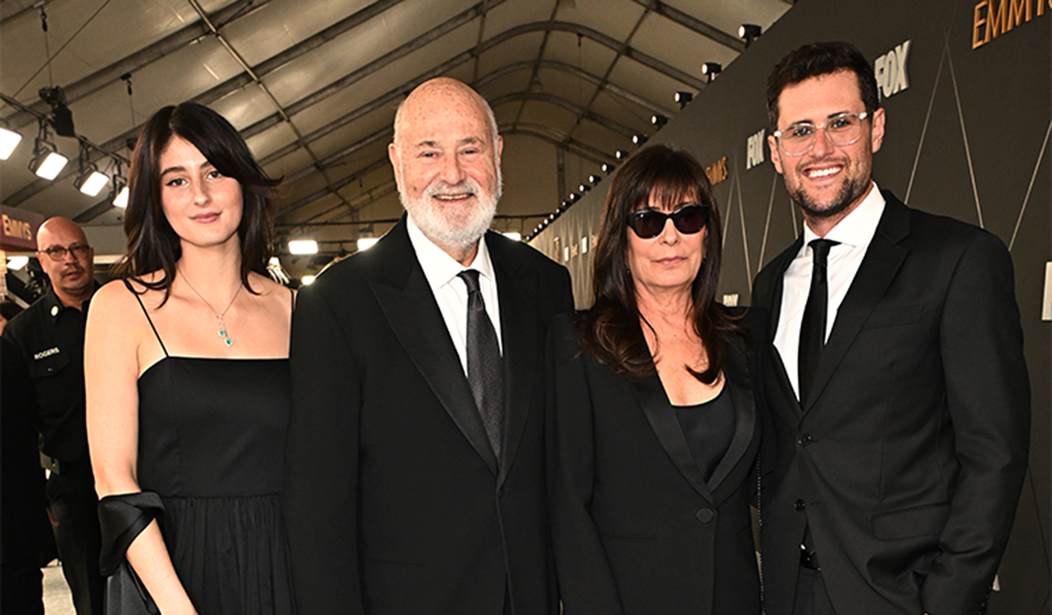
The Hollywood Reporter's Steven Zeitchik wrote this week about a dinner he shared with the Reiners at the premiere of Being Charlie in Toronto 10 years ago. "Ever since news broke that Rob and Michele Reiner had been killed in their home — according to the LAPD, by a knife-wielding Nick — I have replayed every moment from that night in my mind," he wrote, and one can barely begin to imagine.
According to Zeitchik, two lines from the film caused tension between its writer and director. There's nothing unique in that, but it is made more difficult given Rob and Nick's family dynamic. The first line has the father, David (Cary Elwes), tell Charlie, (Nick Robinson), "I’d rather have you alive and hating me than dead on the streets.” In real life, Nick's addiction did have him sometimes living on the streets.
"Rob really, really wanted the line in," Zeitchik wrote. "It explained his actions, justified them, even though he was now apologizing for thinking that way, for being so hard on his son. I looked over at Nick. He didn’t seem so happy to have the line in the film."
The second line was this: “So what do you want me to do? Tell me what to do,” David begs Charlie. And I can't read that without hearing it in Rob's voice.
Here's what happened next at that Toronto dinner:
I asked Nick what he thought of that — what could his father had done? But Nick had no answer. Not at dinner, maybe not ever. Maybe there was nothing Rob could do. Maybe the whole movie, I thought, was Rob coming to terms with that inescapable fact, and all the cheer and the pride, well-earned as it was, could simply not illuminate that darker, more severe reality. He had done everything he could to help his son. He had even set in motion the Hollywood machine to help his son. And yet there was nothing he could do to fully help his son. Some things are beyond our greatest effort.
At dinner, I saw a man who wanted so badly for resolution to be true, for reconciliation to find its way to them, that maybe he was pushing harder than matters should be pushed — that maybe he was trying to will his son into someone he couldn’t be.
Again, having seen addiction up close and all-too-personal, Zeitchik's observations ring true.
Nick was supposedly sober by the time of Being Charlie's premiere, but he later confided to Zeitchik that while he'd given up the hard drugs, he was still drinking and smoking weed. "Listen, I’m not in a position to do this," Nick said he told the film's publicity team. "I’m not a quote unquote sober guy," but "They said 'you have to do this.' They want the whole father-son angle."
I'm not here to speculate on what might have happened next, or pass judgment on how a family deals with addiction. Only the Reiners know for sure, and two of them were just stabbed to death. And I'm certainly not going to pass judgment on a situation where there are no easy answers, no 100% correct processes, for any family.
Nobody can know, when they send their 15-year-old son off to the first of many drug rehab stints, that a dozen years later, he'll come back home, "tweaked out," to murder his bewildered parents.
Rob Reiner and Michele Singer were likely bewildered from the moment they learned their young boy was a drug addict. They must have been bewildered by, as Nick put it, his "resistance every time they tried to reach me," during his nearly 20 years of addiction. But nothing could have have prepared Rob or Michele for their bewilderment when Nick brought out the knife.
In a well-structured essay, this is where I'd bring things full circle. There'd be a Reiner movie quote to tie everything back together with a logic that I'd make you feel was inevitable.
But there's no structure or logic to impose on a story so baffling.
So let me finish with a story where we can set aside Rob the Mean-Spirited Progressive, and focus instead on the movie director — and on the man who would become a loving father.
During pre-production of When Harry Met Sally..., Reiner was still disillusioned with love and marriage following a messy (and embarrassingly public) divorce from his first wife, Penny Marshall. As he originally saw things, Harry and Sally weren't supposed to have a happy ending. "It was going to be the two of them seeing each other after years, talking, and then walking away from each other," Reiner later said.
But he told People magazine last year that during production, "I met my wife Michele, who I’ve been married to now 35 years… I met her while we were making the film, and I changed the ending." And so a bittersweet concept in the end turned into a love letter to the woman he'd spend the rest of his life with.
Whatever his faults, Reiner always found a way to give audiences one perfectly happy ending after another. "I like writing because you can make things happen and turn out the way they never do in real life," Reiner once said, and that, I think, is where I must stop writing for today.
Last Thursday: One Cheer for Colonialism!