
There’s you — and then there’s your reputation. The two are not the same.
If you think the goal of PR is to match who you are with your reputation, you’re mistaken. We’re actually way more ambitious than that: We want your reputation (brand) propelled as far ahead as possible, so it pulls you forward and allows your business model to grow — like a rocket tugging a crate of cargo across the cosmos.
Unfortunately, the opposite can also happen: Sometimes, your reputation is like a heavy anchor. Instead of propelling you forward, it’s a drag on your business model, impeding growth and limiting opportunities.
That’s the mindset I’d like you to have for the following thought experiment. Because, when I say in the title, “Gimme your nominees for the three Biggest PR Losers of the Year,” I don’t mean whom you disliked the most, or who received the most negative press. Think of it like this: Take any political entity (person, party, organization, country, etc.).
Which one had the greatest PR deterioration in 2025, where their reputation (brand) became a heavy anchor, slowing them down and/or dragging them to the bottom of the sea?
So, don’t nominate Hunter Biden; his reputation was already garbage. And don’t nominate Nick Fuentes; he went from a famous Nazi to an even more-famous Nazi, but he’s still a Nazi. We’re not basing this on whom we hate the most, or who’s most deserving of our slings and arrows. It’s not a Nixon-esque Enemies List.
Ask yourself, whose reputation collapsed the most dramatically in 2025?
I already have a (murky) top five in mind, but I’m persuadable. Sock it to me in the comments.
We’ll reveal the three biggest losers in tomorrow’s column.
PRediction: 2025 was just the beginning of the conservative media wars. It’ll get FAR worse in 2026.
Back in the heydays of radio shock jocks, media feuds were fun. Howard Stern developed the template, and it worked beautifully: One radio show picked a fight with another show (usually the less-popular show would attack the more-popular one). They’d go back and forth, call each other names, and whoever won in the Arbitron ratings (now Nielsen Audio) was the victor.
My all-time favorite media war was here in Tampa Bay. Some of their shenanigans were mind-blowing. (Fun fact: Lawyers were disbarred because of it.)
From the shock-jock’s point of view, media wars are fantastic for business. It keeps the focus on them and their show. Their antics become the topic of conversation; and when orchestrated effectively, their audience becomes even more loyal, because they feel like they’re part of the show’s “army.”
Today’s shock jocks aren’t on radio anymore. They live online: Candace Owens, Tucker Carlson, Nick Fuentes, and more. They are to conservative media what the National Enquirer was to traditional news.
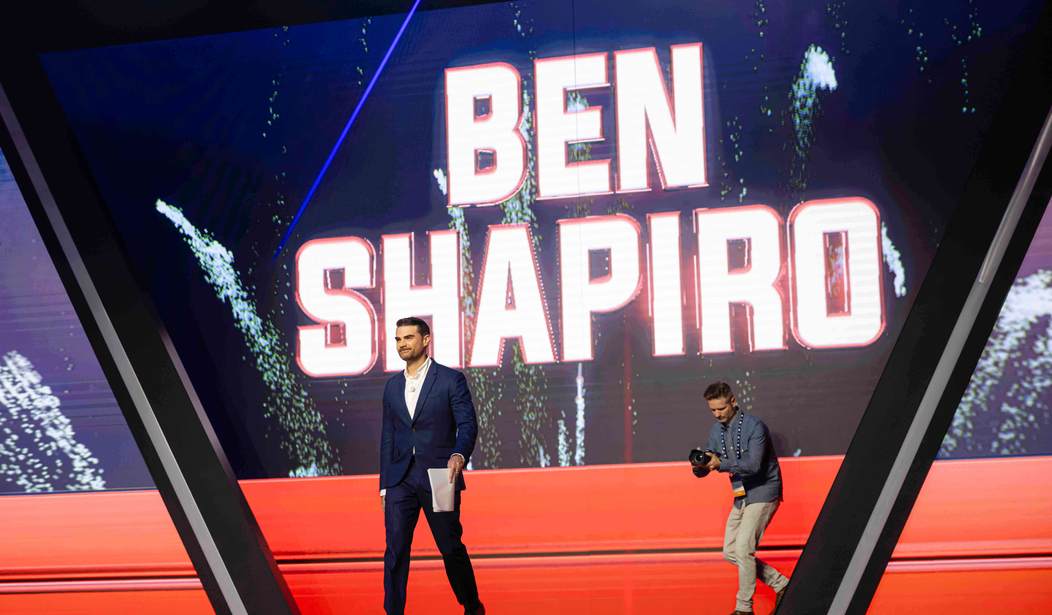
And a hot, juicy media war between, say, Ben Shapiro and Tucker Carlson would attract a ton of attention for Ben Shapiro and Tucker Carlson.
The political shock-jock business model requires outrageous behavior, sensational claims, crazy conspiracies, and escalating controversies to drive clicks, views, and attention. Shock jocks are financially incentivized to lean into conservative-on-conservative conflicts.
It’s like the old Don Ohlmeyer quote, “The answer to all your questions is money.” Shock jocks are gonna do whatever’s in their financial self-interest. The Shapiro-Carlson feud that took centerstage at Turning Point USA is just the beginning.
Keep an eye on this, because I suspect it’ll be yuuuge issue in 2026. It’s gonna get worse, not better.
And it’ll be a net-negative for the MAGA movement.
PRojection: Another big theme for 2026: The Christianization of MAGA.
For most of the last 50 years, the GOP has been comprised of three major blocs. There were the business conservatives, the foreign policy hawks, and the religious right. It all came together beautifully under Ronald Reagan, and the three-piece coalition lasted through the mid-2010s.
But with the end of the Cold War — and especially after the backlash from the Iraq War — the foreign policy hawks eroded in influence. And although 80% of evangelicals still voted for him in 2024, the thrice-married, lewd-talking, gambling-promoting, beauty pageant-owning Donald Trump was always an odd fit for religious traditionalists.
The Reagan coalition and the MAGA coalition comprised different factions.
Especially during Trump’s first term, the religious right’s influence was mostly limited to the appointment of federal judges. (Which led to their biggest victory ever, the overturning of Roe v. Wade.) Because the Democratic Party moved so radically to the left on trans, gender, and children, Trump wisely stayed in the middle — and won the support of religious Americans by being the only grownup in the room.
But since the assassination of Charlie Kirk, there’s been a religious revival in the MAGAverse. Christian themes are front and center.
The MAGA movement is becoming a Christian movement.
It’s an intriguing development, but it’s not without risk. The pool of churchgoers is shrinking, and our 2028 nominee will need the support of non-Christians to win.
Churchgoing evangelicals and hardcore Catholics alone won’t do it.
The key, then, is activating as many churchgoers as possible without alienating other potential voters. That’ll require measured rhetoric, reassurance, and the comingling of religious principles with political policies.
The last one is what I’m most excited about: Many voters, especially in the black and Latino communities, have VERY conservative opinions on social issues. The Democrats have done well with these blocs because of the politics of personal identification: Minorities belong in the Democratic Party. Everyone knows this!
But religious identification matters, too. And it just might be the hammer that cracks the “politics of personal identification” shell for good.
Last week, President Trump launched military strikes in Nigeria to protect Christians. In 2026, we’re gonna see the U.S. assume a leadership role as the global protectors of Christianity.
Those Nigerian strikes were just the beginning.
PRaise: I grabbed one of my kids and caught the new Avatar movie last night. My expectations were meager: I was in it purely for the eye candy. (Say whatever you want about James Cameron, but the man is amazing at directing 3-D movies.) I figured Avatar 3 would be like an amusement park ride — lots of twists, turns, and sensory overload — and hey, as long as the story wasn’t so stupid that it detracted from the visuals, that’s all I needed.
The movie more than delivered on the eye candy. Shot-for-shot, it was one of the most stunningly beautiful films I had ever seen. (Seriously.)
The world-building was topnotch.
Sure, the characters were thin. And yeah, I wasn’t too impressed with either the plot or the motivation behind the characters’ actions, which seemed kind of schizophrenic. One moment, the hero is fighting bravely to defend all his friends and family; the next, he’s prepared to sacrifice an innocent child, a la Abraham and Isaac.
(And we spend half the movie watching characters get captured and then escaping. Must’ve happened four or five times, no exaggeration.)
But Cameron knows how to shoot action sequences, too. After all, he’s the man behind Terminator, Terminator 2, and Aliens. It didn’t matter that the heroes were paper-thin; he built the drama wonderfully, and the stakes felt real and gripping.
My kid and I loved it.
If you’re looking for a family-friendly activity over the holidays, heading over to the neighborhood theater and catching Avatar 3 isn’t a bad way to spend your day. (But be advised, some of the scenes, especially an alien tribe’s drug-fueled quasi-orgy by the campfire, might be too intense for younger kids.)
PRedators: Our pal Tucker Carlson is up to his old tricks. (Credit to my colleague, the wise and powerful Robert Spencer, for covering the story.) When Turning Point USA attendees voted in a straw poll that radical Islam was the greatest threat facing America today, Carlson first claimed it was a psy-op campaign from the Israeli government before declaring:
I mean, I don’t know how they responded to the poll. I don’t know who answered it, but I believe in measuring reality a little more empirically. And I don't know anyone in the United States in the last 24 years who’s been killed by radical Islam.
Hmm. That’s an odd unit of time, isn’t it? Why did Tucker pick 24 years?
Why not a round number, like 25 or 30?
I’m sure it has absolutely NOTHING to do with 9/11 being 24 years, 2 months, and 17 days ago. (That’s just a weird coincidence.) Anything that happened 25 years ago is ancient history!
And since Tucker didn’t know Specialist Sarah Breckstrom, who was murdered by a Muslim Afghan refugee named Rahmanullah Lakanwal just last month in broad daylight, I guess her death doesn’t count either.
Just water under the bridge… or planes into a building.
From America First to Sunni First, Tucker Carlson strikes again.