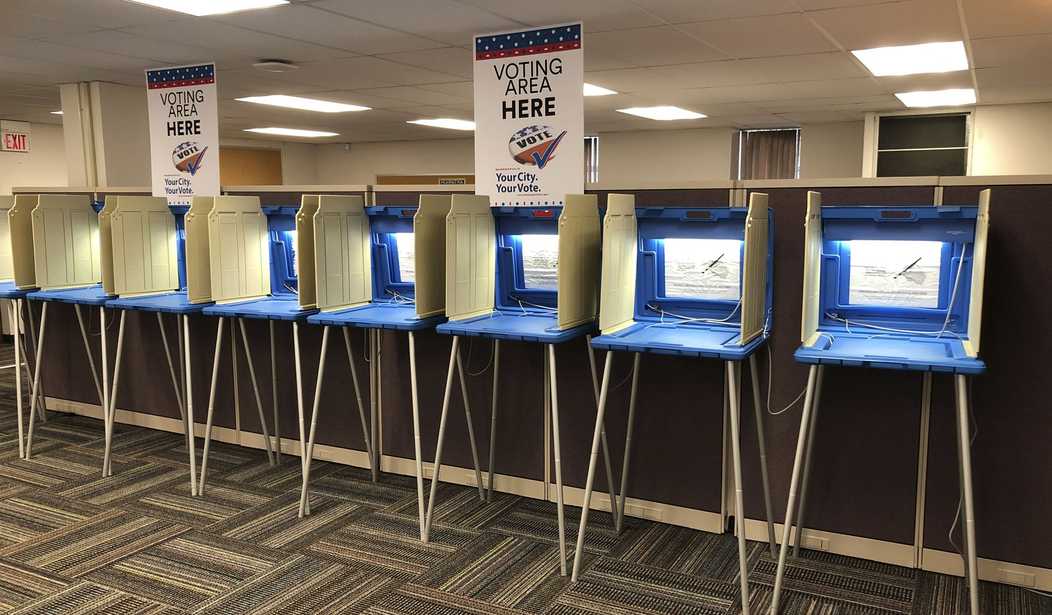
All special interest groups require candidates to complete questionnaires about where they stand on the issue before they'll endorse or donate to their campaign.
Most Republican-leaning interest groups send out five- to six-page questionnaires on the specific issue they're advocating for or against. It's political boilerplate that is a routine aspect of running as a Republican.
As you've already guessed, Democrats do things a little differently.
“These questionnaires, and more broadly the interest groups, are hurting our chances of winning,” Rohan Patel told Politico's Jonathan Martin. Patel and Seth London head up a new group called "Majority Democrats." Centrist party members who recognize that the Democrats have been captured by crazies formed it in the aftermath of the 2024 electoral disaster.
“They all have their own niche questionnaires, some of which are so broad as to be almost absurd, 20 to 30 pages of questions that don’t always have anything to do with their actual issue focus," Patel added.
The questionnaires have proven to be a trap for most Democrats who try not to run to the left of Che Guevara, but who are forced to adopt crazy positions due to "litmus tests" that "The Groups" (generic term for the left-wing advocacy groups) make into an ideological gauntlet that a candidate is forced to run if they want their support.
Kamala Harris fell into such a trap in 2024. She filled out an ACLU questionnaire in 2020, where she answered a question about federal funding for sex changes for transgender prisoners. Her affirmative answer came back to haunt her in Trump's most effective ad of the campaign ( "Kamala is for they/them, President Trump is for you!")
Patel said the transgender question was “one of about 20 questions that were absolutely deranged.”
As Patel and London will post on a site they’re calling “The Questionable,” other groups have asked candidates to commit to federally mandated 32-hour workweeks, halting the expansion of all fossil fuel projects and signing broadly-worded pledges on criminal justice that Republicans happily portray as defunding the police.
It’s the first notably aggressive effort by Majority Democrats to confront their own coalition a year after the group formed in the wreckage of the 2024 campaign. And the offensive goes deeper than merely criticizing the forms, which are a symptom of a broader challenge confronting the party — namely the role of “The Groups,” online shorthand for the constellation of left-leaning advocacy organizations, and the campaign-to-government-to-groups staffer ecosystem which perpetuates their influence.
“In a normal, functioning environment, the party and the aligned institutions of the party would push back on this,” said London.
But Democrats can't "push back" on the radicals because The Groups now are the party. There is no campaign without them. They not only provide the cash to run competitive campaigns, but they are also a major source of the bright young men and women who staff them. And the bulk of foot soldiers who stuff envelopes, knock on doors, and man the phones in get-out-the-vote efforts are activist members of The Groups.
The 2024 "autopsy" that the mainstream party ordered will never see the light of day. That's because word is that it skewers the "Interest Group Questionnaire Industrial Complex," primarily blaming them for the debacle. Party leaders decided discretion was the better part of valor, and rather than offend the sensibilities of the activists, hide their dirty laundry for another day.
Democrats are also fighting structural challenges to winning elections. The Electoral College is becoming an increasingly difficult hurdle to overcome as voters move from high-tax blue states to low-tax red states. Even with gerrymandering, Democrats' margin for error in House races is shrinking, and they are not competitive in large swaths of the country for Senate seats.
Consider: When Barack Obama was first sworn in as president, his party had five of the six Senate seats in Montana and the two Dakotas. Now Republicans have all six.
Yes, winning a bare Senate majority, breaking the filibuster and then granting Washington, D.C. and Puerto Rico statehood is one path to additional Senate seats. Yet that still won’t better the party’s chances across the South and Great Plains, which are vital to building a majority with cushion.
“You look at the next two to three Senate cycles, we’ll be scratching and clawing to get and hold 50 or 51 seats,” as London put it.
They have no chance of winning any sustained majority as long as their candidates hold the most radical, most off-putting positions in most of the country. They are rapidly being relegated to a coastal, big-city, college-town party, with no hope of affecting the kind of change their candidates promise.
That's a sure way for the Democrats to remain irrelevant for the foreseeable future.