







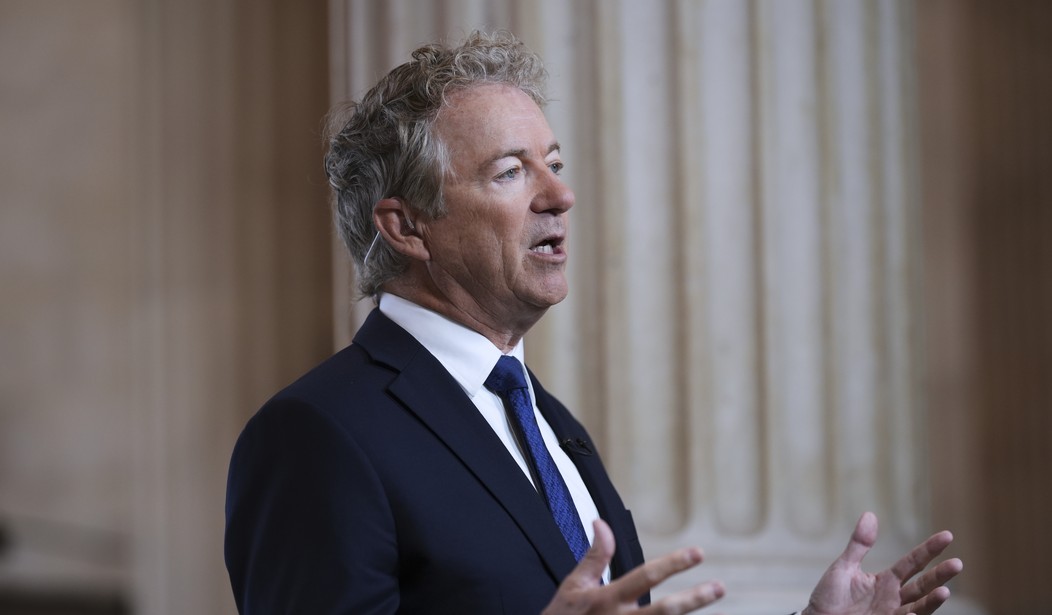
On Thursday, the United States Senate voted on a bipartisan War Powers resolution aimed at limiting the Donald Trump administration's ability to conduct further strikes in or against Venezuela without congressional approval.
It passed in a 52-47 vote with five Republicans crossing the aisle to vote in favor of a communist regime that's plaguing the Americas with Democrats. The fab five were Rand Paul (R-Ky.), Susan Collins (R-Maine), Lisa Murkowski (R-Ala.), Josh Hawley (R-Mo.), and Todd Young (R-Ind.). Surprisingly, John Fetterman (D-Pa.) also voted in favor, which many of his colleagues did not think would happen.
It will now go to the Senate floor for debate, and a final vote is expected as early as next week. If it passes the Senate, it will then go to the Republican-controlled House of Representatives. Even if it passes the House, Trump would most likely veto it.
This is the third time the Senate has attempted something like this in recent months, but the first time that it was able to pass such a measure.
This particular one was introduced by Sen. Tim Kaine (D-Va.) in early December and was cosponsored by Paul, Bernie Sanders, and a bunch of Democrats. It's aimed at directing "the removal of United States Armed Forces from hostilities within or against Venezuela that have not been authorized by Congress."
Congress makes the following findings:
(1) Congress has the sole power to declare war under article I, section 8, clause 11 of the United States Constitution.
(2) Congress has not declared war upon Venezuela or any person or organization within or operating from Venezuela, nor enacted a specific statutory authorization for use of military force within or against Venezuela.
(3) The use of military force by the United States Armed Forces within or against Venezuela constitutes the introduction of United States Armed Forces into hostilities within the meaning of section 4(a) of the War Powers Resolution (50 U.S.C. 1543(a)).
(4) Section 1013 of the Department of State Authorization Act, Fiscal Years 1984 and 1985 (50 U.S.C. 1546a) provides that any joint resolution or bill to require the removal of United States Armed Forces from imminent engagement in hostilities without a declaration of war or specific statutory authorization shall be considered in accordance with the expedited procedures of section 601(b) of the International Security and Arms Export Control Act of 1976.
It comes in the wake of the United States military capturing and arresting narco-terrorist Nicolás Maduro and his wife on January 3.
"The indication from the administration is that this is not a few days or a few weeks, it's likely a few years of U.S. occupation and involvement in this country," Kaine said Wednesday. "This is not an arrest warrant. This is far bigger than that."
This came after members of the Trump administration, including Secretary of State Marco Rubio and Defense Secretary Pete Hegseth, briefed Congress on the situation. Some Democrats accused the administration of "winging" the plan for Venezuela going forward, but Rubio said, "I used to be a senator too; that's what you always say when it's the other party." He also laid out the blueprint of his plan for the South American country.
Become a PJ Media VIP members and support conservative media, gain access to exclusive content, and enjoy other perks. It's less than $20 for the entire year. Click here to get started.

Join the Conversation
VIP members get the ability to comment on articles.