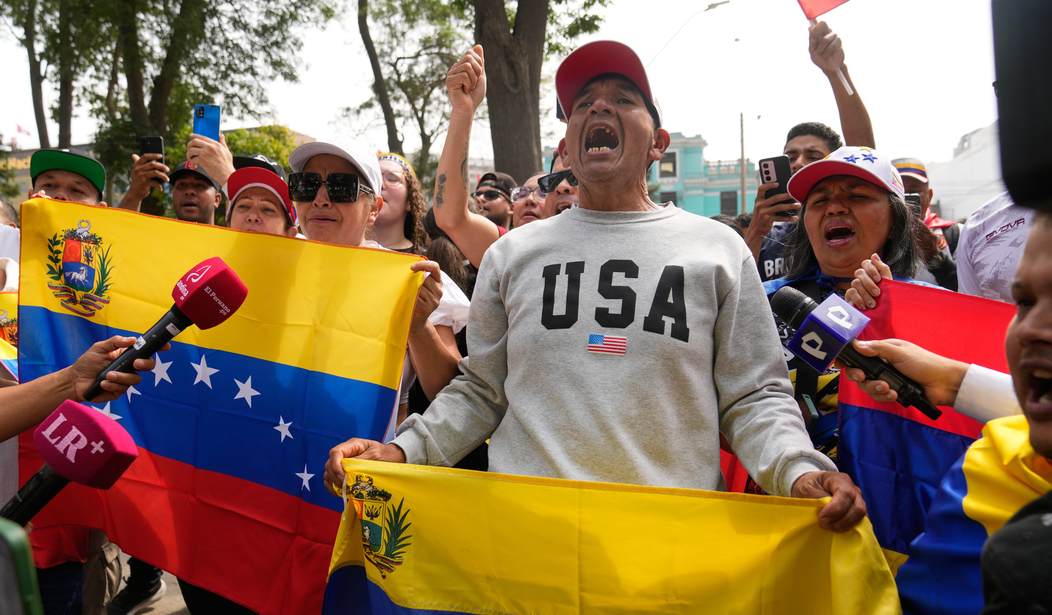

Over the last few days, we've seen countless public celebrations of Venezuelan people around the world cheering, waving flags, and shouting about how grateful they are that the United States has captured and arrested Nicolás Maduro. We've seen them throughout the U.S., from New York to Miami to Texas. We've seen them in various countries across Europe and Central and South America. (Keep in mind, at least 8 million people have fled the country since Maduro took over in 2013.)
According to María Corina Machado, "The brave people of Venezuela took to the streets in 30 countries and 130 cities around the world to celebrate a huge step that marks the inevitability and imminence of the transition in Venezuela."
But do you know where there were little to no public celebrations? Inside Venezuela itself. It's not because the people weren't thrilled — something like 90%, give or take, of the ones still there were begging for the United States to intervene for months. And we did. But a change is not going to happen overnight.
Recommended: Milei to the Latin America Lefties: 'Not Today, Comrades'
The people inside the country are cautiously optimistic but also fearful and uncertain about the immediate future. They're not happy about Delcy Rodríguez being sworn in as interim president, even if it's a temporary plan — I am going to write a lot about that probably on Tuesday because there seems to be a lot of confusion — and they know that even with Maduro and his wife gone, that doesn't mean the regime that has made their lives hell over the last decade is out of power.
Many of them also think back to the summer and fall of 2024, when they did dare to protest Maduro declaring himself the winner of the presidential election, despite clear evidence that Edmundo González was winning with an overwhelming majority.
The memories are too fresh.
In the days that followed the stolen election, thousands of people took to the streets of Caracas and hundreds of other towns across the South American country to protest — and rightfully so. After decades of living under dictators, they wanted a change. Despite attempts to keep them from the polls, including banning Machado — the woman who much of the country saw as their only hope — from running, the Venezuelan people turned out in incredible numbers to vote Maduro out of a place he never should have been in the first place.
To say they weren't happy is an understatement. They were downright angry. They marched, they shouted, they banged drums, and they tore down statues of Hugo Chávez. There were spontaneous rallies, as well as those organized by the opposition. Of Venezuela's 23 states, at least 20 had large protests.
But a dictator's gonna do what a dictator does. Having that many people marching in your streets isn't a good look. He had to crack down.
Maduro sent the Bolivarian National Guard (GNB) into the crowd with tear bombs and tanks. Colectivos, the violent pro-Maduro paramilitary group, joined them in widespread suppression.
Nearly 2,500 people were arrested. I've written about some of Maduro's political prisoners, like the 65-year-old doctor who was arrested for sending her neighbors a WhatsApp message asking them to vote against Maduro so they could have food. Or the young autistic man who was in a bakery near a protest and was arrested for being in the wrong place at the wrong time. Or the man who taking his young children to school and was arrested for being the son-in-law of González, the guy who actually won the election. Or the former governor who recently died in custody — the one who was held captive for a year in deplorable conditions, allowed only one opportunity to see his daughter, because he was part of the opposition.
The regime even brought back Operation Tun Tun (Operation Knock Knock), a strategy used in the past to incite fear. Authorities went door-to-door, looking for people who didn't support the regime. Maduro also encouraged people to report their neighbors.
So, that's why you don't see people in Venezuela holding the same widespread public celebrations you see outside the country. They're not looking for a repeat of the summer before last.
And if the reports I'm seeing online are accurate, the Colectivos are in the streets as we speak.
Los colectivos armados del régimen de Delcy Rodríguez está secuestrando ciudadanos venezolanos. Les están revisando teléfonos y buscando a todo el que haya celebrado la captura de Maduro.
— Emmanuel Rincón (@EmmaRincon) January 5, 2026
Delcy es igual de terrorista.pic.twitter.com/azK3F8sd5y
The Financial Times is reporting that "14 journalists and media workers — 11 from foreign media — have been detained." Here's more:
A state of emergency decree, dated January 3 but published in the official gazette on Monday, directed authorities to 'immediately undertake the search for and arrest . . . of any person involved in the promotion of or support for the armed attack by the US against the territory of the republic.'
A human-rights activist in Caracas said repression had significantly escalated on Monday, with authorities 'going through people’s phones to see if they had anything that could be construed as support for the actions of the US' and that Colectivos have been 'mobilized,' with checkpoints erected around the capital.
The colectivos are largely under the control of interior minister Diosdado Cabello, a member of the regime’s hardline faction who also oversees the police.
So yeah, don't look for any celebrations anytime soon.
I figure it'll be a matter or days before the mainstream media in our country reports that they're sad that we took away their "beloved president" or whatever it was Maduro called himself in court today. Don't let them fool you; he is only that in his own mind.
Over the course of the last six months or so, as I've zeroed in on covering Venezuela and her people and have talked to so many who felt so desperate, I can assure you that most of them are grateful and hopeful underneath that anxiety.