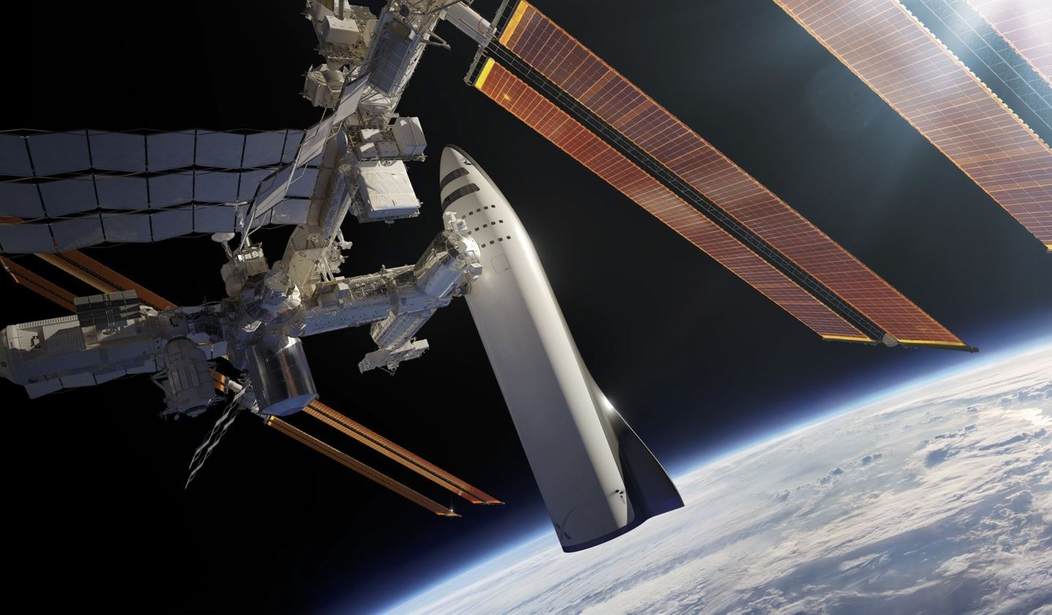

It began, as many futuristic ideas begin, as a plot device in science fiction. Nat Schachner and later Robert Heinlein explored the mechanics of using extraterrestrial resources and zero-gravity production in manufacturing long before NASA or modern private aerospace companies put physical manufacturing hardware into orbit.
The writers envisioned a future where space travel was routine, and the exploitation of the unique aspects of manufacturing in near-Earth orbit paid off in creating whole new industries that altered the course of civilization.
We're not there yet, but we're getting very close. Elon Musk's SpaceX is asking for Federal Aviation Administration (FAA) approval to launch 456 Starship missions a year by 2030. If Musk can get Starship to fly that often, the cost per pound of sending a satellite into orbit would drop from $3,000 to $100-$200. That's a gigantic leap forward and a game-changer for humanity.
One company eager to take advantage of the new space age is Varda Space Industries. On October 1, Varda launched two satellites into orbit, followed by a third a short time later. No private company has ever had three satellites in orbit at the same time.
The three washing machine-sized satellites are part of Varda's plan to launch a fleet of orbiting pharmaceutical factories to manufacture drugs, semiconductor chips, and other products that would take advantage of the vacuum and microgravity in near-Earth orbit.
“We’re the first company in human history to launch multiple commercial re-entry vehicles simultaneously, and as the frequency of launches increases, the once ‘crazy future’ of manufacturing products in space is becoming more and more certain,” said Will Bruey, Varda’s chief executive.
There are several reasons for wanting to manufacture certain materials in space, one of the most important being microgravity. On Earth, gravity causes particles suspended in liquids to settle, while differences in density create currents. Both can interfere with the growth of crystals. “If you are able to remove those effects, you can make crystals grow in a much more ordered sort of way,” said Dr Meganne Christian, mission manager for in-space manufacturing at the UK-based Satellite Applications Catapult.
For pharmaceutical companies, this could open up new ways of formulating medicines, as the size, shape and arrangement of drug crystals can affect how easily drugs dissolve, how stable they are and how they can be administered. In some cases, this could enable drugs that currently require intravenous infusions to be reformulated into more convenient injections.
Other materials, such as the semiconductors used in everything from smartphones to electric vehicles, could also benefit from being manufactured in space, where microgravity and the absence of air could help produce purer crystals with fewer defects.
“Personally, I would really love to try and make graphene in microgravity,” said Christian. Referred to as a "wonder material," graphene is a single layer of carbon atoms arranged in a two-dimensional honeycomb lattice. It's flexible, transparent, incredibly conductive, and stronger than steel. Manufacturing graphene in space would spark a materials revolution, ushering in a new generation of hyper-efficient energy storage, virtually transparent conductive electronics, and structural composites that redefine what is physically possible.
As far back as Skylab in the 1970s, astronauts ran multiple crystal-growth and metallurgical experiments onboard, including growing semiconductor and metallic crystals. These early tests provided some of the very first proof-of-concept data showing that microgravity could produce significantly more uniform, defect-free crystals than terrestrial manufacturing.
But for manufacturing at scale, “you need to get humans out of the picture, because we’re dirty, we cause vibrations, and we require a whole higher level of safety,” said Christian.
This is where Varda’s autonomous factories come in. Known as free-flyers, they hitch a ride into orbit aboard SpaceX rockets, carrying miniature laboratories in which materials can be processed without astronauts. Once the experiments are complete, a capsule separates from the spacecraft, plunges through the atmosphere and parachutes safely back to an uninhabited region of Earth.
Varda is among the furthest advanced in demonstrating this approach, having already returned several capsules from orbit. It plans to launch another seven missions in 2027, and a further 10 in 2028.
Varda isn't the only company engaged in trying to manufacture materials in space. Cardiff-based Space Forge takes a unique approach: it could return semiconductor crystals grown aboard a spacecraft to Earth. The space-grown crystals would then be used as templates for terrestrial manufacturing. Andrew Bacon, the company’s co-founder and chief technology officer, told The Guardian that he hoped to demonstrate the entire manufacturing and return process in space by 2030.
“Since we started in 2018, nobody was talking about it. Now a lot of companies [are] talking about it,” Bacon said. “People are starting to take this market very seriously. It does feel like we’re at the start of a new Industrial Revolution.”
Varda has raised nearly $600 million in total funding (including a $251 million Series D round) and reached a valuation of approximately $1.6 billion, reflecting heavy investor confidence in commercialized orbital manufacturing like pharmaceuticals and fiber optics. Other early-stage players like Space Forge and specialized infrastructure startups have added tens of millions more in venture backing.
Space manufacturing is still in its infancy. There is every reason to believe that in the coming decades, these companies and others will revolutionize everything from medicine to microelectronics, delivering pure, defect-free materials that were previously impossible to create on Earth.
Also for our VIPs: The Little Rover That Could: Curiosity Has Been Exploring Mars for 5,000 Martian Days