
When the first 70 years of humanity's outreach into space are written, there will be a large section devoted to the Moon and the landings on our satellite; there will be exciting tales of missions to the planets, including Russian missions that landed for a short time on the hellish surface of Venus; the incredible exploration of the outer planets Jupiter, Saturn, and Neptune; the magnificent technical achievement of sending the New Horizons probe to Pluto; and the several missions to explore comets and asteroids.
But the missions to Mars will generate the most interest. For in the end, our space outreach is all about answering the fundamental question that humanity has asked since people first gazed skyward.
Are we alone?
We have yet to answer that question definitively, although the more we've learned about the vastness of the universe, the more certain we can be that something is out there. Did life also arise elsewhere in our solar system? Answering that question in the affirmative would be the most profound revelation in the history of science because if life arose on Mars, it certainly could arise anywhere in the universe where the conditions are favorable.
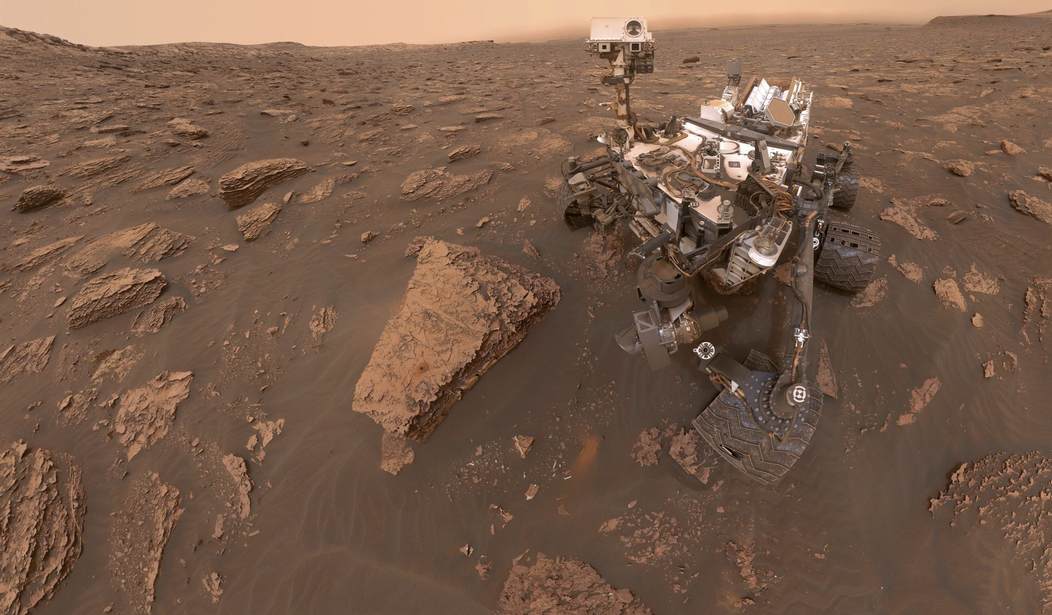
The Curiosity rover is a car-sized robotic explorer investigating the climate and geology of Mars. As part of the Mars Science Laboratory (MSL) mission, it launched on November 26, 2011, and landed safely inside Gale Crater on August 6, 2012. That it made it to the surface and successfully began communicating its findings was a near miracle. More than 20 missions to the Red Planet from Russia, the U.S., and Europe failed.
All told, out of roughly 38 to 40 international attempts sent toward Mars up until August 2012, more than half had completely failed, making Curiosity's flawless "Seven Minutes of Terror" sky-crane landing an even more monumental relief for NASA scientists.
The "Seven Minutes of Terror" included a powered descent in which a supersonic parachute deployed in the upper atmosphere dropped away, and a unique radar system homed in on a surface target.
Because heavy rovers like Curiosity and Perseverance are too large for traditional airbags or landing legs alone, engineers invented the "sky crane."
- A descent stage lowers the rover on a set of nylon tether cords about 20 meters below it.
- Once the rover's wheels touch down on the Martian surface, pyrotechnic blades cut the cords.
- The rocket-powered jet pack then flies away and crash-lands a safe distance away, leaving the rover safely on the red dirt.
After landing, Curiosity immediately went to work.
Curiosity launched with what sounds like a simple question: was there enough water and other ingredients to keep life going on the Red Planet, once upon a time? Within weeks of landing in August 2012, hope of finding something interesting accelerated — the rover found an ancient streambed, which ran at least ankle-deep. Scientists were excited, but cautious.
“This is insurance that we have already found our first potentially habitable environment," said John Grotzinger, then project scientist for Curiosity’s mission, known as the Mars Science Laboratory. But ambitions ran even deeper than the stream — the rover was bound for a challenging climb, at a nearby mountain rising 3.4 miles above the surface, where investigators hoped to find precious organic materials possibly indicating signs of life.
"Investigators had to make tough choices on the two-year (in Earth years) journey to Mount Sharp, writes Elizabeth Howell in Supercluster. Press too fast and they would miss interesting science on the floor of Gale Crater.
“Just upslope from it were what looked like ancient streambeds and fluvial channels — evidence for flowing water in the ancient past. So the idea was perhaps flowing water might have ponded in this low-lying area, and that's what we wanted to investigate,” Ralph Milliken, a participating scientist on the mission, told Brown University in 2012.
“What we found at Yellowknife Bay well surpassed our wildest imaginations for this early in the mission,” he added. “We found evidence that there were mudstones, which are the kinds of rocks you might find in lakebeds on Earth. So it appears as though there may have been an ancient lake.”
Delaying their trek up the side of Mount Sharp for a year paid off in a huge way. Curiosity was on a tight budget and needed to prove to NASA that it deserved more funding for future exploration. The side trip to Yellowknife Bay allowed researchers to write half a dozen breakthrough science papers that easily met NASA's criteria for further study.
Up the little rover went, straining in some places to maneuver over rocks and avoiding ditches.
Most spectacularly, Curiosity showed that 1,000 feet of vertical rock face used to be mud, and that water — draining for a billion years of time — was trickling through the layered, sedimentary rock deposited on the lake’s bottom. The climate was also swinging between wet and dry cycles for a million years, scientists found through chemical analysis.
But there was enough water, scientists later determined, for “long-lived streams and lakes” that existed roughly 3.3 billion to 3.8 billion years ago, creating sediment that put the foundation of Mount Sharp’s lower parts together. Curiosity also whipped out its drill to take several samples around the base, generating a scientific paper in July 2017 showing an abundance of life histories of the rocks surrounding the mountain.
"The challenge of Curiosity is that as capable as the rover is, it was not designed to definitively answer the question of whether organic materials — carbon-based compounds — came from life processes, or from something else," says Howell. That job is left to the Perseverance rover, the comparatively giant laboratory that is collecting rock and soil samples for a "Sample Return Mission."
NASA will get on that mission just as soon as it figures out how to do it. It's proving to be far more difficult than anticipated to robotically pick up the sample packets and fly them back to Earth. The Perseverance Sample Return Mission may have to wait for humans to do the job.
By ascending the three-mile-high Mount Sharp over the last decade-plus, Curiosity has acted like a time machine. The layered strata of the mountain have allowed scientists to read billions of years of Martian climate history, tracking how the planet transitioned from a wet, potentially habitable world to an arid desert.
An argument can be made that Curiosity did more than any other Mars probe to advance our knowledge of the Red Planet and point the way to where and how to look for signs of past life. For 16 years, it has shown that NASA can still do extraordinary science and expand the boundaries of our understanding of the cosmos and our place within it.
Also for our VIPs: Sky Candy to the Max