I grew up about 15 miles from O'Hare Airport. When I was about seven, O'Hare hosted the 62nd Fighter-Interceptor Squadron, which flew North American F-86 Sabers in the early 1960s. During the summer months, we would watch jet contrails overhead, and as they reached supersonic speeds, a tremendous sonic boom would rattle your teeth and the windows.
I thought it was pretty cool. The grown-ups, less so. Eventually, O'Hare stopped all supersonic flights, and the rest of the country wasn't far behind.
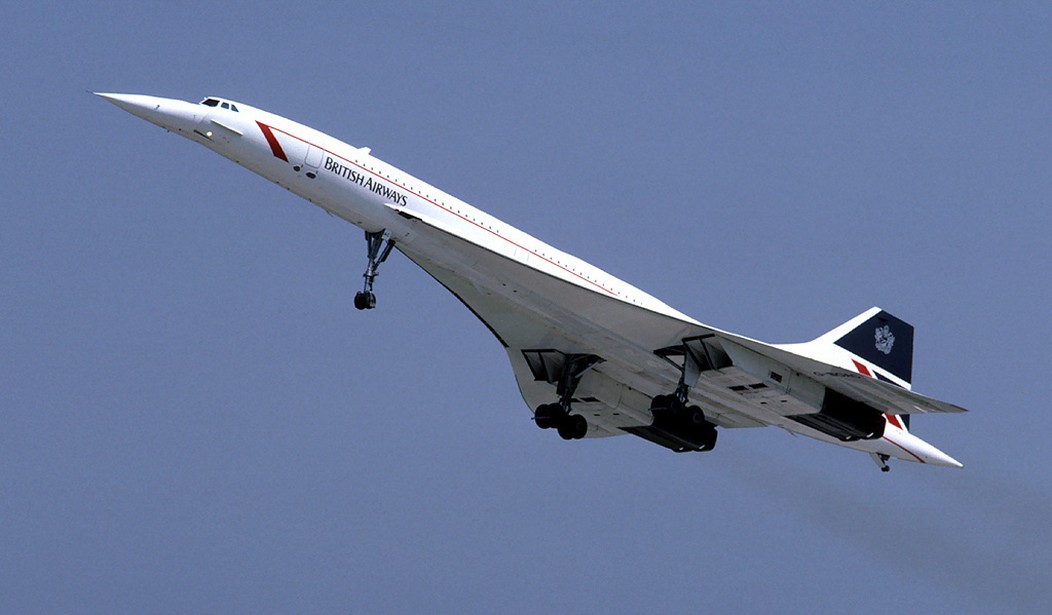
The dream of regular supersonic flights from the U.S. to Europe and Asia appeared to come true when British Airways and Air France introduced the Concorde, the world's first and only supersonic passenger aircraft, in 1976. But the Concorde was too loud for most American cities and too costly to fly, so it flew only from New York to Paris and London. The dream of faster-than-sound travel was shelved in 2003 with the retirement of the Concorde.
But the dream didn't die.
“Manufacturers have demonstrated it is possible to fly supersonic aircraft without sonic booms reaching the surface by using sonic boom abatement techniques, making complete prohibition on civil supersonic flight outside of test areas no longer appropriate, and an unnecessary restraint on the growth of the U.S. aviation sector,” the Federal Aviation Administration (FAA) says in a new proposal.
The FAA's "exact threshold of sound pressure at the surface that any aircraft flying over land in the US would be allowed to produce 0.11 pound per square foot, which is equal to a moderate thump," according to CNN.
One technique to drastically limit sonic booms is called "Mach cutoff."
A plane using Mach cutoff has to fly at a slightly higher altitude than normal airliners and use precise navigation based on each flight’s atmospheric conditions. If the technique is executed correctly, the shock wave produced when the plane breaks the sound barrier bends upward due to temperature and wind speed changes between the air at altitude and the air closer to the ground. If executed correctly, Mach cutoff results in no sonic boom reaching the ground at all.
“That’s about breaking the sound barrier at sufficiently high altitude, generally above 30,000 feet, and it’s about having the computational power and the software to be able to calculate the fastest and most efficient quiet speed for any given day’s weather,” said CEO Blake Scholl, who founded Boom Supersonic in 2014.
“It’s super simple for the pilots,” Scholl added. “On our future airliner, Overture, there will be a ‘quiet’ button, and it will set the speed automatically, flying at the fastest and most efficient speed possible without creating an audible boom. And when you’re out over the open ocean, you can accelerate and go even faster.”
NASA is also working toward a "boomless" passenger jet. Its super-sleek X-59 is already well into its testing phase.
🆕 year, 🆕 NASA Documentary:
— NASA Aeronautics (@NASAaero) January 4, 2025
X-59: NASA’s “Quesst” for Quiet Supersonic Flight ✈️
WATCH: https://t.co/rhlEIVjgpV pic.twitter.com/kKv7vMAlQS
In the case of the X-59, it's the shape of the plane rather than the flight profile that creates quiet supersonic flight.
“In our design approach, the trick is to design the airplane so that the shock waves are relatively equal in strength and relatively evenly spaced along the airplane,” Peter Coen, mission integration manager for NASA’s Quesst mission under which the X-59 plane is being developed, said.
"If you can achieve that, those shocks are still tending to merge, but so slowly that the system reaches the ground before they’re fully merged. So instead of two sharp shocks, you get multiple weaker shock waves. The atmosphere works on them a little bit harder and reduces their strength and smears them a little bit more. So at the ground you hear just a thump — a very gradual pressure increase instead of a sharp one," said Coen.
"Coen believes that for supersonic flight to become economically attractive for large airlines, the solution to the boom problem needs to allow aircraft to fly at unrestricted speeds over land, not just over water. NASA’s Quesst mission is working toward that objective with the X-59," CNN reports.
We're still close to a decade away from regular supersonic flights. Whether the economics of such flights will make sense is the great unknown. How much will it cost to operate these aircraft, and will the flying public buy in are questions that need to be answered before a big airline like United or British Airways opens its wallet to buy one.
Also for our VIPs: A Physicist Says This 'Star Trek' Battle Maneuver Would Actually Work