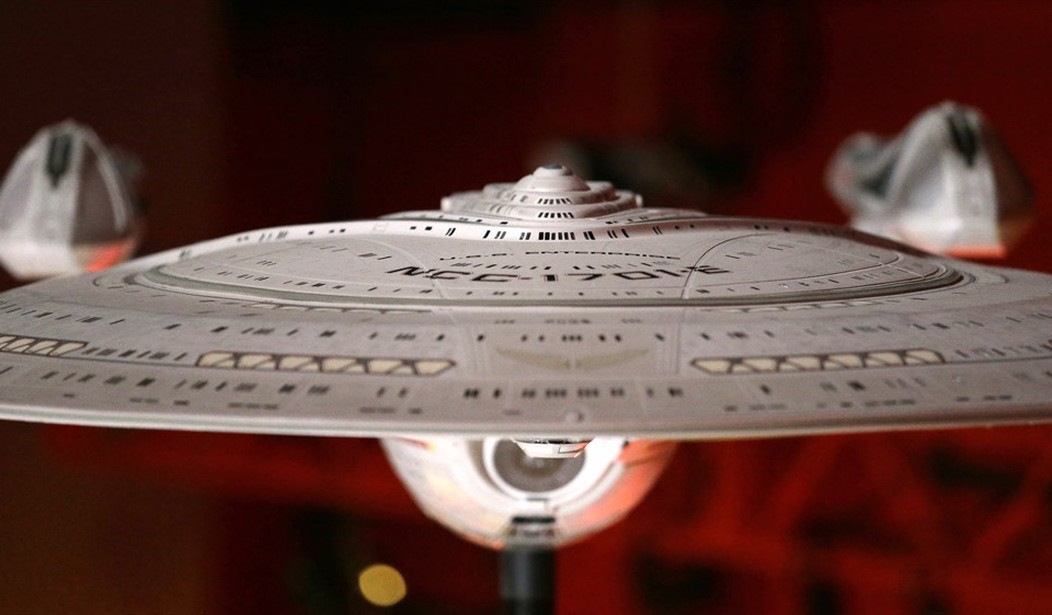
Sixty years ago this last September 8, the NBC series Star Trek premiered to a small but enthusiastic audience. The network doubted its success. It had rejected showrunner Gene Roddenberry's initial pilot ("The Cage") because it believed it was "too cerebral." (NBC later aired the pilot as a two-part episode called "The Menagerie.")
Star Trek was unlike any science fiction series that preceded it. That was entirely due to Gene Roddenberry, who insisted that the science underpinning the gadgets, the ship, and how everything worked have a basis in real-world science. From the matter-energy transport system to the phaser guns and rifles, science advisors tried to place everything within the bounds of scientific possibility.
Obviously, some of the science (especially in the second live-action series, Star Trek: The Next Generation) reached implausible levels (having sex with "Holodeck" characters? Really?)
But most of the time, the writers and scientists working on the show were able to create plausible scenarios. Even the combat maneuvers using faster-than-light ships were examined for scientific inconsistencies.
One of my favorites was the infamous bluff, the Corbomite Maneuver. The USS Enterprise is cornered by the massive alien warship Fesarius. Kirk informs the enemy that his ship is equipped with "Corbomite," a non-existent substance that automatically detonates with equal force if the ship is destroyed, guaranteeing total annihilation for both vessels.
Kirk always had a great poker face, and he pulled off the bluff perfectly. The alien commander, Balock, delayed destroying the Enterprise and said he was taking the ship to another planet. The crew later learned that the alien was bluffing, too. Instead of the fearsome face appearing on the viewscreen, "Balock" looked like a child who was "testing their intentions" to see if they were hostile.
(Interesting Fact: Balock was played by 7-year-old Clint Howard, brother of Ron Howard and an accomplished character actor in his own right.)
Another well-known (among Trekkies) combat maneuver was "The Picard Maneuver." In the first season of Star Trek: The Next Generation (TNG), Picard is surprised when a Ferengi DaiMon (high-ranking military or civilian) offers to give him the salvaged ship The Stargazer, the ship he first commanded. During a patrol, an unknown vessel attacked The Stargazer, which Picard destroyed.
We discover that the Daimon's son was on board that ship, and Bok is seeking revenge on Picard. In the salvaged Stargazer, unknown to Picard, a device designed to make him lose his mind was placed on board. With Picard nearly incapacitated, DaiMon Bok strikes. He disables the Enterprise and moves in for the kill.
Picard fashions a brilliant plan.
He ordered his crew to rush their foe at warp speed (faster than the speed of light) then quickly halt and begin firing. Relativistic physics dictated that if Stargazer traveled faster than visible light, it would technically generate two images of the ship from their attacker’s point of view—one Stargazer at the location just prior to warp speed, then a Stargazer where it halted. The operation was risky, but it gave Picard and his crew a 50/50 chance that the enemy would continue firing on an afterimage of Stargazer.
Traveling faster than lightspeed is widely considered impossible, but the underlying principles of Picard’s Maneuver don’t only hold up to expert scrutiny—its depiction in Star Trek is hypothetically less accurate than it should be. According to de Aguiar Alves, Picard’s odds technically would be even higher in such a scenario. But while a fan of the series, the physicist wasn’t intentionally trying to stress test the episode’s logic. Instead, de Aguiar Alves was working on an actual particle physics problem that involved a slower light speed. At one point, he began sketching out the scenario to double check his work.
“And after I drew one or two diagrams, I started noticing, ‘Hey, I think I’ve thought about something like this before,’” de Aguiar Alves said in a recent interview with Ars Technica.
Actually, according to Dr. Níckolas de Aguiar Alves, the Ferengi crew would have seen three Stargazers, not two. That's because "Picard’s crew didn’t travel at a constant speed during the gambit–they first sped up, then stopped closer to their opponent," according to Popular Science. "That means Stargazer technically accelerated not once, but twice." Dr. Aguiar Alves believes "The Picard Maneuver" is "an excellent scenario to ponder while studying theoretical physics.'
“The main thing they got perfectly, and I think it is a great illustration,” he said.
In later series, including TNG and Deep Space Nine, more scientific inconsistencies popped up as the writers showed little interest in accuracy. If it sounded good, they used it.
Still, it's nice to know that there's a scientific basis for at least some Star Trek plot devices.
Also for our VIPs: Whether AI Saves Us or Kills Us, It Has Changed Our Politics