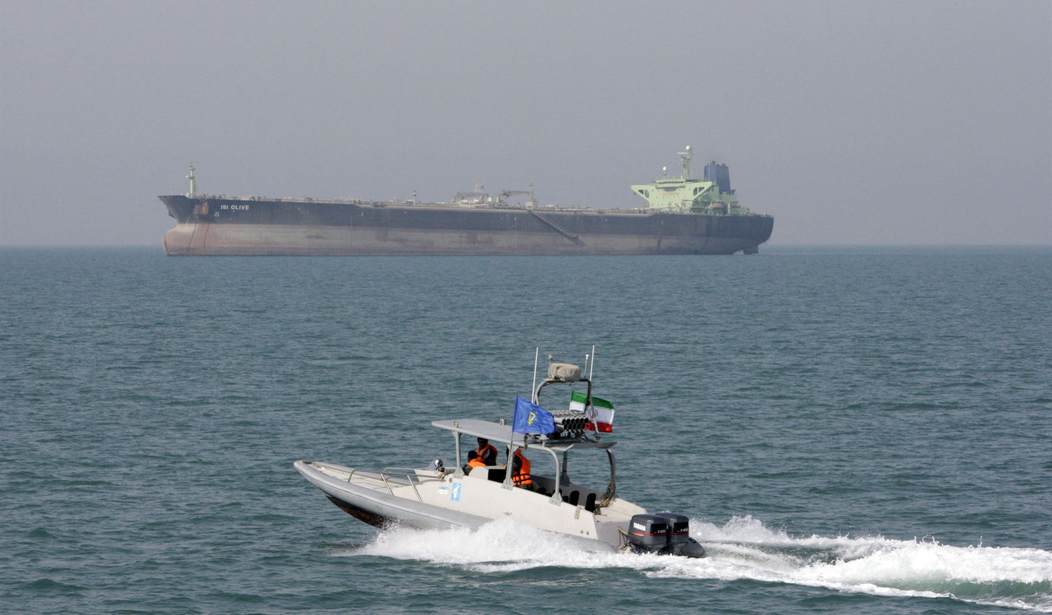

Iran made the mistake of attacking a United States naval vessel twice over the previous two days, leading to a "non-proportionate response."
CENTCOM forces destroyed five Iranian crude oil carriers, Sept. 8, after the Islamic Revolutionary Guard Corps (IRGC) targeted a U.S. Navy warship with ballistic missiles twice over the past two days. The U.S. warship successfully evaded the attempted Iranian attacks and… pic.twitter.com/Gi8a2tloN1
— U.S. Central Command (@CENTCOM) September 8, 2026
"Six months into the war, the oil squeeze is depriving Tehran of its main source of foreign currency as the value of the Iranian rial plunges, inflation soars, and the economy slides deeper into crisis," reports the Wall Street Journal.
Inflation is running at 80% year over year. "The International Monetary Fund forecasts a 5.4% economic contraction this year, the country’s worst since the 1980s," reports the Journal.
“Now, much will depend on the degree of economic pain that the Iranian regime is willing to bear to achieve its military and geopolitical objectives,” said Hamad Hussain, an economist at Capital Economics.
About a third of Iran's budget is funded by oil sales. The military is also funded by sales of crude, but the Islamic Revolutionary Guard Corps (IRGC) has shadow-fleet networks selling oil on the black market and through third parties that augment its budget.
According to ship tracker Kpler, no Iranian crude has passed the blockade line since mid-July. The tracker also notes the amount of cash being paid to Iran for oil under contract has crashed.
"Meanwhile, the volume of Iranian crude already on vessels outside the blockade—a trove that is still generating revenue for Tehran—has fallen to around 29 million barrels from around 90 million barrels in mid-July and could run out next month, according to Kpler," notes the Journal.
Kpler estimates that current deliveries of around a million barrels a day—which mostly go to China—could exhaust the store of Iranian oil on the water by mid-October. Payments for previously delivered cargoes would likely dry up by mid-December.
Even those payments could become harder to collect. Sanctions under Washington’s new economic pressure campaign are targeting banks and other financial channels that facilitate Iranian transactions.
Some Chinese buyers are turning to Saudi, Iraqi and United Arab Emirates crude, Gulf energy officials said. In some cases, Iranian oil now costs refiners more than competing supplies due to its relative scarcity, they said. Iraq has offered discounts of nearly $30 a barrel on some grades. Brent crude was trading at around $97 a barrel Monday.
As if the situation couldn't get any worse for Tehran, oil production has virtually collapsed. Iran is taking only enough oil out of the ground to satisfy its domestic needs. The Journal suggests, "the scenario analysts predicted during the initial blockade this spring—that Iran would have to pare back output to keep its backed-up oil from hitting the 'tank tops' of available storage—is playing out."
The virtually worthless Iranian rial has lost almost 15% of its value against the dollar since Trump announced his "Economic D-Day" in August. With inflation at 80% and the rial being used as kindling for fires, Iran's elites are the only ones who are eating regularly.
“The U.S. campaign will have a significant effect on the average Iranian household. But in terms of Iran capitulating at the negotiating table? I have a lot of doubts,” said Ellie Geranmayeh, an Iran expert at the European Council on Foreign Relations. “The evidence we have suggests the Iranian regime is likely to resist.”
It would seem that what Iran needs is a good-old-fashioned revolution. And, according to Al Jazeera, the Iranian people are arming themselves. There are at least two armed groups in Iran that have become more active since the January slaughter of civilians by the IRGC, where at least 35,000 were gunned down.
Alex Vatanka, a senior fellow at the Washington-based Middle East Institute, said that external support for the Kurdish and Baloch rebel groups could increase the security challenge facing the authorities.
“The Iranian state might see any signs of increased external support for ethnic militants to be of an existential kind this time around due to the war situation,” he told Al Jazeera.
“I only see ethnic militant groups as possibly decisive [in the war] if they are part of a broader externally-funded push to pressure the regime in Tehran, which the Islamic Republic is already anticipating and calls a foreign-led hybrid-war campaign,” Vatanka added.
The U.S. Navy is escorting allies' tankers through the Strait of Hormuz while keeping Iran's vessels bottled up. Oil flow through the Strait is about 40% of pre-war levels, enough to avoid an oil crisis but not enough to keep the price of a barrel below $100.
Can Trump resist the temptation to make a quick deal and bring oil prices down before the election? As always with Trump, your guess is as good as mine.
Also for our VIPs: Remember the 300 Heroic 9/11 Rescue Dogs