
After AfD's win in Saxony-Anhalt, there appears to be a growing populist surge, not just in Germany but across Europe. It would be too easy to reduce it to a general "Make Europe Great Again" movement, but it's certainly showing some interesting trends.
This is the first of a series examining the populist players in Europe:
Alternative für Deutschland (AfD) in Germany
the Rassemblement National (RN) in France
the Freiheitliche Partei Österreichs (FPÖ) in Austria
Vox in Spain
While they all have similarities, they're not identical. Understanding the differences will clarify a lot of what's happening in Europe right now.
Related: AfD and the Most Dangerous Man in Germany
AfD — Germany's Largest Opposition Party
In current polling, the AfD is ahead of the CDU in national polls, and especially strong in the new states of the former East. It was founded in 2013 by professors who left the major parties because they were critical of the European Union — 10 years later, it became the default protest party in the East. In 2015 it moved strongly toward an anti-immigration stance.
One major component of the AfD today is a reaction to the effects of the 1989 Reunification. They say that the East already sat through a surveillance state, a government-controlled press, and a party that called itself anti-fascist but set up the rigid control of the Stasi secret police. Easterners see the new controls — speech law, internal intelligence classifying opposition as subversion, and the COVID pandemic rule by decree. — as far too familiar. The feeling is "we brought down the wall; you built a kinder wall with forms and bureaucracy."
This has taken two forms: first, as a warning. "We recognize the methods. Don't copy them." Second, there is a strong feeling in the East that AfD is a rescue party established to save the country from the CDU-SPD Uniparty, which looks more and more dictatorial. For the East, this is the core of the fight, while the opposition says it's a grotesque overstatement.
The sense in the East is pride in Reunification, and betrayal by the West German parties.
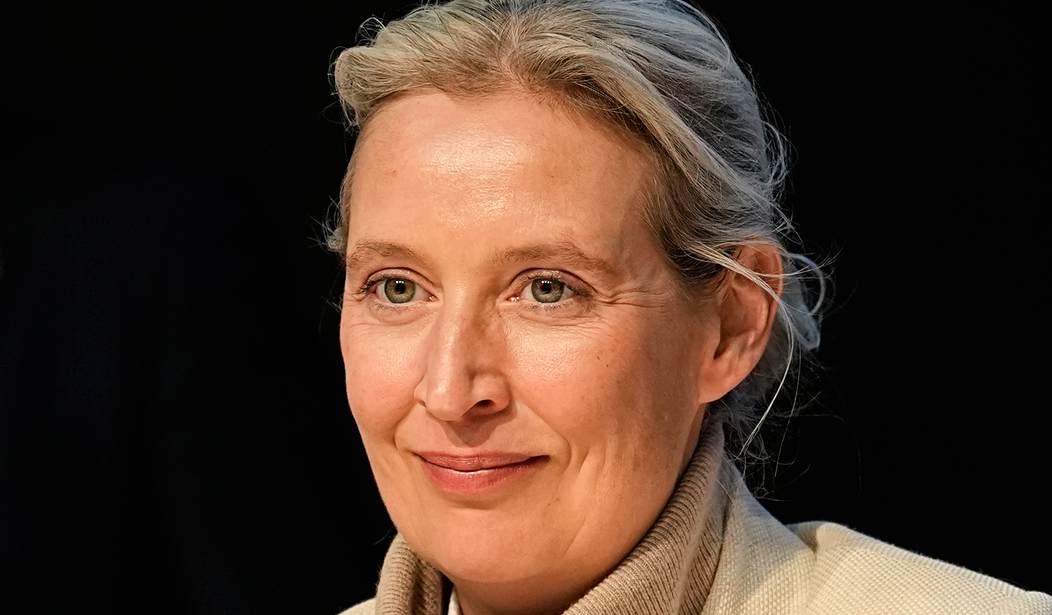
In the national assembly, the Bundestag, Alice Weidel and Tino Chrupalla are co-chairs of the AfD Fraktion.
Alice Weidel: Co-chair of the federal party, Weidel is the television star. She's an economist, a lesbian with a Sri Lankan partner, and a Swiss resident for years. She makes a good counter-argument to people trying to paint AfD as the Skinhead party. If they gain power in the federal elections, the AfD will try to reform the EU back into a union of independent nations, and if it can't, then voters should have a Brexit-style vote.
Tino Chrupalla: The other co-chair, from Upper Lusatia in Saxony on the Polish border. Chrupalla is a master painter, a craftsman from a firmly working-class family, with the nickname der Pinsel — the brush. Politically, he is not a founding member of AfD — he started voting for CDU and FDP, but joined AfD in 2015 over two issues: open borders and what's called the "euro." In the US there's a tendency to identify the "euro" issue with a demand to separate entirely from the European Union monetary system, but it's more than that. Starting in 2010, the EU and Berlin kept writing checks so that Greece, Ireland, Portugal, Spain, and then Cyprus wouldn't collapse the currency union; Merkel's line was that there was no alternative. Basically, "euro" is shorthand for objecting to monetary union as a transfer union, out of German pockets.
In the state parliaments, the important AfD voices are:
Ulrich Siegmund: The lead candidate in Saxony-Anhalt, and "the most dangerous man in Germany" according to Der Spiegel. Winning in the September 6 election has become a political test of whether an AfD candidate can become Ministerpräsident numerically and then be blocked by the current ruling parties politically.
Björn Höcke: the man the other parties use to explain Brandmauer, the Firewall. He spoke in Dresden in 2017, calling the Holocaust memorial "a monument of shame." Every opponent still runs that clip. He's also been criminally convicted twice for using the slogan “Alles für Deutschland” — "Everything for Germany" — which sounds like pretty normal political rhetoric until you realize it was the slogan of the Sturmabteilung — the infamous brownshirts. That's a Kennzeichen ("distinctive sign") recognized in German law as a Nazi reference. Höcke is not on the federal ticket but he is the chair of AfD Thuringia and was the lead candidate when AfD finished first for the first time in any German state.
Related: Germany's Demographic Death Spiral That Mainstream Parties Refuse to Address
What does AfD Want?
A lot of the AfD's issues will seem familiar to Trump fans.
Immigration/remigration: AfD wants to deport rejected asylum seekers immediately, and to stop accepting family reunification as it's being practiced in Germany today; "remigration" as a slogan for reversing the settlement of people who won't assimilate. This is a major selling point in the West as well as the East.
The overreaching state: the German Federal Republic has an expanding surveillance and speech regime. With the Verfassungsschutz internal intelligence service classifying the AfD in Thuringia and Saxony as a security threat, while the federal party fights against it in court, and with people being arrested or fined for insulting German politicians online, to former citizens of the DDR, it looks entirely too much like what they thought they had escaped.
Energy and industry: AfD sees the Green energy program as terribly damaging. The last three nuclear power reactors went offline in 2023. AfD wants to stop dismantling the reactors and go back in. They also want to encourage cheap gas and consider the needs of industry first. They want to rebuild the Nord Stream pipeline, which leads into...
EU, NATO, and Russia: The place where AfD and the US differ the most. AfD members, especially in the East, see the Russia sanctions as damaging to ordinary Germans. AfD is Euroskeptic, and NATO is not the hard point, but dependence on Washington and — in the East — framing Ukraine as a Washington proxy war is.
Family and gender politics: AfD is generally conservative; they oppose pushing gender ideology in schools. Alice Weidel's relationship has let opponents paint AfD as hypocritical; AfD members seem to accept it.
The "Firewall"
At this point, the current government coalition is getting a little bit frantic. In Saxony-Anhalt, the CDU — the senior partner in the government coalition — had their heads handed to them. And the Firewall used to be just a seating chart. After Sunday, it has a voice, and that voice is Merz's.
Related: Germany Votes Right, and the Press Reaches for 1945
Three days after the election in Saxony-Anhalt, Alice Weidel came to the Bundestag as opposition leader and told Merz his coalition is finished. "Schwarz-Rot [the CDU-SPD coalition] ist vorbei." And Merz stood up and gave her the new official position on remigration: ethnische Säuberung, ethnic cleansing, by origin and skin color. To a European who remembers the collapse of Yugoslavia, that's not "we disagree about asylum"; that's the Balkans. He said that her party was a destructive force. If a Siegmund cabinet crosses the line on immigration and foreigners, Berlin can legally step on its neck.
Merz wanted that on television three days after the vote. And that's the 2026 firewall. The government won't file to get the ban the Greens want. But they'll call the first-place party an ethnic cleansing operation on live television, and do their best to prevent AfD from forming a government in Saxony-Anhalt.
Saxony-Anhalt held the election. Merz on Wednesday made it clear that in Germany, a vote is just a suggestion.