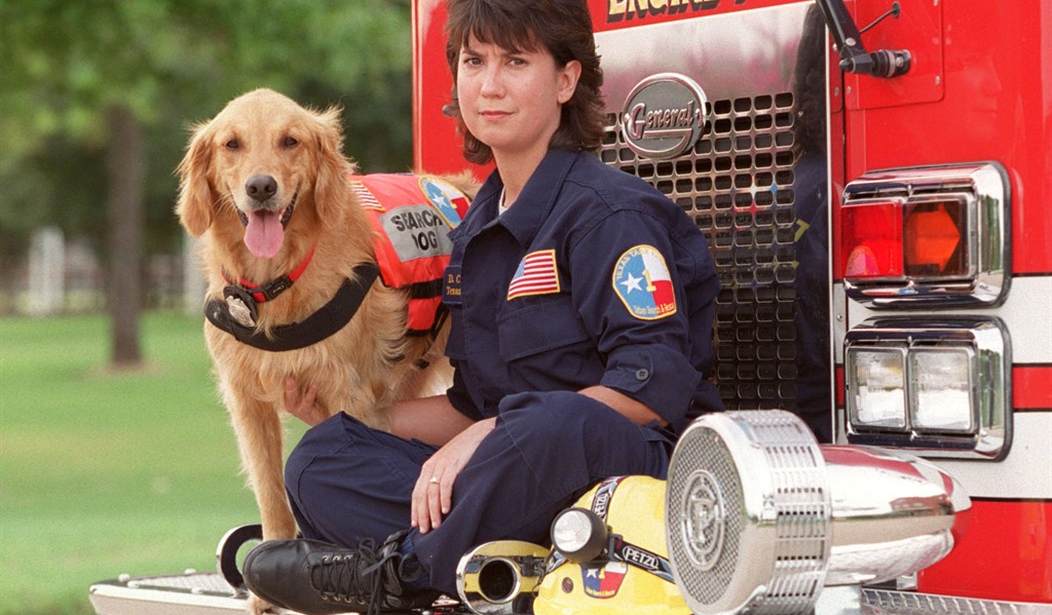

Within hours of the collapse of the World Trade Center towers, rescue workers from coast to coast descended on the site, and more than 300 specially trained rescue dogs were on the scene at the Towers, as well as the Pentagon, using their incredible sense of smell to find living human beings.
After days of searching, the dogs found just 20 living survivors. Rescuers determined that further searches were futile given the difficulty in removing the huge slabs of concrete and twisted steel girders. It haunted rescuers that they may have left living people whom they were technically unable to reach.
The last survivor pulled alive from the World Trade Center rubble was Genelle Guzman-McMillan, who was rescued on September 12, approximately 27 hours after the collapse. Although rescue workers and canine teams continued to dig frantically under the assumption that survivors could be trapped in subterranean air voids, no additional living survivors were found after that window.
Gradually, the rescue effort became a task to recover the remains of the thousands of dead. For that grim task, searchers brought in a different kind of dog. Cadaver dogs, trained by the Federal Emergency Management Agency (FEMA), combed the wreckage for days, weeks, and eventually months. As each layer of what was left of the towers was removed, the dogs moved in, pointing to where remains could be found.
Because of the enormous heat and pressure of the collapse, most of the human remains recovered from the site consisted of thousands of biological fragments rather than full bodies.
Rescue and cadaver canine teams worked alongside human emergency responders, pointing out specific locations under the rubble rather than directly exhuming remains themselves. Over the course of the nearly nine-month recovery operation, workers and dogs located over 21,000 individual pieces of human remains at Ground Zero, which forensic teams at the NYC Office of the Chief Medical Examiner have worked for decades to identify and pair with victims.
Over the last 25 years, the Office of the Chief Medical Examiner (OCME) has painstakingly used the latest technology to recover DNA from the biological remains. To date, 1,654 victims have been positively identified out of the 2,753 people killed at the World Trade Center; the most recent identification was made on Aug. 24, 2026. Roughly 40% of the victims (about 1,099 people) remain unidentified, as forensic scientists continue testing and re-testing recovered remains using evolving DNA techniques.
Working alongside their handlers, the four-legged heroes worked tirelessly climbing huge piles of debris while fires still smoldered. The search for signs of life or human remains was mentally and physically taxing on the dogs, as the SAR [Search and Rescue] dogs began to get discouraged and lose their search drive. Aware of the importance of morale in these dogs and to keep their motivation high, their handlers would stage a “mock find” so the dogs could feel successful.
Veterinarians were stationed at the site to help care for these dogs. Working 12-hour shifts on the pile, the dogs needed to have their paw pads, eyes and noses cleaned often. Cynthia Otto, director of the Penn Vet Working Dog Center, and Lisa Murphy, an associate professor of toxicology and director of the Pennsylvania Animal Diagnostic Laboratory System at the School of Veterinary Medicine's New Bolton Center, were both on the ground supporting these dogs. They recently sat down with the 9/11 Memorial & Museum’s Vice President of Collections and Oral History Amy Weinstein to talk about their experiences taking care of these extraordinary canines at ground zero.
In addition to search and rescue dogs at ground zero, therapy dogs, like Nikie, provided comfort to the firemen and rescue workers who continued to work countless of hours on the pile. They represented a respite from the surrounding destruction and debris, even only for a minute.
During their actual deployment, the dogs required round-the-clock medical care from volunteer veterinary networks. Their immediate injuries included paw pad damage from white-hot debris, jagged steel, and pulverized concrete, which caused frequent burns, lacerations, and scrapes.
Working long, grueling shifts in high-stress, smoky conditions required heavy decontamination, eye-washing, and fluid therapy. Toxic dust caused health problems for many rescuers later on.
A 15-year study by the Penn Vet Working Dog Center tracked 95 deployed canine heroes alongside a control group of non-deployed search dogs to monitor the toxic environment's lifelong impact. Remarkably, the study found no statistically significant difference in cancer rates or chronic respiratory illnesses between the dogs that inhaled Ground Zero dust and those that did not.
Why?
Dogs have long, highly efficient nasal passages lined with mucous membranes that may have acted as a superior natural filter, trapping the heavy dust particles before they could reach deeper lung tissue. Also, most dogs were only deployed on the site for 10 to 14 days, whereas human rescue workers spent months being exposed to the dust. And the dogs didn't have lifestyle factors like smoking that contributed to cancer in humans.
We'll never know exactly what the dogs remembered over the years before they died. The last surviving dog who worked the site was Bretagne, who lived until 2016. She went on to work search-and-recovery missions following natural disasters such as Hurricanes Katrina, Rita, and Ivan before retiring from active duty at age nine. In her retirement, she served as a reading assistant and therapy dog for children at an elementary school near her home in Texas.
She was not forgotten. Facing total kidney failure at age 16, she was humanely euthanized at a veterinary clinic in Cypress, Texas. As she entered the clinic, dozens of local firefighters and search-and-rescue personnel lined the sidewalk to salute her, and her body was later carried out draped in an American flag.
Also for our VIPs: 9/11 Could Happen Again. 9/11 Will Happen Again.