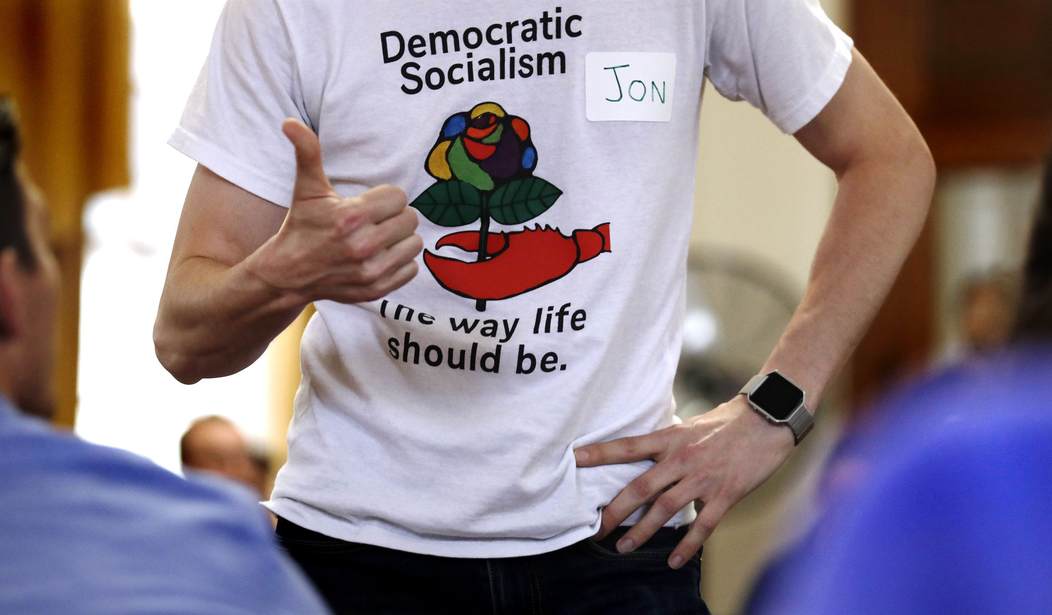

"You have no debt. You don’t need health insurance. You don’t pay a mortgage or have a landlord because comfortable housing is a human right," begins the DSA Program. "Your retirement is publicly funded. Food, education, energy, medicine, and transportation aren’t for-profit businesses; they are common goods and utilities."
Sounds wonderful, eh? Free stuff from sea to shining sea. Purple mountains echo with the cries of joy from citizens whom mommy and daddy government will nurture and keep close from the cradle to the grave.
Perpetual childhood sounds wonderful. Empty your head of cares and concerns, and just live. It's the dream of mankind to leave behind us the drudgery, the worries, the petty annoyances, the drab, boring lives of quiet desperation many of us live, and escape to a paradise where everyone loves everyone else.
Been there, done that. Haight-Asbury was a sleepy district in San Francisco in the summer of 1967, when an estimated 100,000 young people converged on the neighborhood, with cheap rents, communal living, and a burgeoning music scene drawing them. The "Summer of Love," they called it, and "free love," or consequence-free sex, drove it, along with psychedelic drugs and the music of groups such as the Grateful Dead, Janis Joplin, and Jimi Hendrix.
They called themselves "hippies," which is derived from the word "hipster," a term that jazz musicians of the 1940s and the "beatniks" of the 1950s who rejected mainstream norms used. By the end of the summer, the influx of thousands of young people overwhelmed the neighborhood's infrastructure, leading to severe issues with overcrowding, drug addiction, homelessness, and crime. In October 1967, organizers staged a mock funeral entitled "The Death of the Hippie" to mark the end of the movement and encourage people to carry the countercultural ideals back to their own local communities.
Haight-Asbury in 1967 was a fantasy world. Those with money and food shared what they had with others who didn't. The kids picked up cash, mostly by begging in the nearby Panhandle neighborhood or Asbury Park. The kids looked at the communal living, the shared resources, and the drugs and sex, and wondered why the whole world couldn't be like this: one perpetual wall-to-wall party from sunrise to sundown.
The next summer, they headed to Woodstock, N.Y., for another "Be-In." An estimated half a million people attended the three-day festival that featured almost everybody who was anybody in rock music. The same spirit of sharing, giving, communal love, and the euphoric feeling of being surrounded by many like-minded people who believed they were changing the world completed the fantasy that still haunts our politics and generations of naive fools.
Many of those hippies became teachers and educators when they woke up from their drug-induced stupor and realized the world was a much different place from the dream world they inhabited in their youth. They indoctrinated children and, like the aliens in Close Encounters of the Third Kind, implanted a vision of a classless society, where citizens had no cares or worries and where everyone was happy.
This is the fertile ground that the Democratic Socialists of America (DSA) are now plowing. Promising "free stuff" is easy. But how do you explain to these screen-addicted kids that nothing is ever free, that someone, somewhere, somehow has to pay for it?
The DSA program wants the government to pay for "health care, housing, higher education, and electricity," according to the Cato Institute. "Jobs are government-guaranteed, retirement benefits are expanded, paid family leave is universal, fossil fuels are eliminated, and reparations are paid."
What's all that "free stuff" going to cost?
The DSA platform claims that the bill for all this will be sent to “the richest individuals and corporations.” Tally up that bill, and it ballparks between $71 trillion and $212 trillion in new spending over the next decade. Confiscating every dollar of high-end wealth and corporate profits would cover only a fraction of those costs. The DSA agenda necessitates high taxes on middle-class Americans.
Totaling up nine of the largest proposals in the DSA platform would mean new federal spending equivalent to between 18 percent and 53 percent of GDP.
The high and low estimates in the Cato study are due to many government programs overlapping, so estimating how much those agencies would be spending ten years down the road is difficult. But it's not unreasonable to use the higher estimates, since they're more in the ballpark of actual costs than the low estimates.
Medicare for All would cost as much as $75 trillion over the decade after the DSA takes power, if it manages to pass its agenda. That would be an increase of $35 trillion, compared to the $40 trillion in the Congressional Budget Office's (CBO's) projected cumulative nominal GDP for 2027–2036.
Reparations would cost taxpayers $28 trillion over ten years. Sixty trillion dollars for "guaranteed jobs." And $16.6 trillion for "housing for all," as well as $12.2 trillion for infrastructure and transit.
"In total, the DSA’s new spending would cost between $71 trillion and $212 trillion over the next decade," says Cato.
How would that spending compare to other "democratic socialist" countries?
Using the lower-bound estimates, the DSA agenda would raise US spending to more than 57 percent of GDP. Among large, industrialized countries, only Finland would have a larger government. France comes in a third of a percentage point under the US’s low estimate. Add the high-end estimates, and US government spending would reach 92 percent of GDP.
No comparable country on Earth spends anywhere close to that amount. The DSA agenda’s spending could give the government a claim on national output much closer to estimates of state control under Soviet-style communism than to today’s European welfare states.
The DSA agenda has enormous constitutional problems (especially regarding private property and confiscatory taxes), and is unlikely to pass even if the DSA were to win the House, Senate, and White House.
Is that really true? In 20 years, I wouldn't bet against them achieving total power. But not today. For now, we can work to educate younger people about exactly what these communists-in-socialist-clothing are planning, and how those plans would impact our lives and our liberties.
If we fail to do so, the utopian fantasy that overwhelmed a single neighborhood in 1967 could end up bankrupting an entire nation.