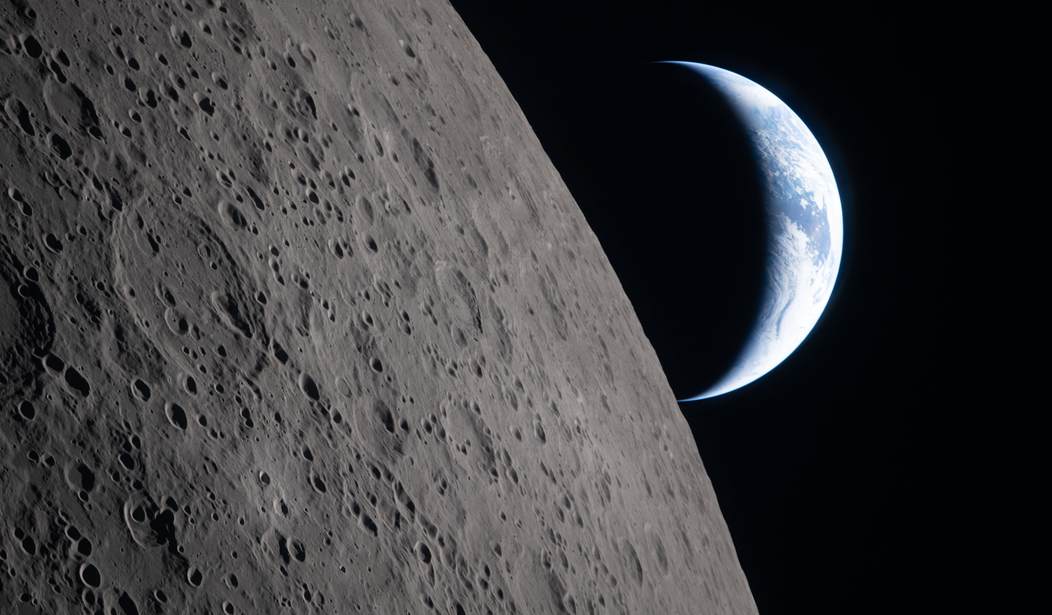
China wants to land its citizens on the Moon by 2030. They are likely to make that date and perhaps even earlier.
Meanwhile, the U.S. Moon landing program got a huge shot in the arm when Artemis II journeyed to the Moon and back. NASA is speculating that a Moon landing by 2028 is possible.
However, SpaceX's huge rocket booster, Starship, is behind schedule, as is Blue Origin's Moon lander. Both projects are needed for the U.S. Artemis IV, which will go to the Moon. China may be the second nation to land a human on the Moon before we get back.
The Moon landings are glorified space stunts. The future belongs to those who can establish a sustained human presence on the Moon that will eventually open the cosmos to commercial exploitation, exploration, and colonization.
It all starts with the Moon landings, however. NASA has built its Moon program on cooperation with other nations. Some programs, like the European Space Agency (ESA) and the Japan Aerospace Exploration Agency (JAXA), are mature space programs with decades of experience. Others, like the Indian Space Research Organization (ISRO), are ambitious but in their infancy. Spreading the costs across an international cooperative effort makes sense, as does the sheer brainpower required for humanity's most difficult and costly endeavor.
Even if China gets to the Moon the first time before the U.S. gets back, Beijing is ill-equipped to immediately challenge U.S. efforts to build a permanent base and begin to exploit the Moon's resources. But China may have its heart set on being first to land on Mars. In this, they may be eminently capable of achieving success.
The question the average American is asking is: it worth it?
One of the most discussed possibilities is Helium-3, a rare isotope found on the Moon in greater quantities than on Earth, reported Reuters. It is often described as a potential fuel for future nuclear fusion, producing energy with minimal radioactive waste. While still theoretical in many respects, it has attracted interest not just from the US, China and Russia, but also from countries like India and Japan.
However, the law regarding moon mining is unclear and full of gaps. The United Nations 1967 Outer Space Treaty says that no nation can claim sovereignty over the Moon — or other celestial bodies — and that the exploration of space should be carried out for the benefit of all countries. The 1979 Moon Agreement states that no part of the Moon "shall become property of any State, international intergovernmental or non-governmental organization, national organization or non-governmental entity or of any natural person." It has not been ratified by any major space power. The US in 2020 announced the Artemis Accords, named after NASA's Artemis Moon programme, to seek to build on existing international space law by establishing "safety zones" on the moon. Russia and China have not joined the accords.
But the ongoing rivalry isn’t just about mining resources anytime soon. For now, it’s more about positioning, gaining early access, building infrastructure, and shaping the rules of how future lunar activity will be governed.
Helium-3 is the "holy grail" of fusion because it is aneutronic—it releases very few neutrons. This means it doesn't make the reactor walls radioactive and allows for Direct Energy Conversion (turning the fusion plasma directly into electricity without needing a steam turbine).
Right now, we're in the "prototype validation" phase, which is the closest science has ever been to a practical Helium-3 breakthrough. While standard fusion (Deuterium-Tritium) is still the primary focus of giant projects like ITER — a massive international research project in southern France building the world’s largest tokamak, a fusion device designed to prove that nuclear fusion can produce sustainable, carbon-free energy at an industrial scale.
Private companies like Helion Energy are making significant strides toward a commercial He-3 cycle. This is a major reason why the U.S. and China want to get to the Moon's south pole — the Moon's regolith (soil) is estimated to contain over a million tons of Helium-3. By contrast, He-3 is very rare on Earth.
One of the major reasons for humans becoming a spacefaring species is the fact that the Earth sits in a shooting gallery. Asteroids, comets, and space debris of all kinds get caught in the Sun's gravity and pass the Earth's orbit on their way to oblivion. The evidence of our planet being struck by large enough objects that would destroy civilization (and perhaps end all life on Earth) makes getting off this rock a survival imperative.
Readers in their 20s will see people living on the Moon and perhaps on Mars someday. If not governments, private companies and individuals will make the journey off Earth to live among the stars.
I wish I could join them.