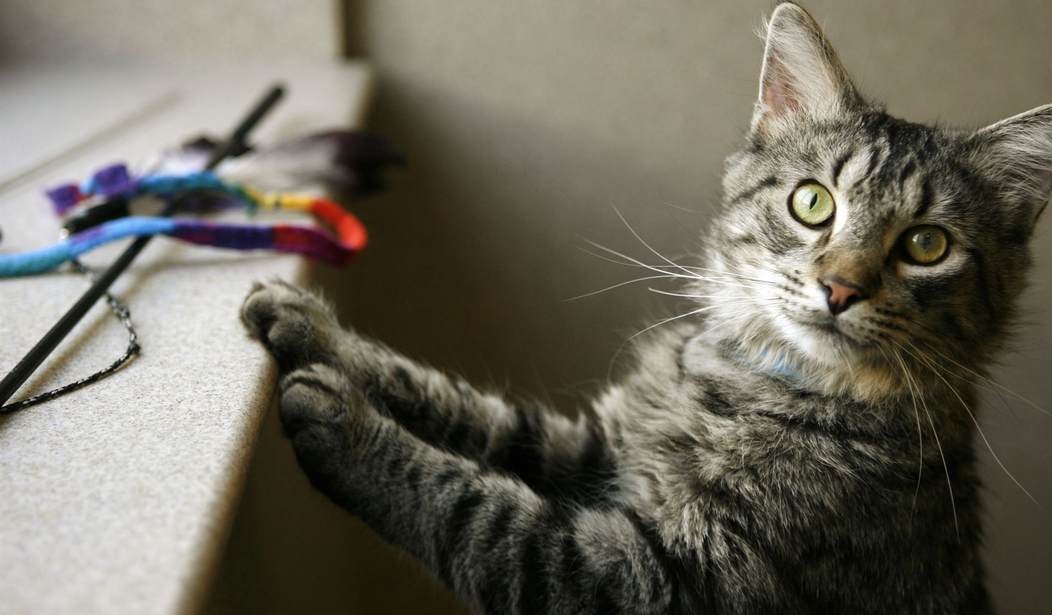
I've had to put several pets down over the 50 years I've been kept by cats. It's among the hardest things I've ever had to do.
It used to be science fiction that we needn't suffer so. Simply by cloning your beloved companion, you could enjoy its company virtually forever.
It's not science fiction anymore.
There are dozens of companies in the U.S. that will clone your animal friend. A tissue sample taken when your pet is alive or within hours of death is all that's needed to have a lab create an exact genetic match of your dearly departed.
That, and around $50,000, no credit extended. And that's not the only drawback to cloning. If you're hoping to recreate an exact copy of your friend in temperment and personality, you're going to be disappointed.
James Serpell, a professor emeritus of ethics and animal welfare at the University of Pennsylvania, believes that there is some dishonesty involved in cloning your pet.
“I think these cloning companies are kind of trying to market what they do as recreating the original pet, and they're not succeeding there,” says Serpell. “And they never will because there's so much that happens post-conception to change how that original DNA is expressed. You can compare it to a set of identical twins; they’re born with identical DNA, but by the time they’re adults they’re quite distinct people with different personalities and preferences –– they’re no longer truly identical.”
Science has come a long way since Dolly the sheep was cloned nearly 30 years ago. Today, pet cloning is becoming more commonplace. The $50,000 price tag is expensive, but within reach for some wealthy individuals or those willing to take out loans. Celebrities like Paris Hilton, Barbra Streisand, and recently, Tom Brady have cloned beloved pets.
The procedure isn’t as simple as running an animal through a sci-fi replicator machine.
“The process involves extracting viable eggs from the fallopian tubes" of the female animal being cloned, Serpell says, "then they inject a surrogate animal with hormones and implant the egg and hope it implants properly. Unfortunately, many of these embryos don't implant successfully, so many of the dogs miscarry, and some of the puppies that are born are malformed and don't survive very long.”
While the process isn’t usually dangerous for the surrogate it’s likely unpleasant, as many women who have undergone IVF can attest. And a 2022 study found a success rate only as high as 16 percent, though at least one company currently claims 80 percent.
A 2025 study on cloned miniature pigs discovered that some traits appear to have a genetic connection, while other traits vary among clones, meaning they’re probably shaped more by experiences.
“Based on the mini-pigs, it seems that some personality traits are quite consistent among clones, for example activity levels, while other traits like boldness seem not to be very consistent within clone lines,” said study co-author Adam Reddon.
Reddon adds, “All personality traits emerge as an interaction between genetic background and the environment an animal experiences, but the work on cloned mini-pigs suggests that some behaviors may be more strongly determined by genetics than others.”
A 2017 study found that cloned puppies had more stable and predictable personalities over time than non-cloned puppies. When tested at two different ages, the cloned dogs tended to keep the same overall temperament, while the control dogs’ personalities shifted more. The cloned puppies were especially consistent in traits related to how they interacted with people, responded to training, and handled stress and fear.
But although their overall fear levels appeared to be quite similar, the way they acted when they were afraid differed. They also deviated on aspects of personality tied to learning, experience, and changing social situations, such as curiosity (just like the mini-pigs). Research has also found that dogs’ experiences during their first year of life influence their later behavior and temperament.
Reddon says, “It seems to me unlikely that the cloned pet would have the same or maybe even similar personality given what we know about the importance of experience in shaping personality.”
It's the old "nature vs. nurture" argument that geneticists and behavioral scientists have been having for decades. The answer is that it depends on both: not just genetics, but also how the animal is raised.
The one thing that's certain is that your beloved companion will almost certainly not be resurrected as a new, younger version of the pet you fell in love with. That doesn't mean you can't love the clone as much as you did the original. Eventually, you will probably accept the difference and embrace your beloved copy as much as you did the original.