It's only recently that the general public has been made aware of the dangers of microplastics in the environment. In truth, they're everywhere; in our food, in the air we breathe, in every nook and cranny on planet Earth. We absorb them through our skin. They're in every organ in our bodies, including the naughty bits.
"We are doomed," say many greens. Now give us money so we can fight to save you from the greedy plastics industry.
Pardon me, but the apocalypse has been unavoidably delayed. It turns out that we've been the victims of bad science based on ideology rather than empirical evidence.
In October, "the European Food Safety Authority (EFSA) literature review concluded that almost all published microplastic and nanoplastic studies were littered with mistakes, poor methodologies and unjustifiable conclusions," according to the Science Literacy Project.
"As of 2026, the scientific consensus suggests that the average adult ingests between 74,000 and 121,000 microplastic particles every year from food and water alone," I wrote in January. "If you include the particles we inhale from the air, that number can rise to over 211,000 particles annually.
But the effects on human health were unknown. The Guardian reported in a "bombshell" article, "There is an increasing international focus on the need to control plastic pollution, but faulty evidence on the level of microplastics in humans could lead to misguided regulations and policies, which is dangerous, researchers say."
Eight days after the “bombshell” Guardian article, a group of activist scientists struck back with a rebuttal stressing the dangers of microplastics. The authors, Joe Yates, Philip J Landrigan, Jennifer Kirwan and Jamie Davies, were coordinated (by some unmentioned organization) to write separate letters bundled into a response article to try to diffuse the Guardian’s unexpected criticism of the anti-plastics campaign.
Their main point, outside of the usual “industry collusion” trope, is that disagreement is an important part of the scientific process but the media should not use it for political purposes. I wonder why these “independent scientists” did not publish the same responses when their papers arguing that microplastics are causing serious health issues were amplified by the same media groups.
If you're a casual news reader of climate change claims, you recognize this technique instantly. You would think the hysterics would come up with a different line of defense instead of following the same playbook.
Challenge their findings, and they accuse you of being an industry toady. Use real science to rebut their claims, and they fall back on the "all scientists disagree" trope. Since they can't defend themselves against the real scientific conclusions that debunk their claims, they ignore other scientists' conclusions and try the "Look! Squirrel!" ploy. They never quite get around to defending their work.
This month, New Scientist came out with an even more critical assessment of the poor methodology and ridiculous conclusions from the recent slew of studies on micro/nanoplastics. The article, written by Chelsea Whyte, entitled: “How worried should you be about microplastics?”, concluded that you should not be worried at all, but rather, mildly bemused.
The article started with an assessment of the exposomist claim that we ingest 5 grams, or the equivalent of one credit card, of microplastics per week. Whyte claims the study used some very shoddy math and in reality, we more likely ingest only “0.0041 milligrams per week, which is less than a grain of salt)”. Like the Guardian “Bombshell” article, she examined the flawed methodology of vaporizing tissue samples, a practice that would convert human fat into microplastic false positives.
This is not to say that plastics in the envioronment isn't an existential problem.
"An estimated 75-199 million tons already exist in the ocean, with plastic found from the poles to the seafloor," I wrote in January. "What's more, plastic production is increasing, with plans for significant expansion, which would worsen the crisis."
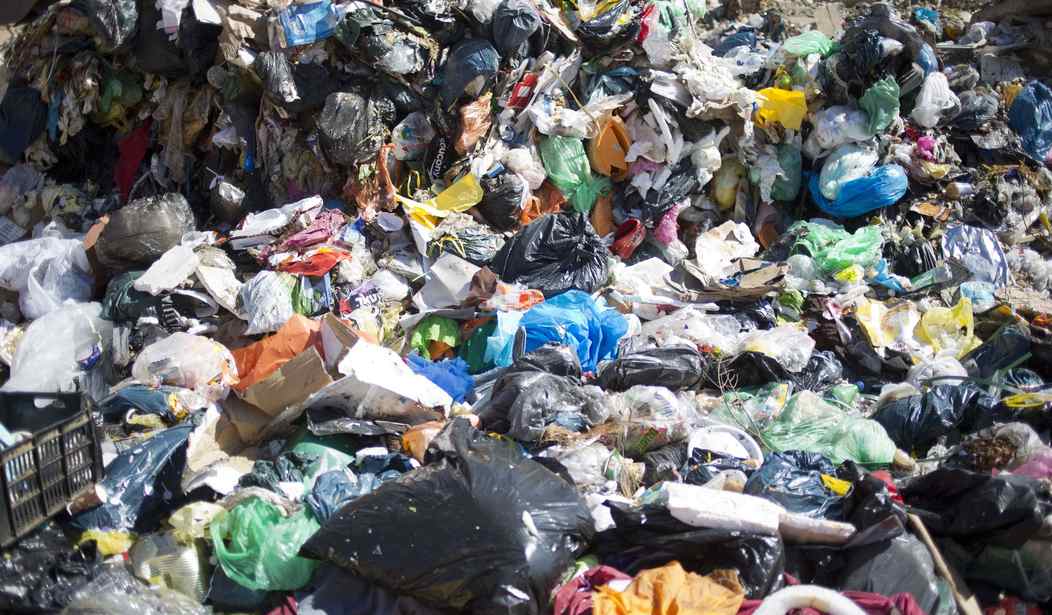
Microplastics are probably not killing us, but plastics in the oceans and the wild are killing fish, birds, and other wildlife. They are destroying ecosystems upon which humans depend for their survival.
It's a shame that some scientists feel the need to scaremonger and generate hysteria, obscuring the real threats that plastics pose.
PJ Media will give you all the information you need to understand the decisions that will be made this year. Insightful commentary and straight-on, no-BS news reporting have been our hallmarks since 2005.
Get 60% off your new VIP membership by using the code FIGHT. You won't regret it.