





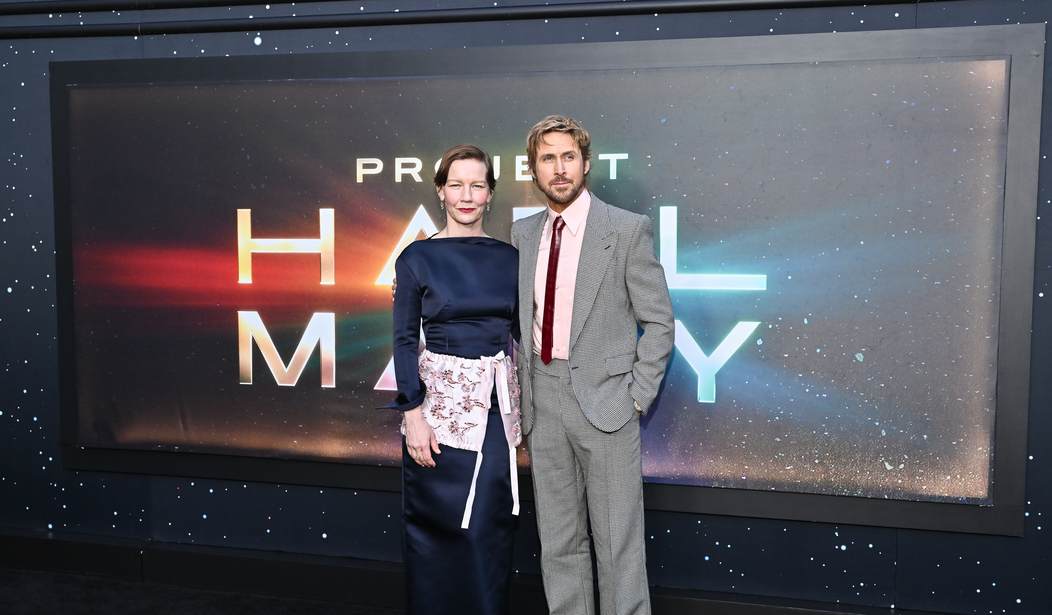
At the beginning of Project Hail Mary, the title card reads, “An Amazon Original Film,” before the MGM lion appears, albeit silently. Back in 2016, TV’s South Park created the phrase “member berries” to describe how, even a decade ago, so many shows on streaming platforms such as Amazon’s are built around callbacks to the beloved older TV shows and movies that inspired them, such as the many Star Wars series on Disney+ and the many Star Trek series on Paramount+.
If you’re a fan of the science fiction genre, you’ll recognize many of the member berries and tropes that Project Hail Mary employs. However, unlike a multi-episode TV series, because Project Hail Mary, based on the 2021 novel by Andy Weir, was built for the big screen and shot in Imax, it has an immersive, well-crafted production design, and beautiful cinematography. But unlike the uber-woke fair on most streaming services, Project Hail Mary has a real heart to it, thanks to a solid script, and a touching performance by Ryan Gosling.
Silicon Avatar
In Cast Away, Tom Hanks had to emote to a volleyball his character named “Wilson.” In the outer space scenes in Project Hail Mary, Gosling has to play off an alien being that he dubs “Rocky.” Surprisingly, in most scenes, Rocky is a puppet (and an Academy Award-nominated one at that), whose strings and mechanisms have been digitally airbrushed out, rather than a full-blown CGI creation. As a result, Rocky has a real physicality on screen, and thanks to some solid scriptwriting, he becomes one of the most believable — and beloved alien characters seen onscreen in quite some time.
But good science fiction has been able to create this sort of suspension of disbelief when written and filmed correctly. In 1970, film critic Joseph Gelmis asked Stanley Kubrick about Hal, the legendary supercomputer in 2001: A Space Odyssey, “Why was the computer more emotional than the human beings?” Kubrick replied:
This was a point that seemed to fascinate some negative critics, who felt that it was a failing of this section of the film that there was more interest in HAL than in the astronauts. In fact, of course, the computer is the central character of this segment of the story. If HAL had been a human being, it would have been obvious to everyone that he had the best part, and was the most interesting character; he took all the initiatives, and all the problems related to and were caused by him.
Some critics seemed to feel that because we were successful in making a voice, a camera lens, and a light come alive as a character this necessarily meant that the human characters failed dramatically. In fact, I believe that Keir Dullea and Gary Lockwood, the astronauts, reacted appropriately and realistically to their circumstances.
One of the things we were trying to convey in this part of the film is the reality of a world populated -- as ours soon will be -- by machine entities who have as much, or more, intelligence as human beings, and who have the same emotional potentialities in their personalities as human beings. We wanted to stimulate people to think what it would be like to share a planet with such creatures.
In the specific case of HAL, he had an acute emotional crisis because he could not accept evidence of his own fallibility. The idea of neurotic computers is not uncommon -- most advanced computer theorists believe that once you have a computer which is more intelligent than man and capable of learning by experience, it's inevitable that it will develop an equivalent range of emotional reactions -- fear, love, hate, envy, etc. Such a machine could eventually become as incomprehensible as a human being, and could, of course, have a nervous breakdown -- as HAL did in the film.
The year before Hal made his big screen debut, Star Trek aired one of its best episodes. “The Devil in the Dark,” written by co-producer Gene L. Coon, was about a completely alien creature, whom, called a “Horta,” and like Project Hail Mary’s Rocky, we are told is also made out of silicon. In the 1968 book The Making of Star Trek (co-written by Stephen E. Whitfield), Gene Roddenberry wrote:
What’s been wrong with science fiction in television and in motion pictures for years is that whenever a monster was used, the tendency was to say, “Ah, ha! Let’s have a big one that comes out, attacks, and kills everyone.” Nobody ever asked “why?” In any other story, if something attacks (a bear, a man, or whatever), the author is expected to explain, “Here is why it is the way it is, here are the things that led it to do this, here is what it wants.”
A classic example of doing this right was one of our most popular episodes, written by Gene Coon, entitled “The Devil in the Dark.” The “Horta” was an underground creature which attacked a group of miners. In the end they find out that it attacked because—surprise—it was a mother! It was protecting its eggs because the miners were destroying them in the belief that they were just strange-looking mineral formations.
With this understood, the Horta suddenly became understandable, too. It wasn’t just a monster—it was someone. And the audience could put themselves in the place of the Horta . . . identify . . . feel! That’s what drama is all about. And that’s its importance, too . . . if you can learn to feel for a Horta, you may also be learning to understand and feel for other humans of different colors, ways, and beliefs.
Given that this was 1967-era episodic television, the Horta seen on screen was actually a sort of shaggy suit made of painted foam rubber that looked a bit like a giant moving Stouffer’s Microwave Lasagna. Inside the giant lasagna was Hollywood stuntman and monster performer Janos Prohaska, who moved on the ground on his hands and knees, to maintain a low-to-the ground profile to further enhance its completely alien form. Project Hail Mary’s Rocky is a puppet about the size of a dog, whom we are told is also made out of silicon, and can’t be exposed to our oxygen-nitrogen atmosphere lest he begin to burn up and die.
The Anti-Mary Sue
Regarding Ryan Gosling’s Ryland Grace character, Rocky’s flesh and blood counterpart from Planet Earth, great movies, particularly great science fiction movies, depict their leading characters as operating in an arc from everyman or everywoman to all-conquering badass hero. Luke begins Star Wars as a callow farm boy with modest skills at piloting a land speeder to, by the end of the film (spoiler alert) blowing up the Death Star. At the start of Close Encounters of the Third Kind, Richard Dreyfuss is an electric company lineman, before the UFOs arrive and he begins his quest to discover their meaning. Sigourney Weaver’s Ripley begins Alien as just another blue-collar space trucker and ends it (another spoiler alert) by defeating the xenomorph that had killed the rest of her ship’s crew. Linda Hamilton’s Sarah Connor begins the first Terminator movie as an L.A. waitress before Kyle Reese and Arnold arrive.
Stanley Kubrick and Arthur C. Clarke crafted an enormous amount of world building before the cameras rolled on the set of 2001: A Space Odyssey to depict the space voyages of the 21st century as populated by soulless bureaucrats and automaton astronauts until Keir Dullea’s Dave Bowman realizes that to survive, he must awaken from his mental slumber to best the cycloptic Hal 9000.
By contrast, one of the biggest complaints about the Star Wars trilogy that debuted in 2016 was that Daisy Ridley’s Rey inhabited the science fiction trope of the “Mary Sue” character, which is defined as a young woman who is “exceptionally talented in an implausibly wide variety of areas, and may possess skills that are rare or nonexistent in the canon setting. She also lacks any realistic, or at least story-relevant, character flaws — either that or her ‘flaws’ are obviously meant to be endearing.” In sharp contrast, Project Hail Mary’s Grace is depicted at first as a brilliant and iconoclastic scientist, but a physical coward. He’s the last man who should be going into space, and he knows it all too well. But by about three quarters of the way through the movie, he’s on his way to becoming a full-blown hero, literally on his way towards saving the world.
On Saturday, America’s Newspaper of Record reported:
Hollywood Baffled By Success Of Movie Made To Entertain People https://t.co/tpzZJMTHVR pic.twitter.com/qMq6r1G7mP
— The Babylon Bee (@TheBabylonBee) April 18, 2026
Project Hail Mary isn’t a perfect movie. You may object to the constant cross-cutting between present day events in outer space and Grace’s earlier days on planet Earth. The conclusion of the movie involves numerous anti-climaxes; as Ross Douthat writes at National Review, calling the movie, “an Overlong Shot,” and writing that “despite its seeming simplicity, Project Hail Mary somehow lasts for 2 hours and 36 minutes. It lingers over its starscapes, it teases you with sacrificial deaths that aren’t, it ends and ends and ends again. At various moments, when the music was demanding a strong emotional response, I was imagining how I’d cut 30 minutes without losing more than an ounce of plot.”
Those flaws aside, while extremely well executed, and employing the trope of the man asking himself, as the Talking Heads’ David Byrne would say, “Well, how did I get here?”, Project Hail Mary is ultimately smart filmmaking at its core. It’s the sort of movie that Hollywood used to be able to do in its sleep, resulting in summer blockbuster after summer blockbuster. Like 2022’s Top Gun Maverick before it, the fact that audiences are celebrating the rare post-2020 Hollywood movie that actually gets most of the pieces of the puzzle correct is a reminder of just how bad the industry has stumbled, post-Covid. That Hollywood can still occasionally produce a watchable movie has become its industry’s own Project Hail Mary.
(Incidentally, given their many smart choices in directing Project Hail Mary, it makes you wonder how 2018’s Solo: A Star Wars Story might have turned out if Kathleen Kennedy hadn’t fired Lord and Miller from co-directing that film.)

Join the Conversation
VIP members get the ability to comment on articles.