







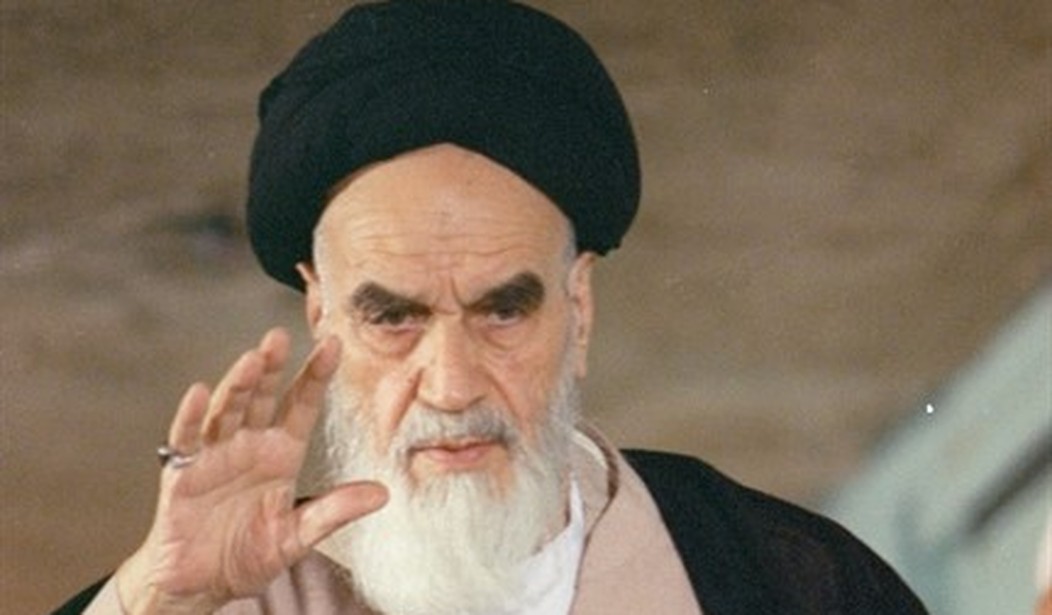
It was Valentine's Day 1989, and in addition to all the love poems, hearts, candy, and flowers, the Muslim leader of Iran, Ayatollah Ruhollah Khomeini, was in high dudgeon about… something.
This wasn't unusual for Khomeini. He could play the Western media like Charlie Daniels's fiddle, forcing the media to cover him while he made some sort of outrageous, exaggerated comment about one of his many, many enemies.
This was different. Khomeini issued a fatwa against an obscure British writer named Salman Rushdie for writing a book titled Satanic Verses.
A fatwa is typically issued by a mufti (a qualified legal scholar) in response to a query from a private individual, a judge, or a government. It addresses questions ranging from daily rituals and dietary laws to complex issues of commerce or medical ethics.
In most cases, a fatwa is not legally binding on all Muslims. It is considered an advisory opinion based on the scholar’s interpretation of the Quran and the Hadith. Individuals are generally free to follow or ignore it, though devout followers may feel spiritually obligated to adhere to it.
The specific fatwa issued by Ayatollah Khomeini against Salman Rushdie in 1989 was highly unusual. Because it was a political, extrajudicial decree from a Supreme Leader — and it carried a call for violence — it functioned more as a sovereign command within the context of the Islamic Republic of Iran rather than a traditional academic response to a religious question.
Rushdie's "transgression" was writing a book that Khomeini never read but was told was very blasphemous. The title refers to a controversial tradition in Islamic history concerning the Prophet Muhammad. In this tradition, Muhammad is said to have briefly mistaken words whispered by Satan for divine revelation from God. These "satanic verses" reportedly suggested that three pagan goddesses — al-Lat, al-Uzza, and Manat — could intercede with God.
Rushdie used the device of the whispered words from Satan as a brilliant way to expose some of the contradictions of Islam, as well as an exploration of the immigrant experience, identity, and struggle of faith, rather than an attack on Islam itself.
For devout Muslims, the story fiddled with the core of their faith: the origin story of Islam.
The reaction in America was shameful. President George Bush refused to invite Rushdie to the White House when he visited America in 1992. Bush's cowardly spokesperson, Marlin Fitzwater, said, “There’s no reason for us to have any special interest in him.”
Several translators of Satanic Verses were attacked, and two were killed. Air Canada refused to sell a seat to Rushdie, then withdrew the ban after a worldwide outcry.
Khomeini died a few months after issuing his fatwa against Rushdie. To keep the pressure on, the 15 Khordad Foundation raised its price on Rushdie’s head to $2.8 million. ("The 15 Khordad Foundation is a so-called charitable foundation subordinate to Supreme Leader Ali Khamenei. Since 1989, the 15 Khordad Foundation, inspired by Ayatollah Khomeini’s order calling for Rushdie’s execution, has proudly placed a bounty on the author’s life," explains the U.S. Dept. of the Treasure.) Rushdie continued his life in hiding, protected by British guards.
Jonathan Rosen, writing a long think-piece in The Free Press on the significance of the fatwa against Rushdie, traces the decree from Tehran, 1989, to the Twin Towers in 2001.
"The fatwa that took aim at a novel, and at the culture that permitted such things, and that is still alive decades later, was of a piece with the fatwa that sent airplanes like bullets into the heart of America, killing almost 3,000 innocent people it considered guilty, piloted by terrorists it considered martyrs, who shouted God’s name as they committed mass murder. Like a message written on the shell casing of a bullet to pretend it serves a higher purpose than murder, that is the greatest blasphemy I know," Rosen writes.
Decades later, a young American, Hadi Matar, acted on Khomeini's words as if they had been written that day.
Thirty-three years after Rushdie was sentenced to death, Matar traveled from Fairview, New Jersey, to Chautauqua, New York, where he attacked Rushdie with a knife from behind as he sat onstage at the Chautauqua Institution waiting to give a speech about free expression and the importance of keeping writers safe. Matar, who told a reporter that he had only read “a page or two” of The Satanic Verses but knew it was an “attack on Islam,” stabbed the 75-year-old writer in the face, the eye, the neck, and the midsection, 15 times before being tackled by bystanders.
That was the logic of the fatwa. Khomeini hadn’t read The Satanic Verses either but had revoked its creator’s right to exist anyway. This helps explain how Matar, who was found guilty of attempted murder last year, could tell the court before his sentencing: “Salman Rushdie wants to disrespect other people. He wants to be a bully; he wants to bully other people. I don’t agree with that.”
An Islamic charity, the Foundation to Implement Imam Khomeini’s Fatwas, gave Matar a nice piece of land, which promised more to whoever finished the job. The murderer of Sarah Milgrim and Yaron Lischinsky, a young couple leaving the Capital Jewish Museum in May 2025, Elias Rodriguez, was feted across the Islamic world. He was "hailed as an 'American Yahya Sinwar' by Iranian TV, which likened him to the mastermind of the October 7 massacres for killing 'two wild Zionist beasts . . . sending them to hell,' and for bringing the Iranian resistance to the U.S," Rosen writes.
Related: After More Than 35 Years, the Lebanese Government Is Finally Trying to Disarm Hezbollah
It won't matter if the government of Iran falls. The fatwas against Rushdie and others are eternal. The very nature of the fatwas requires the faithful to kill for Islam. The fatwa's power is that "it is a few sentences read aloud on Radio Tehran, mere breath, that will remain its most successful method of exporting the Islamist revolution, even after the murderous regime it created goes down," says Rosen.
"The fatwa’s ability to erase borders—not only between Tehran and London or New York, but between words and violence—made it a sort of spell," Rosen writes. "It was at once a death sentence, a wanted poster, a call to arms, a license to kill, a pardon before the fact, and a reward after it."
"You can kill a man, but you can’t kill an idea" is a famous quote often attributed to civil rights leader Medgar Evers. Ending the Iranian regime won't "kill" radical Islam. The best we can expect is that its teeth will be pulled and its ability to do harm will be lessened.
PJ Media will give you all the information you need to understand the decisions that will be made this year. Insightful commentary and straight-on, no-BS news reporting have been our hallmarks since 2005.
Get 60% off your new VIP membership by using the code FIGHT. You won't regret it.

Join the Conversation
VIP members get the ability to comment on articles.