







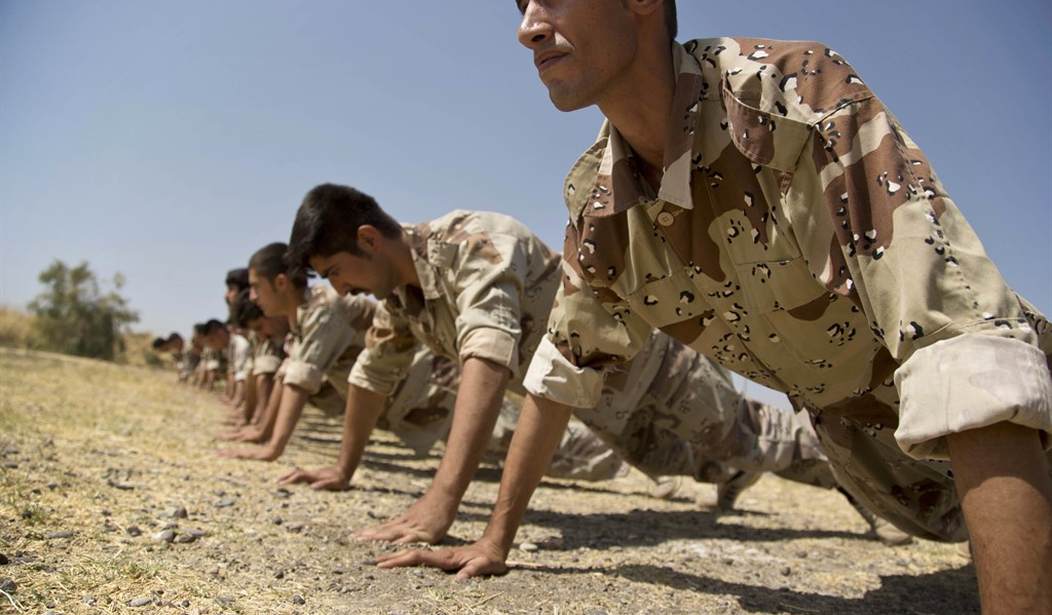
Iranian Kurdish militias in Western Iran and Northern Iraq have been sneaking back and forth across the Iranian border in the last week. They are contemplating joining the fight to oust the Iranian government and gain greater autonomy or, God forbid, carving out an independent state for Kurds across the region.
Kurds are a distinct ethnic group who occupy a swath of territory from northwestern Iran, Eastern Iraq, Eastern Syria, much of Southern Turkey, and a slice of Azerbaijan.
Taken together, the Iran-Iraq Kurdish militias would be a force that Iran's Revolutionary Guards would have to reckon with. This is a blooded army, having fought a low-level insurgency for decades against Iran and Syria's Bashar Assad, while, most recently, helping a coalition, including the U.S., to defeat ISIS.
But what do they really want? The entry of the Kurds to be used as ground forces to further destabilize the Iranian regime and encourage a nationwide revolt is a fraught proposition. It's a wild card that could easily blow up in Israel and America's faces by setting the entire Middle East aflame with other ethnic minorities all agitating and fighting for their own independence.
The biggest initial risk would be to the Kurdish people.
“There is a big opportunity—an opportunity for greater autonomy and to set up democracy,” said Zagros Enderyarî, an official with the Kurdistan Freedom Life Party, also known as PJAK, one of several armed Iranian Kurdish groups based outside Iran. “But there is also a risk. The Iranian regime killed many people during the protests, and they could do that again—especially in Kurdistan.”
Following the 1991 Gulf War, the Kurds in Iraq rose up after President George Bush urged the Iraqi people to overthrow Saddam. He stated, "There’s another way for the bloodshed to stop, and this is for the Iraqi military and the Iraqi people to take matters into their own hands and force Saddam Hussein, the dictator, to step aside."
Believing these calls implied American military backing, the Kurds in the North and the Shia in the south launched massive uprisings immediately following the ceasefire. At the height of the revolt, rebels controlled 14 of Iraq’s 18 provinces.
Then Bush gave the order for Americans to stand down. Whether Bush had thought through the consequences of an independent Kurdish state or was always planning to betray them is unclear.
Today, both the United States and Israel are arming the Kurds.
The idea behind the strategy is to open the way for a popular—and possibly armed—uprising in Kurdish-majority areas that have long bristled at the dominance of the Iranian government. An armed mobilization would rely on both Kurdish forces crossing into Iran from the border areas of Iraq, as well as on units that are already in the country, according to members of Iranian Kurdish groups.
There are also concerns that other ethnic groups such as the Azeri in the north and the Baloch to the east might join an uprising that could destabilize the regime in Tehran.
The prospect is already alarming some of Iran’s neighbors who worry that events could morph into secessionist movements that might cause problems for them. Pakistan has long worried that Baloch in eastern Iran might launch attacks on its territory to strengthen a Baloch separatist movement there. Turkey, which saw an influx of refugees from Syria over the years and has a large Kurdish population within its own borders, on Wednesday said Iran’s territorial integrity should be preserved.
“The war that is currently underway has little to do with our usual struggle, but the situation that has arisen may provide an opportunity for the Kurdish forces to take action,” said Kamal Karimi, a member of the Central Committee of the Democratic Party of Iranian Kurdistan, or KDPI.
Related: China Watches Helplessly From the Sidelines as Its 'Axis of Chaos' Disintegrates
In addition to the danger of other ethnic groups across the region fighting for independence or more autonomy, there are significant risks for the Kurds as well.
"Iranian forces are already targeting positions of Iranian Kurdish groups," reports the Journal. "Iran’s Islamic Revolutionary Guard Corps and the Ministry of Intelligence, in a joint operation, destroyed what they described as the headquarters and an ammunition depot belonging to Kurdish separatists in a border area, Iranian state-run media reported on Thursday," according to the Journal.
The plan to use the Kurds to ignite a nationwide popular rebellion could work, but it's a big gamble. Trump has been willing to take some big gambles in this war already, so it's probable that he and Netanyahu will roll the dice on this.
PJ Media will give you all the information you need to understand the decisions that will be made this year. Insightful commentary and straight-on, no-BS news reporting have been our hallmarks since 2005.
Get 60% off your new VIP membership by using the code FIGHT. You won't regret it.



Join the Conversation
VIP members get the ability to comment on articles.