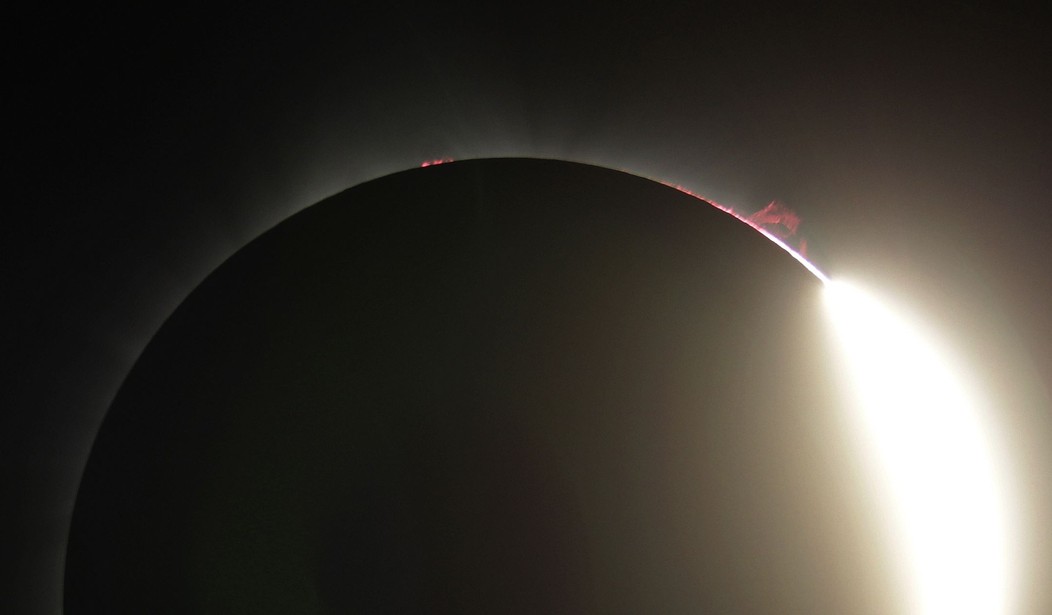
Last November, our sun burped out several powerful solar flares in the "X" category, the most energetic category of solar flares. When they reached the Earth, the electromagnetic energy wreaked havoc on satellites, radio communications, and other electronic infrastructure.
Satellites today are "hardened" against most of these powerful flares, but we're in a "solar maximum" period, having just passed the peak of the 11-year sunspot cycle.
Along with those November solar flares, there were Coronal Mass Ejections (CMEs), which are clouds of plasma charged with powerful magnetic fields. Once they hit Earth, if we're not ready for them, it could mean sayonara for satellites vital to our communications grid. About every 11 years, the magnetic poles of the sun flip halfway through its stretch of maximum activity. This causes a literal explosion of sunspots, which lead to the solar flares and CMEs that, if they're big enough, threaten to shut the planet down electronically for weeks, if not longer.
It happened in 1859. Richard Carrington looked through his telescope in Surrey, England, on Sept. 1 and drew a group of sunspots. Suddenly, he observed “two patches of intensely bright and white light” emerge from the spots. It was the most massive solar flare ever observed, and the gas and atomic particles created magnificent auroras as far South as Cuba.
They also bedeviled telegraph lines.
That evening, vibrant auroras illuminated the night sky in North America and reached as far as Cuba and Chile. It was so bright that confused gold miners in the Rocky Mountains got out of bed and made coffee and breakfast at 1 a.m. At around that time in Boston, The New York Times reported, “ordinary print could be read by the light.”
This geomagnetic storm interfered with telegraph communications around the globe. Sparks reportedly leapt from telegraph machines, shocking operators. In Boston, employees of the American Telegraph Company discovered that they could harness auroral current to transmit messages to Portland, Maine, without the need for batteries.
“For observers of the 1859 solar storm, the blood-red displays of the aurora borealis were both beautiful and threatening, a form of contaminating cosmic fire capable of altering day-to-day experience,” wrote Kate Neilsen, then an English Ph.D. student at Boston University, in 2017. Solar activity like this storm “brought attention to the unnerving power of the sun to disrupt human activity,” she explained.
Indeed, it's unsettling to think of what would happen if a solar flare took out our electronic infrastructure. It would be worse than an electromagnetic pulse (EMP) from a nuclear explosion. A CME is far more powerful, as the energy released by a large X-class solar flare is equivalent to millions of 100-megaton hydrogen bombs exploding at the same time. Where the EMPs' effects would be highly localized, the damage from an X-class solar flare would be planet-wide.
The region where this latest solar flare bombardment originates is known as Sunspot region 4633. It's 15 Earths wide and a boiling, churning mass of plasma.
This movie shows the past 24 hours in active region AR 14366 – the area responsible for the recent strong solar flares! This wavelength shows cooler (1 million °C) plasma, revealing how dynamic the coronal magnetic field is right now. This region has many more flares to give! pic.twitter.com/BuRCmpUQ6Z
— Dr. Ryan French (@RyanJFrench) February 2, 2026
Here's a view of AR 14366 in ultraviolet light.
5½ days of sunspot group 4366
— Marko Rummelsburg (@doktornihil) February 5, 2026
We've seen 63 M-class flares, 6 X-class flares, 0 radiation storms, 5 coronal mass ejections (CMEs) - 3 of them slow.
It has passed its zenith, but it is not yet at an end. The big question is: will it produce another CME? pic.twitter.com/kHeGaBSS4i
We can only do so much to prepare for a geomagnetic storm precipitated by an X-class solar flare. Even shutting down satellites might not save all of them. The inards would be cooked as surely as if they weren't shielded at all.
Being aware of the danger is half the battle. Prepping for such a catastrophe is common sense.