







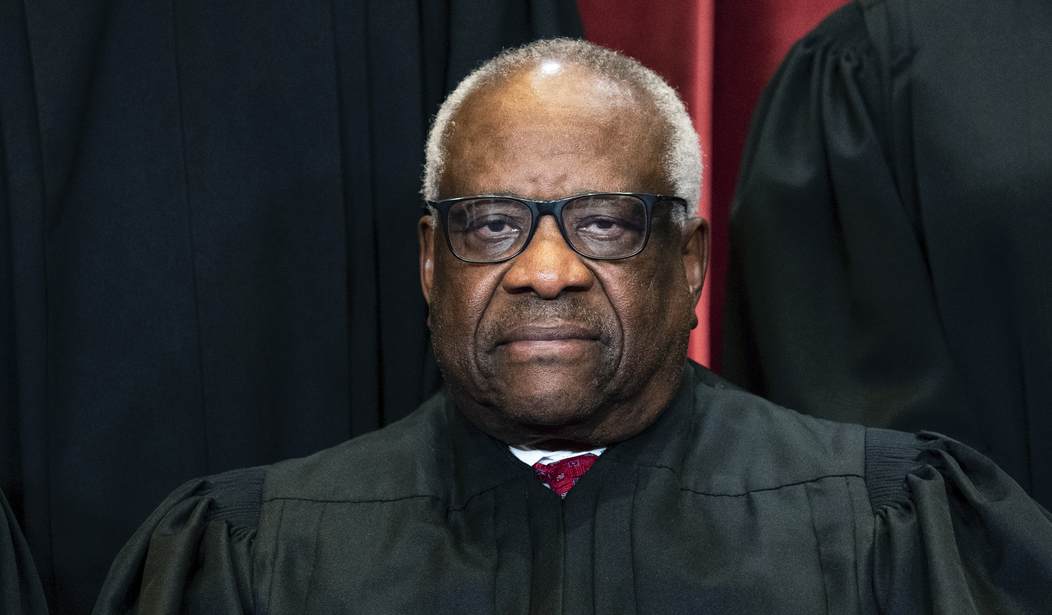
The Supreme Court handed President Donald Trump a significant defeat on tariffs Friday morning, and the sharpest voice in the room wasn't in the majority. It was Clarence Thomas, writing in dissent, methodically dismantling the majority’s reasoning for stripping the president of broad tariff authority under the International Emergency Economic Powers Act.
The ruling blocks Trump from using IEEPA as the legal foundation for his reciprocal tariff policy. For what it’s worth, the court didn't wipe out his tariffs entirely — other statutes still provide Trump with opportunities to impose tariffs — but the majority made clear that sweeping executive tariff power requires explicit congressional guardrails.
What made the decision especially striking was the coalition that produced it. Chief Justice John Roberts wrote the majority opinion, joined by Amy Coney Barrett and Neil Gorsuch, alongside the court's three liberal justices. Thomas, Samuel Alito, and Brett Kavanaugh dissented.
His dissent goes straight to the constitutional text and history. "I write separately to explain why the statute at issue here is consistent with the separation of powers as an original matter," he wrote. His argument is grounded in the Founding era's actual understanding of foreign commerce — not a modern reinterpretation of it.
Thomas draws a hard line between domestic legislative power and foreign trade authority. Congress holds the taxing power and the power to set domestic rules governing life, liberty, and property. Foreign commerce is a different animal entirely. "Power over foreign commerce was not within the core legislative power, and engaging in foreign commerce was regarded as a privilege rather than a right," he explained.
If foreign trade regulation isn't a core legislative function, then delegating it to the executive doesn't violate separation of powers at all. In fact, that would mean it's actually consistent with how the Founders understood the relationship between the branches.
Related: Trump Responds to Supreme Court's Decision on Tariffs
Thomas backed this up with history. From the Founding forward, Congress routinely handed trade regulation, including the power to impose import duties, to the executive branch. Courts upheld that arrangement every time it was challenged. "The power to impose duties on imports can be delegated," Thomas wrote. He concluded, "Congress's delegation here was constitutional."
That framing treats unlimited tariff authority the same way the Court treats other major questions — skeptically, demanding Congress speak clearly before the executive acts broadly.
Thomas thinks that's the wrong test applied to the wrong power. His reading of the original Constitution puts the executive branch in charge of foreign commerce. He argues the majority conflated two distinct constitutional functions and punished the president for Congress's longstanding practice of handing him the wheel on trade.
In his own dissent, Justice Kavanaugh argued that the majority's decision would lead to chaos.
“The United States may be required to refund billions of dollars to importers who paid the IEEPA tariffs, even though some importers may have already passed on costs to consumers or others,” he wrote. Kavanaugh also noted that Trump used tariffs as leverage while making trading deals worth trillions of dollars, and that the court’s ruling “could generate uncertainty regarding those trade arrangements,” he wrote.
Want to support fearless journalism that exposes the Left and tells the stories the media won’t? PJ Media delivers the truth and holds the powerful accountable. Become a VIP member today—your support fuels our mission and unlocks exclusive content, podcasts, an ad-free experience, and more.
Use code FIGHT for 60% off. It's a great time to join our movement. Join now and stand for America-first journalism!


Join the Conversation
VIP members get the ability to comment on articles.