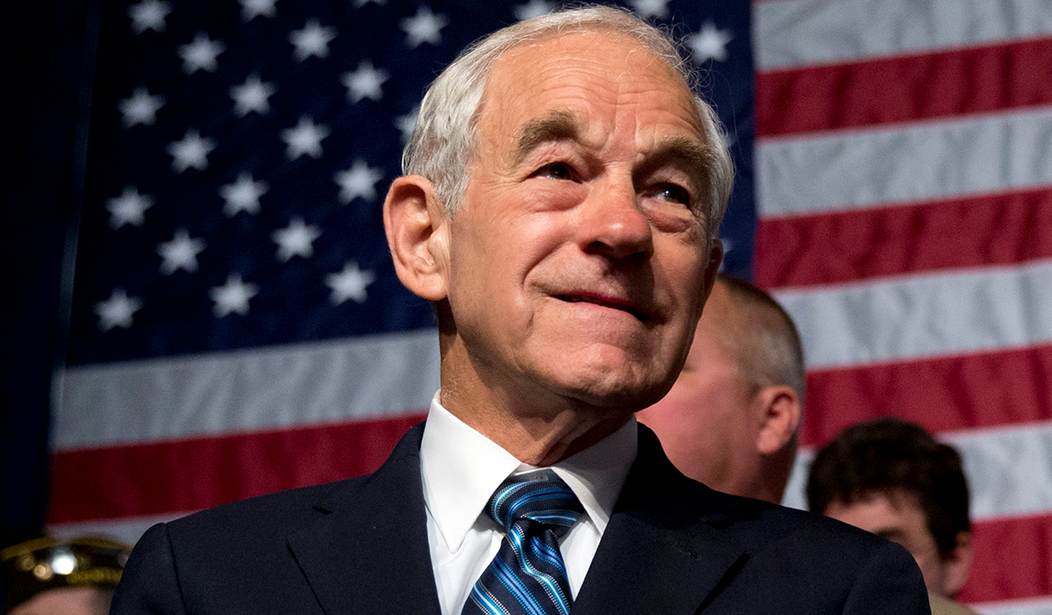
It’s starting to feel like we’ve seen this movie before. Back in 2008 and again in 2012, Ron Paul built entire presidential campaigns around the idea that the Republican Party had lost its way — that true conservatism meant clinging to a purist version of libertarian economics. Those vanity campaigns became minor cult movements, more concerned with ideological purity than with building a winning coalition. Now, looking at his son, Sen. Rand Paul, I’m starting to wonder if history’s about to repeat itself in 2028.
Rand Paul’s comments this week didn’t do much to calm my suspicion.
Appearing on ABC’s This Week on Sunday, Ron Paul’s son, Sen. Rand Paul (R-Ky.), used a question about the 2028 presidential race as an opening to launch a broader ideological critique of where he believes the Republican Party is headed.
Host Jonathan Karl noted that endorsements were already lining up for Vice President J.D. Vance, citing comments from figures like Marco Rubio, who told Vanity Fair that “if J.D. Vance runs, he’ll be the nominee, and I’ll be one of the first to support him.” Karl asked whether Vance had effectively become the GOP’s heir apparent.
ICYMI: Biden Sought Revenge Against Sinema With Partisan Investigation
Paul dodged the question and framed his response around the fight over the party’s philosophical core. “I think there needs to be representatives in the Republican Party who still believe international trade is good, who still believe in free market capitalism, who still believe in low taxes,” Paul said.
From there, Paul drew a sharp contrast between what he described as traditional conservatism and the party’s growing protectionist wing. He said the defining difference between conservatives and liberals once centered on spending restraint, not tax hikes.
“It used to separate conservatives and liberals that conservatives thought it was a spending problem, we didn’t want less revenue, we wanted less spending,” Paul said. “But now all these pro-tariff protectionists, they love taxes. And so they tax, tax, tax, and then they brag about all the revenue coming in. That has never been a conservative position.”
Paul made clear that he sees his role as pushing back against that shift, regardless of who ultimately leads the ticket in 2028. “So I’m going to continue to try to lead a conservative free market wing in the party, and we’ll see where things lead over time,” he said.
🚨New: Kentucky Senator Rand Paul was critical of VP JD Vance on ABC News
— The Calvin Coolidge Project (@TheCalvinCooli1) December 21, 2025
Paul: “I'm going to continue to try to lead a conservative free market wing of the party, and we'll see where things lead over time”
Jon Karl: “And that's not JD Vance”
Paul: “No”pic.twitter.com/VsutYljSCE
I’m reading between the lines, are you?
Paul has long been uncompromising and utterly convinced he’s the lone keeper of the conservative flame. But it’s also exactly the kind of rhetoric that turns a healthy policy disagreement into an identity crisis for the party. He says he’ll “continue to try to lead a conservative free-market wing in the party,” which is easy enough to dismiss as a senator talking shop. But if you squint, it starts to sound like a soft launch for a presidential campaign.
History offers a warning here. Rand Paul already tested the presidential waters once, in 2016. That bid went nowhere. The landscape in 2028 will look different with Trump off the ballot, though the end result may look familiar. Paul’s brand of politics remains a tough sell for the Republican mainstream. His ideological rigidity limits his appeal beyond a narrow slice of the electorate.
Like his father, Paul naturally attracts libertarians and libertarian-leaning conservatives. That bloc tends to view the GOP and Democrats as two sides of the same coin and can be easily convinced to sit out Election Day unless its preferred candidate tops the ticket.
That dynamic played out when Ron Paul ran in 2008 and again in 2012. If Rand Paul decides to jump back into the race in 2028, I fear history will repeat itself.
That’s what makes Rand Paul’s rhetoric alarming.
For all his talk about unity and conservative values, there’s a tone of separatism creeping into his message. We’ve seen what happens when Republicans eat their own in election years. It’s never pretty, and it always ends the same way. Rand Paul says he just wants to keep free-market conservatism alive. Fair enough. But it sounds like he wants to run, and if he does, I worry he will run the same kind of campaign his father did at the expense of the party.