





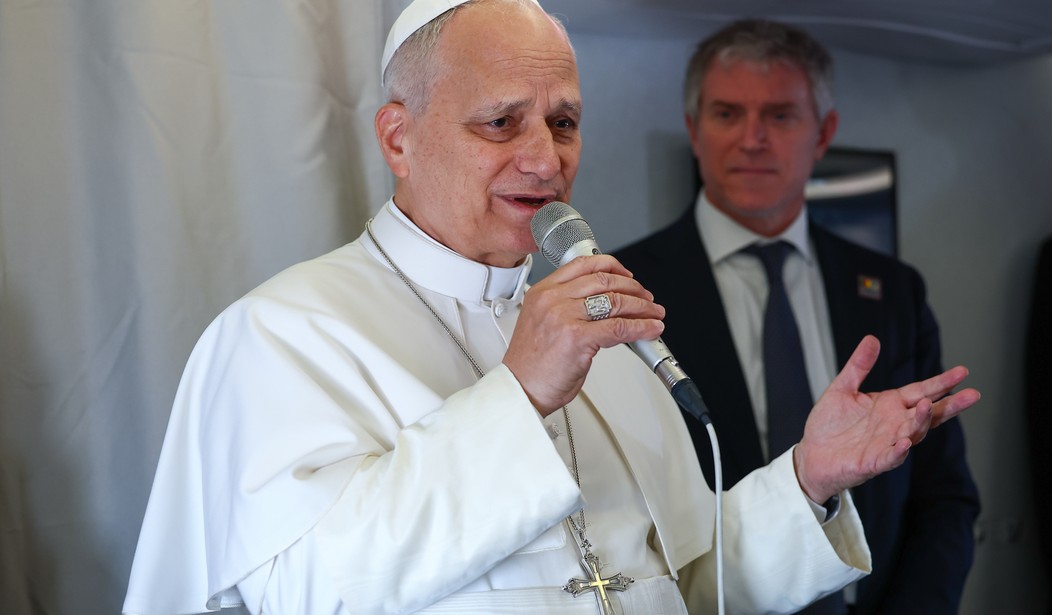
The current kerfuffle over President Donald Trump’s tweet war with Pope Leo XIV, aside from its secondary political considerations, has raised important questions about the legitimacy of the Catholic Church’s intervention in issues of public affairs.
The current Republican talking point is that the Pope should “stay in his own lane.” And it is true; the Catholic Church teaches that the pope should stay in his own lane, so to speak. But what is the official definition of his own lane?
In many ways, it comes down to the definition of two words that sound alike. Secularism, which the church opposes, and secularity, which the church endorses. The similarity of the words is unfortunate.
Secularism is a concept that, in many ways, emerged from the French Revolution. To this day, all churches in France are owned by the state, and religion in public life has been more or less sharply curtailed in varying ways over the last 250 years. God has no place in the public square. His presence is restricted to the four walls of your particular church building.
This radical French heritage has become part of the equally radical inversion of the concept that goes under the false title of the "separation of church and state" in the United States. The phrase is not in the Constitution but in a letter from the deist Thomas Jefferson to Baptists in Danbury, Conn. At the time, Jefferson had published a copy of the New Testament that excised all of Jesus’s reported miracles because he considered them made up. And oddly, Connecticut at the time had a state religion, Congregationalism, which lasted in some areas of the state until the 20th century.
The actual purpose of American religious freedom was to free religion from French-style state control and not to have a national religion. It was to ensure that the federal government could not ban the input or presence of religious institutions in national public life.
Today, issues around the Israeli-American war with Iran are in many ways identical to those used to launch the Iraq war: potential weapons of mass destruction, persecution of its citizens, etc. And they touch directly on the issue of a healthy secularity.
Documents issued in 2003 by the Congregation for the Doctrine of the Faith, under the future Benedict XVI, and an encyclical letter by Pope Saint John Paul II, Veritatis Splendor, are as relevant today as then in the just war debate.
The CDF document defined the healthy secularity that the church endorses in Doctrinal Notes on Some Questions on the Participation of Catholics in Political Life.
“6. The appeal often made to “the rightful autonomy of the participation of lay Catholics” in politics needs to be clarified. Promoting the common good of society, according to one’s conscience, has nothing to do with “confessionalism” or religious intolerance. For Catholic moral doctrine, the rightful autonomy of the political or civil sphere from that of religion and the Church – but not from that of morality – is a value that has been attained and recognized by the Catholic Church and belongs to the inheritance of contemporary civilization.”
So, in matters of war and peace, the church will tell leaders to negotiate seriously, but it does not tell them how to negotiate. On the other hand, no leader has the power or the right to determine his own “truth” in defiance of moral reasoning.
Secularity is essential to the common good. The church doesn’t tell politicians or businessmen what the best solution to a problem is or how to run their business. But if they defy the common good by violating the moral law, it is the duty of church leaders to speak up. Going to church on Sunday and lying and cheating on Monday don't balance the scales in your favor.
A new document on this issue has just been released: U.S. Bishop Chairman on Doctrine Issues Clarification on Just War Theory.
A theologian friend has summed it up succinctly. “Since being attacked and responding in self-defense is the first principle of just war doctrine, a so-called preemptive war is by definition 'unjust.' It is a yes-or-no question: 'Who attacked whom?' Therefore, it is not a matter of nuance... This is precisely the kind of logic, of balancing goods, or good intentions, which John Paul II condemned in Veritatis Splendor."
“President Trump is not a Catholic, so the expectation of him appreciating all this as Catholics *should* is probably too much to expect. He does want peace, and to prevent greater tragedies down the road, as should we all. As an American and a veteran I happily support him in his efforts, both to the defang an evil regime and to do so without World War III or destroying individual civilizations along the way.”
Related: Obama’s Strategist David Axelrod Met With the Pope: What Did They Talk About?
In a nutshell, the ends never justify the means. In many ways, preemptive war is just a fancy euphemism for aggression. And the fact that many Catholics in the military understand that evil means can not be used even toward what some consider a just end, there appears to be an unprecedented surge in filings for conscientious objector status.
This has happened before. In World War II, a friend’s father did this when he was commanded to bomb civilian cities in Germany, which he viewed as a war crime and against his Catholic faith. His request was granted. It was a heroic stand.
Join PJ Media VIP today and get 60% off with promo code FIGHT. Join now to support this news site, go ad-free, and comment as you see fit.
Join the Conversation
VIP members get the ability to comment on articles.