





Glad greetings! Happy Wednesday, Sept. 30, 2026. Fall's had a full week to settle in now, so no more excuses about not knowing where you left the sweaters. It’s been getting down into the 30s around the Florack Word Ranch the last few days. Bit warmer today, though.
My calendar says it's Ask a Stupid Question Day, International Translation Day, National Chewing Gum Day, and National Hot Mulled Cider Day. Ask the question you've been embarrassed to ask, thank a translator for keeping the world talking to itself, chew some gum, and warm up with a mug of cider — today's the last day of September, so make it count before the calendar flips.
Today in History:
1777: The Continental Congress, fleeing advancing British forces, relocates to York, Penn.
1791: Mozart's opera The Magic Flute premieres in Vienna.
1846: Boston dentist William Morton uses ether as an anesthetic for the first time, extracting a tooth from merchant Eben Frost.
1868: The first volume of Louisa May Alcott's Little Women is published.
1882: The Vulcan Street Plant in Appleton, Wisc., becomes the first hydroelectric power plant in North America to serve private and commercial customers.
1889: Wyoming's state constitutional convention approves a constitution granting women the right to vote.
1938: A day after signing the Munich Agreement, British Prime Minister Neville Chamberlain returns home declaring he has secured "peace for our time."
1946: An international military tribunal at Nuremberg finds 22 top Nazi leaders guilty of war crimes.
1949: The Berlin Airlift officially ends after delivering more than 2.3 million tons of food, fuel, and supplies to a blockaded West Berlin.
1954: The Navy commissions the USS Nautilus, the world's first nuclear-powered submarine.
1955: Actor James Dean is killed in a car crash near Cholame, Calif., at age 24.
1962: James Meredith enrolls at the University of Mississippi under federal escort, becoming the school's first black student.
1981: Sandra Day O'Connor is sworn in as the first woman to serve on the U.S. Supreme Court.
Birthdays Today include: Truman Capote, author of In Cold Blood; Deborah Kerr, actress from The King and I; Elie Wiesel, Nobel Peace Prize laureate and author of Night; and Johnny Mathis, singer known for "Chances Are" — if today's your birthday, too, happy birthday.
* * *
I swear, if I have to sit through another lecture from the socialist Left about “the rich paying their fair share" — the word “postal” comes to mind. Leaving aside what exactly constitutes a ‘fair share,” which they never actually pin a value on, of course. The rich already pay the majority of federal and state taxes, but this never gets mentioned.
But let’s examine this from the standpoint of a radical thought experiment.
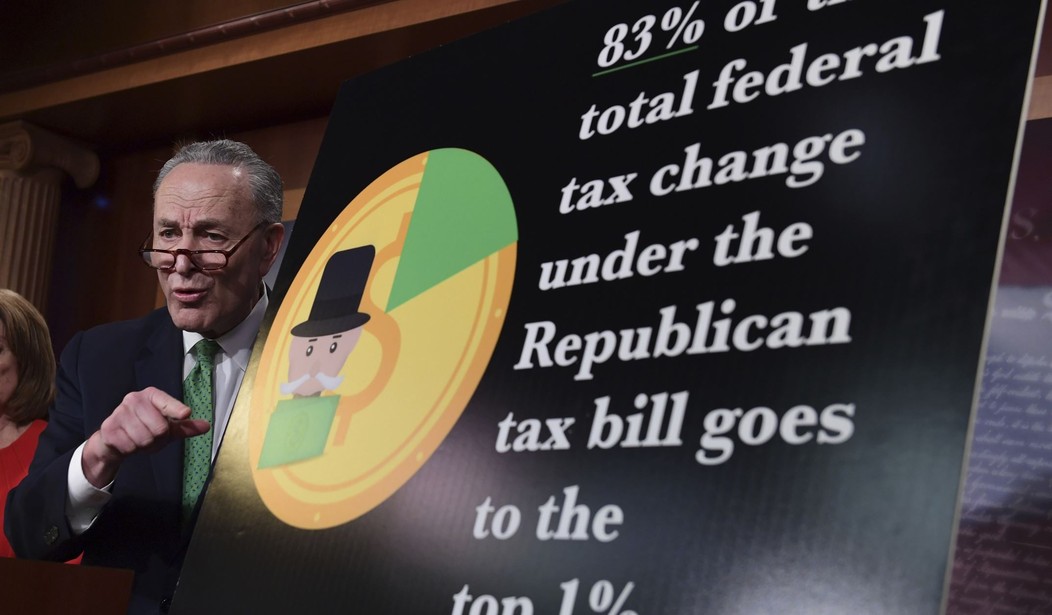
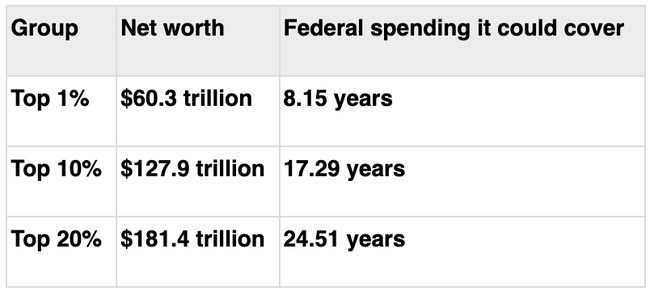
Let's consider the net worth of three groups of people here in the U.S.: the top 1%, the top 10%, and the top 20%. We aren’t talking about income here; we’re talking about standing wealth — the kind Bernie Sanders and Chuckles Schumer make their own millions endlessly railing about. Take all these Americans' net worth. Not a percentage of it — take all of it. Every last penny.
Now, how long would the federal government survive on those funds?
I'm using the Federal Reserve's latest Distributional Financial Accounts (Q2 2026) and the CBO's current projection of $7.4 trillion in federal outlays for FY2026. The Fed puts total household and nonprofit net worth at $195.87 trillion. Using this as a baseline, let’s project how long confiscating all that wealth, every penny of it, and directing it to the federal treasury would keep the government afloat. We’ll take that Q2 2026 household net worth and toss it into the projected FY2026 federal outlays of $7.4 trillion.
 Sounds ideal, doesn't it?
One trouble with that conclusion is that historically, whenever there's been an influx of cash into the federal coffers, spending has grown to swallow it, and then some. A good example of this is the Democrat-run House under Ronald Reagan.
Here's what actually happened back then, and I know all of this because I lived through it and wrote about it, both at the time and since.
As the economy boomed in the mid-1980s, federal revenue rose sharply, up 65% by 1989 from where it stood when Reagan took office, largely from real economic growth rather than new taxes. If the "more revenue solves the problem" theory held, that windfall should have narrowed the deficit on its own. It didn't.
Federal spending rose 69% over the same stretch, edging out even that historic revenue surge, with a Democrat Party that controlled the chamber for the entirety of Reagan's presidency consistently pushing spending above what he requested. Reagan wanted the growth of government reduced. The Reagan White House wrote budgets for eight years designed around that goal. Congress had other ideas, and Congress, as it always does, wrote the checks. Every single one of Reagan’s budgets was DOA at Capitol Hill despite Congress's promises to curb spending. They ended up spending around $1.65 for every dollar of increase that Reagan’s policies brought in. Had they actually curbed their spending habits, there would have been no deficit by the end of Reagan’s second term. I hasten to add that the Democrats have been pointing a finger at Reagan ever since those days, rather than placing the blame where it belongs — and far too many swallow their blame game. It never fails.
But let's say the Far Left goes through with the idea. As Alvin Lee once wrote, in the Ten Years After hit "I'd Love to Change the World," "Tax the rich, feed the poor, 'til there are no rich no more." The implied question becomes, "Then what? What happens when that cash influx dries up?"
If a thus-expanded government becomes dependent on spending at a level that could only be sustained by continually consuming accumulated private wealth, even absent any other factors (there are many, all of which make the problems worse), it would eventually confront a shrinking private capital base and a tax base made up of lower-income folks like you and me, who could no longer support its spending habits.
What would the Federal Government do at that point?
Borrow. The Treasury could issue debt to keep spending going. But borrowing doesn't create wealth; it transfers resources from lenders to the government today in exchange for future claims on taxpayers. If the tax base had already been heavily depleted, lenders would eventually demand higher interest rates or stop lending, probably both.
Tax the remaining population more heavily. Once the targeted wealth was exhausted, the government would have to draw increasingly on wages, business income, consumption, property, and whatever other taxable economic activity remained, which, by that point, comparatively wouldn't be much.
Print money. The government could ultimately rely on monetary financing. That doesn't make the resources magically appear, either. If government spending substantially exceeded the economy's capacity to produce goods and services, the likely consequence would be inflation, and under sufficiently extreme circumstances, potentially monetary instability.
Since you can't confiscate the goose and still expect egg production, eventually there will need to be spending cuts, no matter what other steps are taken, because government gets its income from production. None of the other steps I've mentioned will substitute for it.
I guarantee you that I will be getting mail that says they’d never try that confiscatory nightmare. Given the rhetoric we're seeing from the Left, I’m not so sure of that. But perhaps more importantly, anything less than doing that will not have the beneficial effect the Left claims, even in the short term. Kinda hard to hide behind a crashing economy. The longer-term scenario would be even worse, because the move wouldn’t create a permanent source of revenue. Once that initial burst of income is gone, there’s no replacing it. And guess who has to pay to keep the now much larger government afloat? That’s right, you and me.
Can't you hear them now? "Hey, I thought someone else would pay for it."
So, the next time some bleary-eyed DSA member starts in with this ‘tax the rich’ nonsense on social media, show them this. I’ll guarantee you they’ll block you and so you won’t have to deal with you any longer.
Exclusively for our VIPs: The ‘Repressed’ Churchgoing Couples Seem to Be Doing Just Fine
= = =
Thought for the Day: Chamberlain came home promising "peace in our time" the day after signing away someone else's country — proof that the easiest deals to celebrate are usually the ones somebody else pays for. Which drives a lot of the “tax the rich” nonsense.
VIP members: It’s time for you to add your wisdom to the mix in the comment section. I say without hesitation, I have been genuinely pleased to note such in the comment section lately. And I thank you for it. Without a doubt, I have some of the smartest readers I know of.
Take care, gang. Make the most of today, but make sure you’ll be around for tomorrow. I’ll see you here then.
Editor’s Note: Thanks to President Trump’s leadership and bold policies, America’s economy is back on track.
Help us continue to report on the president’s successes and combat the Democrats' lies about America's economic revival. Join PJ Media VIP and use promo code FIGHT to receive 60% off your membership.


Join the Conversation
VIP members get the ability to comment on articles.