





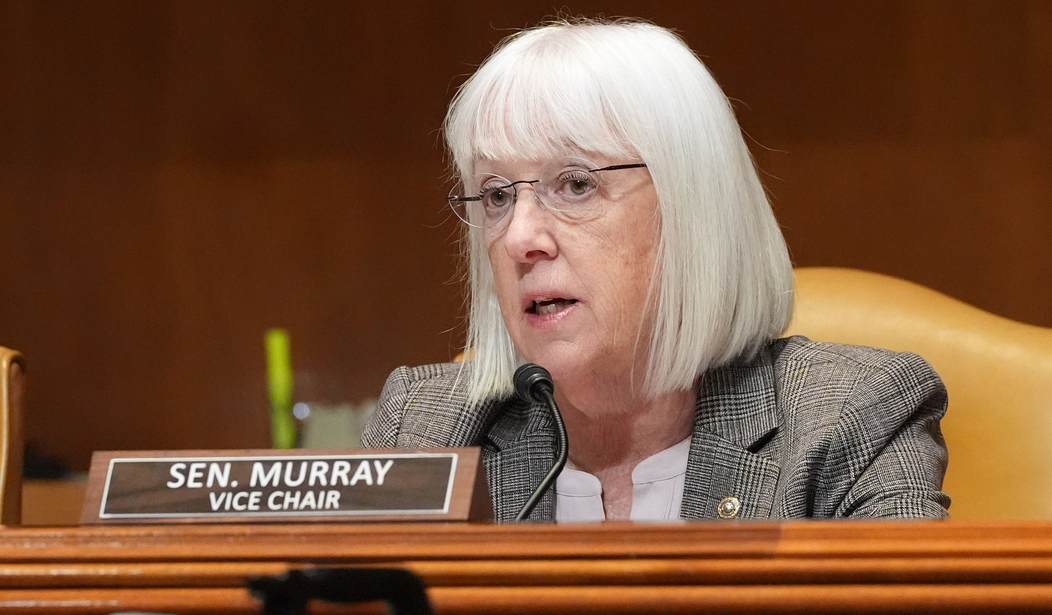
Is it my imagination, or are those moments becoming more frequent when some prominent national leader utters a statement so disconnected from facts and logic that all you can do is shake your head in disbelief? Consider this recent gem from Sen. Patty Murray (D-Wash.):
"REMINDER: The single biggest driver of our national debt for the last 25 YEARS has been Republican-led tax cuts." This tweet appeared on X on August 21, not long after the Treasury Department announced the national debt had hit $40 trillion.
Murray is the Ranking Member on the Senate Appropriations Committee, and she has been in the Senate since first being elected to it in the 1992 election. She served in the Washington state legislature before coming to Capitol Hill. She is a 1972 graduate of Washington State University with a BA in Physical Education.
The senator is not stupid, but there it is: Note the unstated presupposition underlying the claim that cutting taxes forces the national debt to increase only makes sense if the speaker assumes that you don't own your private property, including the money you earn on the job.
No, the government owns your private property, including especially the money you are paid for working. You only have it because the government doesn't confiscate all of it. When the government reduces your taxes, that's a gift to you, not the obligatory return of your property to its rightful owner.
But that's only the opening fact. If only Murray had read these facts published by Just Facts Daily, the basic point of which ought to be known by every senator:
- Since 1960, federal revenues in every decade have averaged 17% to 19% of the U.S. economy with no upward or downward trend.
- In contrast, federal spending has risen from 18% of the U.S. economy in the 1960s to 24% over the most recent decade with a definitive upward trend and a spike to 31% during the Covid-19 pandemic.
- Over the same period, federal spending on social programs has risen from 21% of all federal outlays in 1960 to 60% in 2024 with a steep upward trend and a spike to 74% during the Covid-19 pandemic.
Put another way, federal revenues — the measure of private property taken by the government in the form of taxes, fees and related charges — have been remarkably consistent for more than seven decades, even as federal expenditures have blasted upward from representing 18% of the U.S. economy to 24%.
And the key driver of federal spending is not defense, but entitlement benefits and social welfare outlays. And, as JFD makes so clear, even a TDS-obsessed Washington progressive can, with just a little concentrated thought, grasp it:
- Social programs — which provide healthcare, income security, education, nutrition, housing, and cultural services — are mostly mandatory programs in which spending continues indefinitely unless Congress and the president pass new laws to change the status quo.
- Thus, the Congressional Budget Office projects that even though taxes will remain above the historical average for the coming decade, increased spending on mandatory programs and interest on the debt will cause the national debt to grow “well above the previous record.”
- In total, social programs and interest on the national debt currently account for about 76% of all federal spending.
And there is the additional fact that distinguishes entitlements like Social Security, Medicare, and federal employee pensions: the government promises, promises, promises but doesn't reserve the assets required to fund those promises.
As this space reported last week, the real national debt is not "merely" $40 trillion; it is $170 trillion:
"Truth in Accounting’s analysis of the most recent audited Financial Report of the U.S. Government found its overall financial condition worsened by $11.6 trillion in 2025. The mounting debt burden of $170.3 trillion represents the total benefits promised to citizens, yet the federal government has no clear idea where the money will come from to pay for them. This staggering debt translates to a $1.1 million liability for every federal taxpayer, resulting in the federal government receiving a failing grade for its fiscal health."
Murray didn't cite a source for her claim that tax cuts are the main driver of the increasing national debt, but JFD suspects it came from a 2024 report from the Committee for a Responsible Federal Budget (CRFB).
Apparently, neither Murray nor her staff bothered to do a little digging to determine if there were significant problems with the study. For starters, the CRFB study "places all tax cuts into one bucket while splitting the added spending into three buckets." That led to these flaws:
- When all of the spending is placed into one bucket, the study shows that added spending accounted for 61% of the growth in debt from 2021 to 2023, while tax cuts accounted for 37%.
- More importantly, the study states that the figures above don’t account for the “effects of the built-in spending growth in certain parts of the budget, while it takes for granted the built-in growth in revenue.”
- That methodology overstates tax cuts by ignoring the effects of bracket creep, and it understates added spending by excluding the soaring growth of mandatory social programs.
Even worse for Murray, the CRFB study offered this observation:
Putting aside the study’s methodology, it still conflicts with Murray’s claim that “Republican-led tax cuts” are to blame for the debt, because the study states that “77 percentage points of debt-to-GDP can be explained by legislation with some meaningful level of bipartisan support,” “while highly partisan Democratic actions explain 12 percentage points, and highly partisan Republican actions explain 8 percentage points.”
Maybe after 34 years of repeating talking points over and over, it's time to call it quits and make way for a new Washington state senator capable of genuinely critical thinking. But that's just me.
Editor's Note: Do you enjoy PJ Media's conservative reporting exposing the radical left and woke media? Support our work so we can keep bringing you the truth.
Join PJ Media VIP and use promo code FIGHT to receive 60% off your membership.



Join the Conversation
VIP members get the ability to comment on articles.