Hard to believe it's been a year already.
I found this in an op-ed by Jeff Reynolds at Restoration News this morning. And therein lies an observation worth considering:
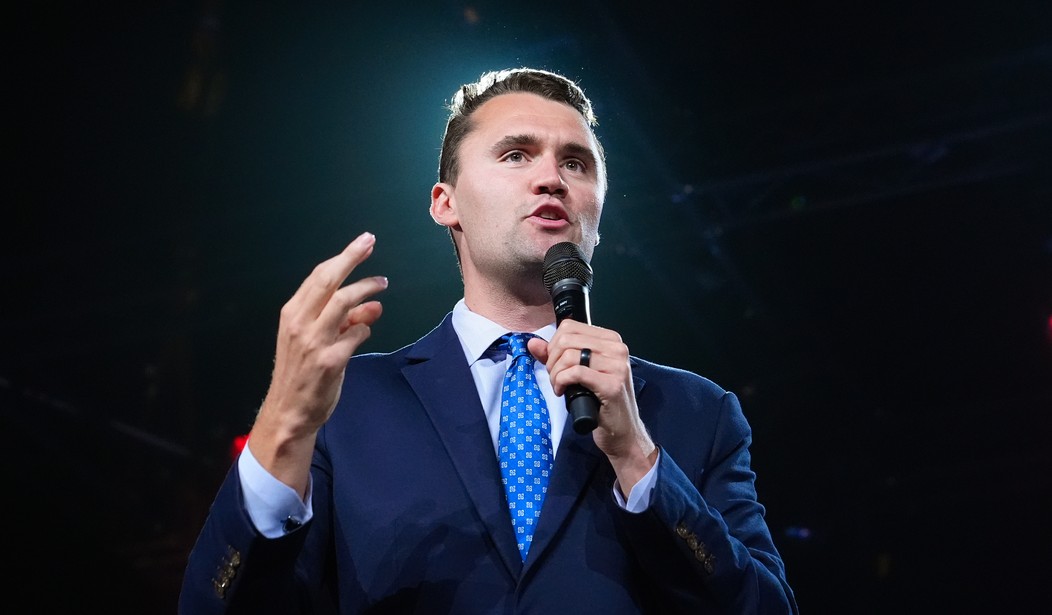
It's difficult to separate the tragedy that occurred from the caricature of how it appears in modern society. But what is fundamentally true is this: America witnessed the public murder of a 31-year-old political activist who professed his Biblical worldview and his faith in Jesus Christ. The murderer acted out of hatred for Charlie's fundamental right to profess his deepest beliefs.
The very fact that the discussion continues on the legacy of Charlie Kirk indicates the scope of his lasting impact on America. And while certain demonic forces celebrate his death and dance on his grave, the far larger impact shows up less often in the news or social media: explosive growth in membership in the organization he founded, and a surge in Christian conversions among young people.
Indeed so.
(You can read the full op-ed here.)
But now we come to the grave dancers themselves. I was hardly alone in the days following Charlie's assassination in noticing something rather striking about many of the people celebrating his death. Collectively, they looked and sounded as though somebody had spiked the punch bowl at Studio 54 with a rather inventive substance. And similarly, the shooter himself and his roommate. Somehow, this was supposed to represent mainstream America.
It didn't, of course. Not remotely.
These weren't ordinary Americans gathering in some spontaneous expression of national grief. They weren't even people making a reasoned political argument about a public figure with whom they disagreed. They were celebrating the murder of a 31-year-old man whose great offense, apparently, was having the temerity to say things they found politically, culturally, and religiously unacceptable. That distinction matters.
There is nothing particularly unusual about disliking a political activist. America was built, in part, on the proposition that we are free to dislike one another's politics with considerable enthusiasm. You can despise someone's opinions. You can ridicule his arguments. You can campaign against him. You can call him a fool, a fraud, an extremist, or worse. What you cannot reasonably call normal is celebrating his assassination.
And yet, for some, that was precisely the reaction. The spectacle was revealing not merely because of what they said, but because of the sheer glee with which they said it. There was something almost carnival-like about some of the celebrations: the costumes, the theatrical posturing, the shrieking, the dancing, the grotesque displays of triumph. It was less like a political movement making an argument and more like a particularly deranged street festival celebrating the elimination of a political enemy.
The effect was almost surreal. Imagine trying to explain to someone from another country that this was supposed to be the respectable, enlightened, tolerant side of American politics. You'd have a hard time keeping a straight face.
America saw people who claimed to champion tolerance celebrating intolerance. It saw people who constantly lecture the rest of us about violence celebrating the violent silencing of someone with whom they disagreed. It saw people who insist that political disagreement requires empathy suddenly discovering that empathy has an expiration date — specifically, the moment the dead man happens to be conservative, Christian, and worst of all, effective. And it saw something else that may ultimately prove even more consequential: These people apparently believed that they were the normal ones. That's the part that should concern anyone paying attention.
They seemed genuinely astonished that the rest of the country wasn't joining the party. They had mistaken their particular corner of the internet, their activist enclaves, their university bubbles, and their media ecosystem for America itself. They mistook being surrounded by people who think exactly as they do for being part of a national consensus.
Then Charlie Kirk was murdered, and the mask slipped. Suddenly, millions of Americans were given an unfiltered look at a political subculture that had spent years lecturing them about compassion, tolerance, diversity, and civility. And the picture wasn't exactly Norman Rockwell. It was more like Norman Rockwell after being locked in a room with a bottle of absinthe and a screen permanently tuned to TikTok. The irony is almost too perfect.
Kirk spent his career arguing that young Americans had been taught to hate their own country, their own traditions, their own history, and increasingly their own religious inheritance. His opponents insisted that he was the dangerous one.
Then, when he was murdered, some of them celebrated. Oh, sure — not all of the left, obviously. Not remotely. There were Democrats and liberals who condemned the assassination, expressed sympathy for Kirk's family, and understood the basic moral distinction between opposing a man's ideas and celebrating his death. But the people who chose to dance on his grave did something that may prove extraordinarily difficult for the broader political left to undo.
They made themselves visible. And visibility matters. I can't think of anything that has caused the left more long-term damage than that.
For years, the American left has benefited from a remarkably effective public-relations arrangement. Its most radical elements could say or do outrageous things, while respectable voices insisted that those people were merely misunderstood, fringe, or somehow unrepresentative. But there is a problem with that defense when the fringe starts holding the parade. The grave dancers supplied the imagery themselves.
Nobody had to caricature them. Nobody had to invent some sinister propaganda poster. Nobody had to manufacture their contempt. They put it on display, and in full color, no less. With a full orchestral score. And dancing.
The tragedy is that Charlie Kirk's murder was supposed to silence him. Instead, it appears to have done something else entirely. It turned the spotlight around.
The man lying dead became, paradoxically, less visible than the people dancing around him. And what those people revealed about themselves may ultimately have done far more damage to their cause than any speech Charlie Kirk ever delivered.
Because Americans who might never have listened to Charlie suddenly had a reason to ask why anyone would celebrate his murder. Americans who had never cared much about Turning Point USA suddenly had a reason to look at what Charlie had built. Young people who had been told that Christianity was obsolete suddenly had a dead young Christian man whose faith had become the very thing his enemies hated about him.
That's a rather spectacular failure for the people who thought killing Charlie would make his ideas disappear. History has a nasty habit of doing that. Martyrs don't always disappear. Sometimes they become symbols. Sometimes their deaths expose their enemies. And sometimes the people dancing on the grave inadvertently become the best recruiting tool their supposed enemy ever had.
Which brings us back to those dancers. I can't imagine the political left deliberately commissioning a more damaging portrait of itself.
We've been told for years that conservatives exaggerate the extremism of the modern left. We've been told that the radicals are merely a tiny fringe. We've been told that the increasingly bizarre rhetoric, the contempt for Christianity, the hostility toward traditional America, and the willingness to excuse political violence are all just isolated incidents.
Perhaps.
But when the cameras came on after Charlie Kirk's assassination, some of those supposedly isolated incidents began to show up in the public eye. And that is an image that doesn't wash away easily. The left may eventually come to understand that.
Well… maybe. But I doubt it.
Now that some of the dust has settled, listen closely, and you'll notice that the grave dancers are proof of exactly why what Charlie was saying needed saying.
The action that some believed would silence a point of view did the opposite. It's true, we're seeing stories and editorials questioning the future of Turning Point itself, but not the values that Charlie himself championed. Which may be why so few leftist outlets are even daring to comment on the anniversary of his assassination today.
Recommended: 'Trust Us, We're Normal Now' — and Other Punchlines