I have to admit, I've always been into things radio. As I was growing up, through the 60’s, we had a shortwave radio in the house, one that Lafayette sold as a kit back in those days. I was forever hooked. I spent hours listening to outlets like the Voice of America, HCJB from Brazil, the BBC’s foreign service, and so on. I was fascinated with the idea that I could pick up signals directly from so far away using a hunk of wire in the attic.
I started in CB (citizens band radio) back in the early ‘70s, and went on from there to a broadcast career (while still running CB). Then, a few years back, I decided to get into ham radio (aka amateur radio). As it stands now, I've been on the air in one form or another for about 50 years.
Now, getting your ham license means taking a test. Understand, here in the United States, as in most countries, amateur radio is federally licensed. For the last several years, there have been three separate classes of license: Technician, General, and Amateur Extra. Each level has its own set of frequencies and modes that you are allowed to transmit on.
If you pass the test, you get your license — once Washington gets things processed. And yes, I have my federally issued license on the wall of my radio room (my “shack,” in ham radio parlance). When I went through the process of getting it, I started at the Technician level, which is the lowest level. A beginner’s license, if you will.
Funny aside: I was able to do that because I’d suffered a broken arm a few days before, and I was unable to work. The guy who administered the test actually checked my arm sling to make sure I wasn’t hiding answers.
The test involves questions about electronics theory, rules and regulations, and practical operating skills. The questions at each license level are increasingly difficult and technical as you go higher.
I held my Technician Class license for about a year and then went to test for the one I hold today, a General Class license. In the last four years, I have made contact with about 7,000 different stations. I’ve “worked” stations in all 50 states, all the provinces of Canada and Mexico, and 182 other countries around the world.
You might ask: Doesn’t that require very high-power transmitters with huge antennas? Well, no. I’ve never had a transmitter that had more capability than 100 watts. And my big antenna is a vertical shaft around 30 feet tall.
I hear you asking: “Isn’t that like CB?” Well, yes, and no.
With CB, you are limited to 40 different channels at the fairly low transmission power of four watts. While distant communication is occasionally and conditionally possible, you’re usually limited to about 10 to 20 miles’ worth of range. You’re also limited to voice communications. Also, there’s no license required.
With amateur radio, you have a much wider range of frequencies and many different modes of operation. Not only are voice and Morse code available, as well as video modes, but there is a plethora of digital modes, most of which have only been developed fairly recently. But of course, you’re required to be licensed.
Let’s watch this video, which can explain a lot for you:Larry, WD0AKX, gives us a nice demonstration of what operating on the shortwave bands is like:
Obviously, Larry’s got a hell of a setup. But understand: He’s been building this system for years. I notice, for example, a police scanner on his desk. I have an identical one here, and it’s around 30 years old.
One of my favorite modes is the highly computerized FT8. This is a very narrow-banded and highly structured communication mode that is based on the protocols used to communicate with the Voyager Probes. You can make contacts in that mode that you’d not be able to make in any other mode. The reasons are pretty technical why this is so effective, but I can explain.
Imagine trying to pop a balloon with a magic marker, a thick one. Now, imagine trying to pop that same balloon with a pin. Obviously, you’d have a much easier time using the pin, wouldn’t you? That’s because all your power is focused on one spot. FT8 is a very narrow-banded mode, which pretty much sounds like a single tone. The variations in the tone are very slight, small enough that humans generally can’t hear it working, but your computer can.
Personally, I run a very computerized setup. But as I've said, I spent years supporting computers for a living, so it's kind of a natural extension of that. But a computer background is not a requirement.
As the first vid explained, there are whole bunches of activities you can take part in that fall under the umbrella of ham radio. Emergency communications during times of crisis, for example, such as during tornadoes and hurricanes. Times when nothing else — your cell phone, your land line — can’t get through, ham radio can. In many areas of the country, hams are highly respected for their abilities and dedication to getting messages through.
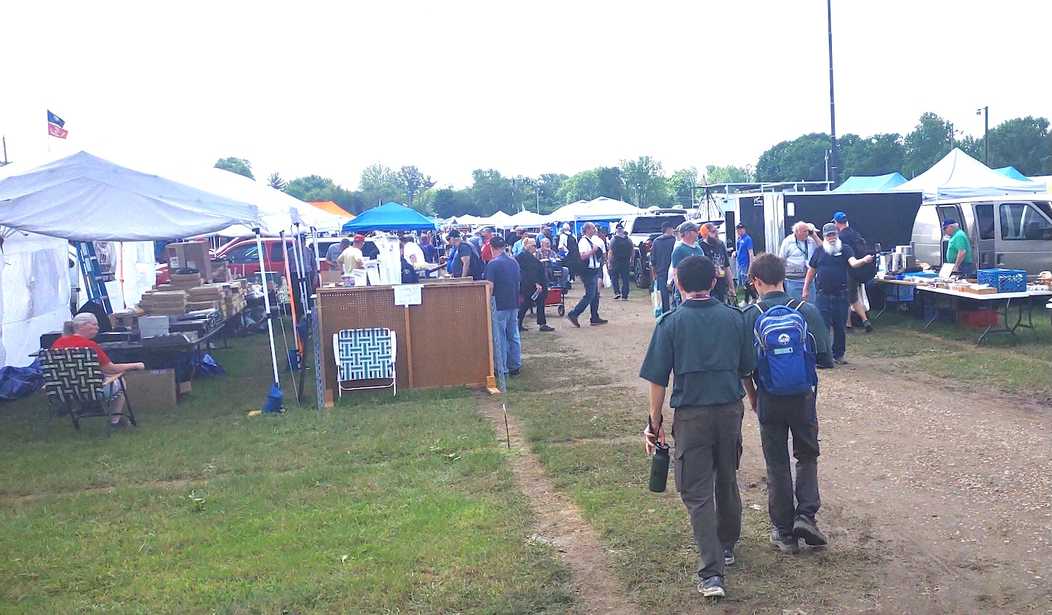
Then there are the ham fests, which are basically hams getting together for conferences, award ceremonies, food, friends, and just plain fun. The biggest is the annual Dayton Hamvention, which is now held at the Greene County Fairgrounds in Xenia, Ohio. Last May’s attendance there was around 36,000 people from literally all over the world. That’s like an entire small city moving to Xenia at once. The picture at the top of this page was taken at the Xenia gathering.
I mentioned earlier this week something I call “Fox Hunting.” Essentially, the game is to set up a low-power transmitter someplace, then everyone uses directional equipment to try to find the signal. This can be quite a challenge.
There are contests almost every weekend, where you try to gather as many contacts as you can in a specified period, usually limited to a specific band or mode
You can talk to astronauts; you can bounce your signals off the moon. You can run your signal through satellites. There are hams who get a kick out of working from various parks with very temporary setups.
How much does a station cost? Well, a lot of that depends on what you want to do. My own station cost around $3,000 when all the stuff, big and small, is accounted for. But keep in mind, that’s over a period of about five years, and once you get it, it's yours. A technician can start out with a handie talkie for between $30 and $100. That’s what I did.
These days, I often think about that seven-year-old kid listening to the old kit shortwave radio, as I operate my station today. I get a charge out of making radio contact using less power than your porch light.
There was magic in the air, in those days.
And you know what? There still is.
Related: The Anti-ICE Signal Chat Group Is Discovered, So It Moves to (Illegal) Ham Radio? Ummmm, Yeah.