





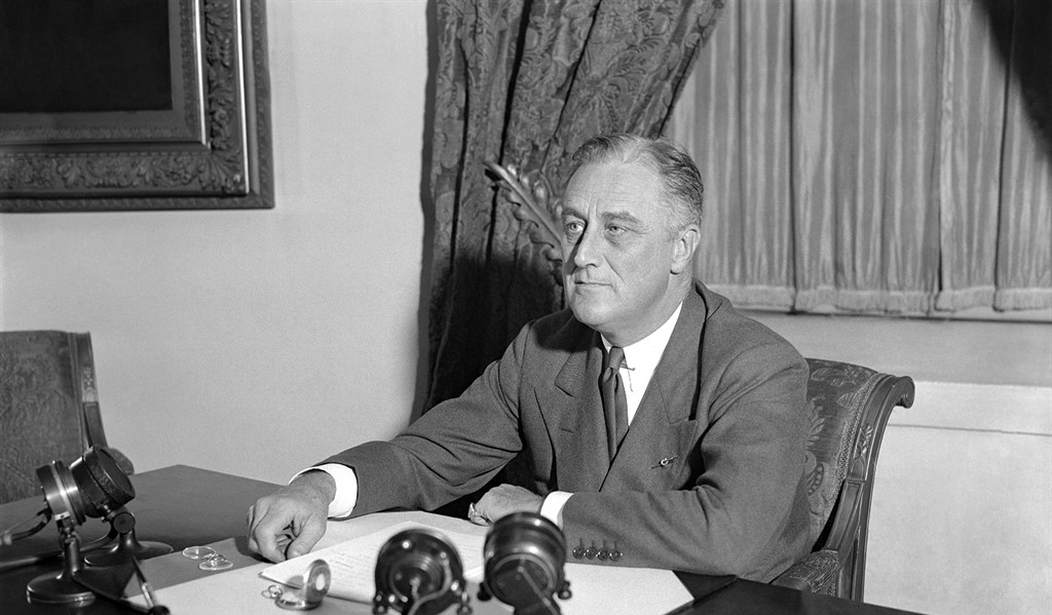
Franklin Roosevelt sat down on Aug. 14, 1935, and signed the Social Security Act into law. Ninety-one years later, it's hard to name a federal program that has touched more American lives.
Roosevelt had taken the helm of the country in 1932 in the midst of the Great Depression, the nation’s worst economic crisis. The Social Security Act (SSA) was in keeping with his other “New Deal” programs, including the establishment of the Works Progress Administration and the Civilian Conservation Corps, which attempted to hoist America out of the Great Depression by putting Americans back to work.
In his public statement that day, FDR expressed concern for “young people [who] have come to wonder what would be their lot when they came to old age” as well as those who had employment but no job security. Although he acknowledged that “we can never insure one hundred percent of the population against one hundred percent of the hazards and vicissitudes of life,” he hoped the act would prevent senior citizens from ending up impoverished.
Although it was initially created to combat unemployment, Social Security now functions primarily as a powerful safety net for retirees and the disabled, and provides death benefits to taxpayer dependents. The Social Security system has remained popular and relatively unchanged since 1935.
Retirement planning, survivor benefits, disability protection, and the finances of millions of families now run through a system born from that signature.
The Social Security Administration now sends roughly 75 million payments each month, totaling about $1.6 trillion a year. Workers fund Social Security from every paycheck, employers match the payroll tax, and retirees organize their lives around the benefits they were promised.
In addition to paying benefits, the agency issues millions of Social Security numbers each year, maintains the wage records of workers, and more. The scope of what SSA does is enormous, and we are proud to serve the American people every day.
Over the past year, the agency has made historic progress in customer service, digital transformation, and fraud prevention, delivering on a promise to protect and strengthen Social Security for all Americans. Our service delivery improvements include:
- Reducing the National 800 Number average speed of answer from 34 minutes in 2024 to 8 minutes to date, a 75 percent reduction.
- Completing 385 million online transactions FY 2026 year to date (YTD), a 37 percent increase from 2024.
- Shortening field office wait times by 30 percent.
- Reducing the initial disability claims backlog by over 30 percent, from a high of nearly 1.3 million in 2024 to 853,000; and decreasing disability hearing wait times over 90 days to 266 days FY 2026 YTD, reaching historic lows.
- Saving $16 billion with a better control environment.
Whatever anyone thinks about FDR or the New Deal, Social Security became part of the basic financial structure of American life.
Here's the part that Washington would rather talk about after the next election: the Old-Age and Survivors Insurance Trust Fund is projected to exhaust its reserves in the fourth quarter of 2032. When that happens, continuing revenue would cover only 78% of scheduled retirement and survivor benefits. The date moved one quarter closer in the 2026 trustee report.
Social Security won't disappear in 2032; payroll taxes will still arrive. But telling a retired couple that Washington can send only about 78¢ of every scheduled benefit dollar isn't much comfort after they spent decades paying into the program.
Independent federal projections also put exhaustion of the retirement fund in 2032.
The warning is hardly new. Senate Finance Committee Chairman Mike Crapo (R-Idaho) said at a recent hearing that the last comprehensive effort to restore Social Security's solvency was the bipartisan 1983 reform.
United States Finance Committee press release:
Social Security provides critical benefits to millions of seniors, individuals with disabilities and their families.
For many Americans, it is the cornerstone of retirement security. It also provides vital support to workers who can no longer earn a living due to a severe injury or illness, and to families who have lost a loved one.
For decades, the Social Security Board of Trustees has recommended that Congress act quickly to address the program’s long-term financial challenges. According to the Trustees’ latest projections, the Old-Age and Survivor’s Insurance Trust Fund will be exhausted in late 2032. If Congress fails to act before then, incoming program revenues will be sufficient to pay only 78 percent of promised benefits.
Congress has a responsibility to protect and strengthen Social Security for current beneficiaries and future generations. The longer we wait, the more difficult this challenge will become.
The last comprehensive effort to improve Social Security’s solvency took place over 40 years ago and culminated in the Social Security Amendments of 1983. Those reforms were preceded by high-level bipartisan negotiations, informed and facilitated by the work of the National Commission on Social Security Reform, or what was known as the ‘Greenspan Commission.’ That process demonstrated the value of creating a forum where policymakers could work through difficult issues and build consensus on a bipartisan basis.
More than two decades later, I participated in another bipartisan effort to develop recommendations to address our nation’s long-term fiscal challenges, along with Senator Dick Durbin, the Democratic co-author of one of the process bills that will be discussed today. As part of its work, the National Commission on Fiscal Responsibility and Reform, often referred to as the Bowles Simpson Commission, developed a bipartisan Social Security solvency plan. While the Commission’s recommendations ultimately did not receive the support necessary to move forward, its work has informed subsequent Social Security solvency discussions.
As Social Security approaches a pivotal moment, Members of Congress have proposed a variety of process reforms designed to facilitate bipartisan discussions and help develop lasting solutions. Today's hearing will examine those approaches and consider what lessons can be drawn from past efforts.
Congress has known for years that today's math doesn't work forever; it has simply found more political value in warning voters about the other party than in settling the problem.
President Donald Trump marked today's anniversary by promising to defend Social Security and protect seniors.
Today, our Nation commemorates 91 years since President Franklin D. Roosevelt signed the landmark Social Security Act into law. For more than nine decades, this program has stood as a fundamental promise at the heart of American life, guaranteeing that the men and women who built our country, raised our families, and powered the greatest economy on Earth can live out their later years with the security and prosperity they earned.
As President, I will always defend Social Security, protect America’s seniors, and invest in the dedicated workers who form the backbone of our Republic. To that end, I proudly signed the Working Families Tax Cuts Act into law, which eliminated federal taxes on Social Security benefits for millions of seniors—the largest tax break in history for older Americans—empowering them to keep more of what they have earned through a lifetime of work. Within a single year, more than 35 million senior citizens have claimed an average deduction of over $7,500, providing real savings for households all across America during tax season. This relief will continue to strengthen the financial security of our country’s retirees, and giving them the dignity, stability, and peace of mind they deserve after years of dedication in the workforce.
Preserving Social Security for future generations also requires eliminating waste, fraud, and abuse in every corner of the program. These benefits belong to the American citizens who earned them through decades of honest labor, and my Administration will never allow criminal illegal aliens and fraudsters to raid a system they never paid into. To end this theft, I signed a Presidential Memorandum stopping illegal aliens and other ineligible individuals from obtaining Social Security Act benefits—and we are deporting illegal aliens who steal from our country. Through these actions, we are restoring integrity to Social Security and safeguarding every last dollar for the hardworking Americans who fund it.
From sweeping tax relief to lower costs for prescription drugs, health care, and everyday essentials, my Administration is working tirelessly to make life more affordable for all Americans. We will ensure that Social Security remains unshakable and that every American senior can enjoy the safe, secure retirement they worked a lifetime to achieve.
Democrats make similar promises in their own language.
Fine.
Protection requires more than words because every realistic fix carries a political cost: higher taxes, slower benefit growth, a later retirement age, broader taxable wages, other changes, or some combination.
Even popular policies have consequences. The 2026 trustees say Trump's 2025 tax law reduced future revenue flowing into the Social Security trust funds from taxes on benefits, while lower fertility and lower projected immigration also worsened the long-term outlook.
Giving seniors tax relief is politically attractive, but replacing lost revenue is the part nobody campaigns on.
FDR can be praised for Social Security or blamed for expanding Washington's reach, but he faced the issue in front of him and acted.
I'm not a fan of FDR, not even close, but the man did act. Today's political class has inherited a program touching nearly every family and a deadline visible on the calendar.
Yet Congress keeps postponing the choices because somebody might lose an election.
Americans have paid into Social Security over their entire working lives. They have every right to demand something more courageous than another promise that nothing will change.
Social Security turned 91 today, and Congress should make sure it can keep its promises long enough to turn 100.
Washington counts on Americans forgetting stories like these before the next election. We don't. Join PJ Media VIP today and get 60% off with promo code FIGHT while supporting the independent journalism that keeps asking the questions politicians would rather avoid.



Join the Conversation
VIP members get the ability to comment on articles.