





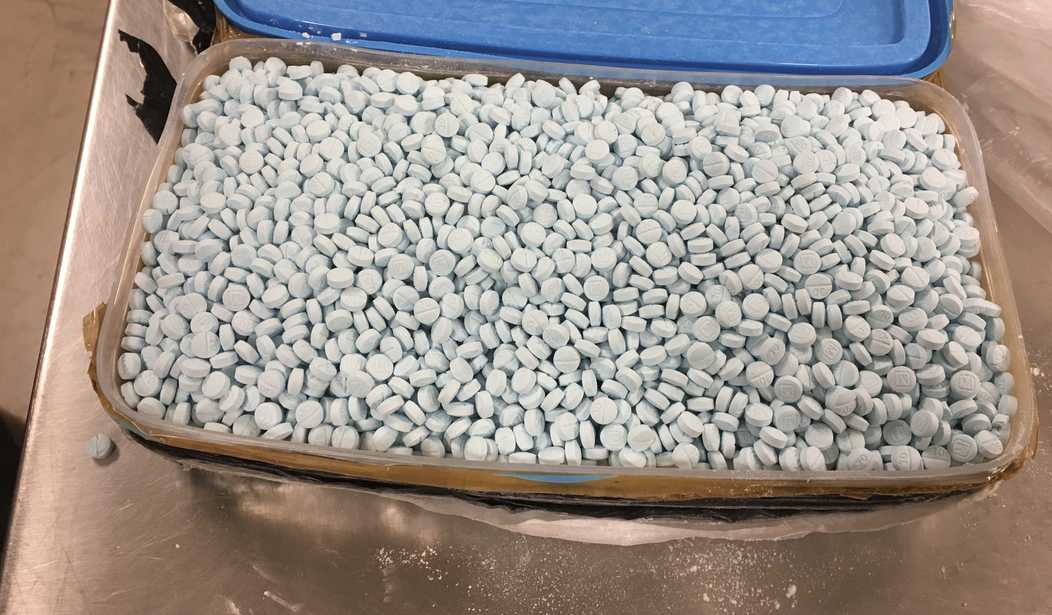
In November 2022, DEA agents tracked a suspected fentanyl courier from Arizona into New Mexico. A new whistleblower complaint says agents were told to monitor the shipment, not seize it, and make no arrests.
The U.S. Justice Department is conducting an internal probe of the operation that critics say likely led to numerous deaths. The most recent whistleblower complaint details a November 2022 fentanyl delivery from Arizona to New Mexico where Drug Enforcement Administration agents were told to monitor the shipment but not arrest anyone.
“Agents believe the courier made a minimum of at least five large deliveries over the following months, each time bringing 50,000-100,000 fentanyl pills and 20-40 pounds of methamphetamine per trip,” the complaint says. “The DEA did not arrest the courier until June 2023; at that time, agents found him with 19 kilograms of methamphetamine and 7 kilograms of fentanyl.” According to the DEA, as few as two milligrams of fentanyl can be lethal depending on a person’s body size and tolerance, and one kilogram of fentanyl has the potential to kill 500,000 people.
The new complaint also notes that during a training session, one DEA agent dismissed concerns about the operation, saying, “We walk fentanyl,” but adding that federal prosecutors were aware of it.
The complaint comes after the U.S. Justice Department’s Office of Inspector General interviewed two other whistleblowers—former DEA Special Agent David Howell and financial investigator Kevin Small, who worked as a contractor for the DEA’s Albuquerque office—on Friday and Monday, respectively.
The courier allegedly completed at least five more deliveries over the following months, carrying 50,000 to 100,000 fentanyl pills and 20 to 40 pounds of meth each time.
When agents finally arrested the courier in June 2023, they found 19 kilograms of meth and seven kilograms of fentanyl. The DEA warns that as little as 2 milligrams of fentanyl can be lethal, depending on body size and tolerance.
Federal agents understood the poison they were watching move through American communities.
The unnamed DEA special agent is now the third whistleblower tied to the operation. DEA whistleblower David Howell and former DEA contractor Kevin Small had already raised concerns.
Howell was the first to blow the whistle on the operation, alleging that the DEA allowed hundreds of thousands of fentanyl pills into New Mexico because Justice Department prosecutors wanted to track the shipments and bring a bigger criminal case against traffickers. Former U.S. Attorney for the District of New Mexico, Alex Uballez, oversaw the program, Howell said. Uballez publicly defended the operation, telling The Associated Press it saved lives, was key to intelligence gathering on drug traffickers, and that “the bigger fish are worth catching.”
Howell also alleged that he faced retaliation by DEA officials for exposing the program.
The new 20-page complaint is from a DEA special agent whose name is redacted in the document released by his attorney. Similar to Small’s complaint, the third whistleblower alleges retaliation by Jeffrey Armijo, the assistant special agent in charge of the DEA’s Albuquerque office.
In a March 28, 2025, conversation detailed in the complaint, Armijo screamed, “This is a one way conversation and this stays within my office.” The complaint alleges Armijo threatened to have the whistleblower moved to a different office and said, “I will ice you like Dave [Howell] where you will not work another case again.”
During a May 2024 training session, Howell questioned how much fentanyl agents were allowing to move through Albuquerque.
The latest complaint also alleges retaliation. The whistleblower says Jeffrey Armijo, assistant special agent in charge of the DEA's Albuquerque office, threatened to "ice" him as Howell had been iced, leaving him unable to work another case.
Agents charged with stopping deadly drugs were allegedly warned about what could happen if they challenged the plan.
Government records had already exposed a 2023 delivery of 74,000 pills at an Albuquerque mobile home park. Howell also told Justice Department investigators about separate deliveries of 150,000 and 50,000 pills that agents observed but didn't seize.
Federal guidance urged agents to take fentanyl whenever practicable because surveillance tactics used with other narcotics become far more dangerous when a few milligrams can kill.
Former U.S. Attorney Alex Uballez, who led the District of New Mexico from 2022 to 2025, defended the strategy as a way to gather intelligence and reach larger trafficking organizations.
The DEA has long contended it would not be plausible to seize every shipment of every drug. But the strategy of allowing staggering amounts of counterfeit painkillers to hit the streets shocked several veteran agents who spoke with AP.
Ridding the streets of illicit fentanyl, manufactured mostly in Mexican labs, became the DEA’s top priority over the past decade as overdose deaths surged. At the same time, its lethality — a few milligrams can kill the average adult — upended time-tested tactics that had been used to combat drugs like cocaine and heroin. Those methods have included allowing drug transactions to be completed so agents might follow the narcotics through the supply chain. Fentanyl, however, is so dangerous that the Justice Department developed guidelines for agents in such circumstances, encouraging them to seize the opioid whenever “practicable.”
Alex Uballez, who served as U.S. attorney in New Mexico from May 2022 until February 2025, said authorities at times allowed drug shipments to go unseized as part of a broader effort to gather intelligence and build cases against major drug traffickers. He said the approach reflected his office’s limited resources and his belief that prosecuting larger organizations can have a bigger impact than interdicting every suspected drug transaction.
Last year, the DEA recorded the largest fentanyl bust in its history in Albuquerque.
“The bigger fish are worth catching,” Uballez said, “and that will save more lives.”
The DEA said in a statement that “the investigative decisions at issue were lawful, reasonable under the circumstances and consistent with Department guidance.”
“Public descriptions suggesting that DEA knowingly permitted fentanyl to reach communities are false and fundamentally mischaracterize the facts,” DEA spokesperson Amanda Wozniak wrote in an email. She said the investigations involved court-authorized wiretaps “in which agents and prosecutors conducted real-time surveillance, intelligence gathering, and operational analysis targeting larger drug trafficking organizations.”
A 2024 Justice Department review found the decisions reasonable and said they created no specific danger to public health. DEA Administrator Terrance Cole has now requested an independent inspector general review.
New Mexico Attorney General Raúl Torrez has opened a criminal investigation. His state recorded a 21% increase in overdose deaths while the nation saw a 14% decline.
New Mexico Attorney General Raúl Torrez, a Democrat, said federal agents “are not above the law,” but they enjoy substantial legal protections when carrying out official duties.
Still, Torrez said he would start “demanding documents and information about the DEA’s conduct, in New Mexico and nationally, to determine whether what occurred here reflects a broader pattern of reckless or unlawful behavior.”
“If those allegations are accurate, the consequences for New Mexicans were not abstract. They were fatal,” Torrez wrote in a letter to Democratic Gov. Michelle Lujan Grisham, who earlier this week called for the inquiry.
“New Mexico already ranks among the states hardest hit by fentanyl overdose deaths,” he added, “and the families who have lost children, siblings and parents to this crisis deserve a full accounting of what the federal government knew, what it did and what it failed to do.”
The DEA initially denied Howell’s allegations in a statement to AP. But the agency later called upon the Justice Department’s independent watchdog to conduct its own investigation.
“Should that review identify areas of improvement, the DEA will of course implement changes to better their practices,” the Justice Department said in a statement. “We welcome a partnership with Governor Lujan Grisham, as well as New Mexico state and local leaders, to fight the scourge of fentanyl and keep her constituents safe.”
New Mexico was already bleeding from fentanyl, and federal officers allegedly used its communities to test how long they could follow the poison before stepping in.
How many Americans paid for the Biden DEA's gamble? Investigators may never produce a clean number. Once pills pass from a watched courier into street distribution, the government loses the chain of evidence needed to connect one shipment with one death.
Howell believes the operation killed people, while the DEA maintains its decisions were lawful and reasonable.
The scandal doesn't require pretending President Joe Biden personally approved each shipment. The operation ran inside his Justice Department during Merrick Garland's tenure as attorney general, under a U.S. attorney Biden appointed.
An administration that claimed compassion as its moral language allowed officials to weigh American lives against the hope of building larger cases.
A policy that treats American neighborhoods as acceptable risk is hostile to the people government exists to protect. Whether the motive was arrogance, indifference, or blind faith in a larger prosecution, the result remained the same: deadly pills moved while federal agents watched.
President Donald Trump's Justice Department now has a duty to uncover who approved the strategy, how many pills escaped seizure, where they went, and whether officials punished agents who objected. Families who buried children deserve more than a defense about bigger fish.
We may never learn how many Americans paid. The possibility that federal officials created a system making the answer unknowable is an indictment all its own.
Washington’s failures don’t become less dangerous when officials hide them behind procedure and promises. Join PJ Media VIP today and save 60% with promo code FIGHT.



Join the Conversation
VIP members get the ability to comment on articles.