







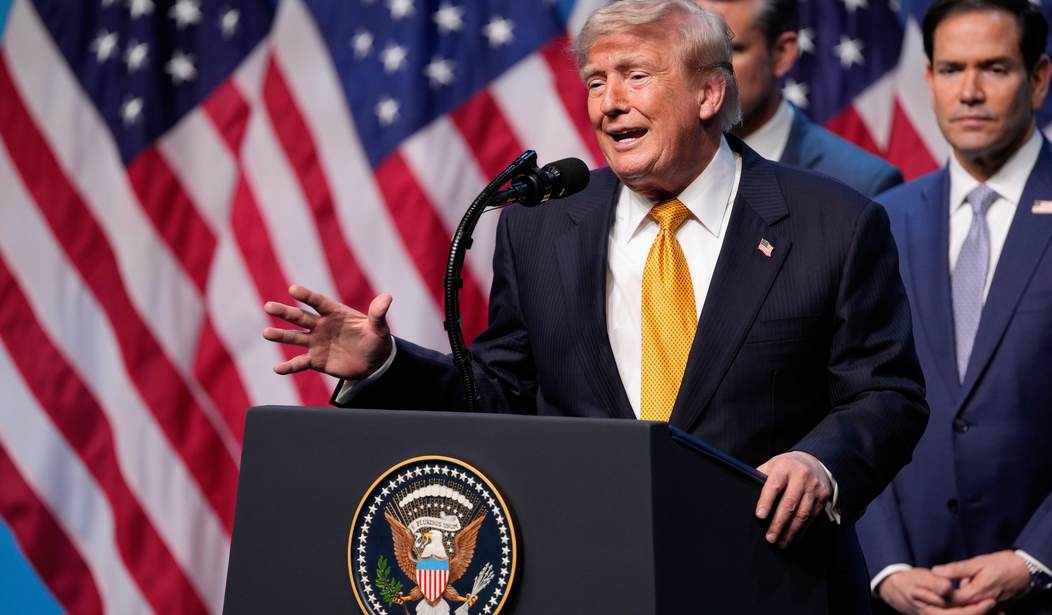
President Trump didn't close the door on Iran talks after the latest strikes, and that restraint isn't weakness. It's the harder path when missiles are flying, oil routes are threatened, and one bad order can put thousands of American troops, sailors, pilots, and civilians at risk.
Qatar, Pakistan, Turkey, Egypt, and Saudi Arabia have been trying to keep channels open, and a U.S. official said technical-level talks continue toward a nuclear deal.
Townhall confirms talks continue amid kinetic events:
NEW: @townhallcom can independently confirm other reporting that Iran talks are ongoing despite recent strikes.
— Cameron Arcand (@cameron_arcand) July 9, 2026
From a U.S. official:
“President Trump made his feelings very clear yesterday in no uncertain terms. Iran’s attacks on these innocent vessels are acts of terrorism.…
Trump had already declared the U.S.-Iran memorandum and ceasefire effectively over after Iranian attacks in the Strait of Hormuz, and he ordered two rounds of airstrikes.
Although the exchange of fire slowed, diplomacy didn't erase the danger; force helped create room for diplomacy to keep breathing.
🇺🇸🇮🇷A U.S. official said on Thursday the Trump administration is "still committed to finding a resolution, and technical talks continue" to reach a nuclear deal
— Barak Ravid (@BarakRavid) July 9, 2026
🇺🇸🇮🇷"President Trump made his feelings very clear yesterday in no uncertain terms. Iran's attacks on these innocent…
The talks haven't been abstract committee chatter. U.S. and Iranian negotiators met indirectly in Doha days earlier, with the Strait of Hormuz and frozen Iranian funds at the center of discussion.
The waterway carried about one-fifth of global oil and liquid natural gas trade before the war, so every threat against shipping reaches far beyond the Gulf.
President Teddy Roosevelt's old rule still fits: speak softly and carry a big stick. Trump doesn't have to mistake patience for surrender. The soft part is keeping mediators working, keeping back channels alive, and giving Tehran a chance to step away from the cliff.
The stick is the carrier group, the airstrike, the sanctions, the blockade threat, and the clear message that American restraint has an expiration date.
Iran's rulers understand pressure better than goodwill. The regime has spent years pursuing nuclear leverage, backing proxy violence, threatening shipping, and using terror as a foreign policy tool.
The White House has stated Trump's position plainly: Iran can't be allowed to obtain a nuclear weapon, and maximum pressure is meant to deny every path to one.
Secretary of War Pete Hegseth said Operation Epic Fury had clear goals: destroy Iranian offensive missiles, missile production, the navy, and security infrastructure, while preventing nuclear weapons.
He also said the campaign doesn't include nation-building or democracy-building goals. That narrow focus matters because America has already paid too much in blood for open-ended wars with blurry missions.
The left will call any strike reckless and any negotiation naive depending on which attack line fits the hour. Trump's job isn't to satisfy people who would fault him either way. His job is to keep Iran from going nuclear, protect American forces, keep vital sea lanes open, and avoid a larger war if strength can prevent one.
Peace talks aren't a gift to Tehran; they're a test. Iran can prove whether it wants survival more than escalation. If it keeps hitting ships, threatening bases, and hiding behind diplomatic fog, Trump should make the cost heavier than the gain.
If it backs down, America loses nothing by accepting a result that saves lives and blocks a nuclear weapon.
The best outcome isn't a headline that makes Washington feel wise. The best outcome is American forces safe, Iran contained, ships moving, allies protected, and no mushroom cloud hanging over the next generation.
Trump is right to let the talks continue, but he's definitely right to keep the big stick where Tehran can see it.
Support fearless conservative journalism. Join PJ Media VIP today and get 60% off with promo code FIGHT.
Join the Conversation
VIP members get the ability to comment on articles.