





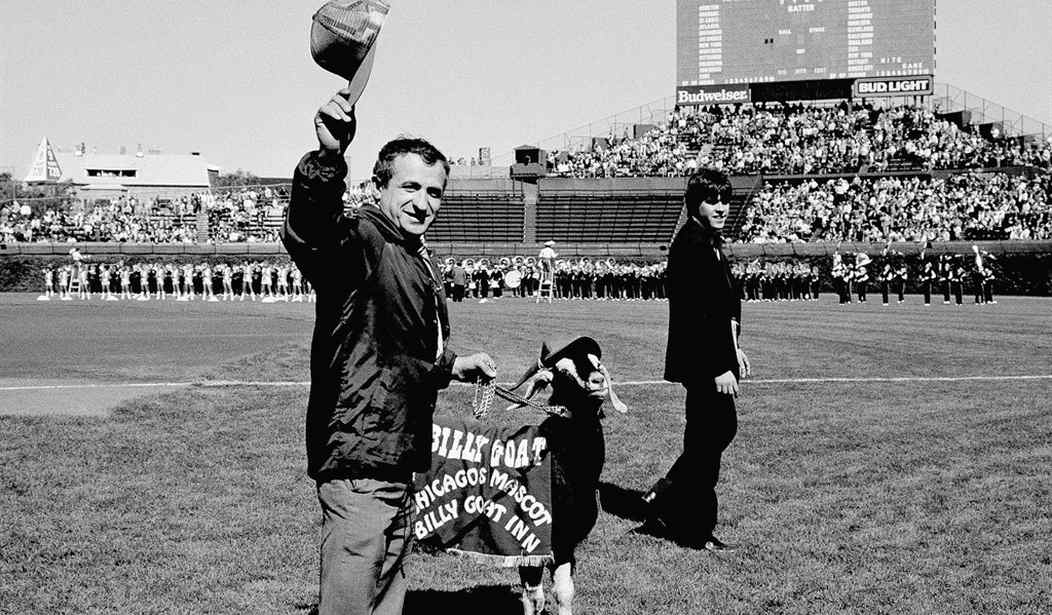
Sam “Cheezborger” Sianis, the legendary owner of Chicago's Billy Goat Tavern, died Friday at 91, and with him went one of those rare American characters who proved that a man didn't have to chase fame to become famous.
Sometimes, he only had to stand behind a counter, work hard, feed people, bark out the rules, and let the country catch up to the joke. His sons, Bill and Paul Sianis, have helped operate the family business since Sam mostly retired about a decade ago, keeping the old spirit alive in a city that has sanded down too many of its sharper edges.
For anyone of a certain age, and I'm definitely dating myself here, the words come back without effort: “Cheezborger, cheezborger, cheezborger. Cheeps, no fries, Coke, no Pepsi.”
In the deep recesses of my brain, I still hear Dan Aykroyd and John Belushi hammering out the line in that old Saturday Night Live sketch like short-order cooks with a comedy license.
My friends and I have repeated it for decades, whether we were talking about food, baseballs, or drafts of beer. We weren't quoting Shakespeare, but we were quoting something better for a Saturday night in America: a joke everybody understood before comedy needed a committee meeting, focus groups, or memos written by the DNC.
I'm old enough to remember watching the SNL skit live on that Saturday night. My friend and teammate here at PJ Media, Tim O'Brien, is fortunate enough to have visited the Billy Goat. I asked him if he would share his experience, and he graciously sent me the following.
Mike Royko of the Chicago Sun-Times had a syndicated column back in the ‘90s, and I was one of his faithful readers. He often created these fun, fictional conversations on a topic of the day that were between him and his fake alter ego named Slats Grobnik. Slats was a blue-collar character who gave Royko a way to put things into the most basic and simple terms for his reader.
Sometimes, Royko would meet with Slats at Royko’s favorite real-world after-work bar called the Billy Goat Tavern. When I was on a trip to Chicago, I had some time to kill one night, so I took a cab to the Plaza of the Americas, where I needed to ask a guy at a newsstand for directions. He pointed me to some public stairs that went just underneath the plaza.
At the bottom of the steps was this little hole-in-the-wall bar and the “Billy Goat” sign outside the door. I went in to have a beer, and when I sat down, the guy behind the bar took my order and asked me if I wanted a cheeseburger. He didn’t hand me a menu. He just asked if I wanted a cheeseburger. I said, “Sure.”
So, the whole time, I’m thinking of Mike Royko and Slats Grobnik as I’m checking the place out, and then I see behind the bar these black-and-white stills of the famous cheeseburger sketch on Saturday Night Live. Then it all clicked. This was that place, too!
When the guy who took my order came back over with the burger and fries in one of those cheap plastic baskets with red-and-white checkered wax paper, I didn’t say much to him about the skit. I just said, “Is this the place from Saturday Night Live?” He casually pointed to the photos, nodded, and walked over to someone else to take their order.
I knew the minute I had to go down those steps, I was going to like this place, and I did. It felt like I’d been there many times before.”
The sketch, known as “The Olympia Restaurant: Cheeseburger, Chips, and Pepsi,” aired during SNL's third season in 1978 with actor and comedian Robert Klein as host. Don Novello has long been connected to the Billy Goat Inspiration, while Aykroyd has offered another memory tying the idea to the café owned by Belushi's father. Comedy history gets messy because memories age like old receipts in a coat pocket.
Still, the Billy Goat Tavern's fingerprints remain all over the national imagination.
The Billy Goat story began before television gave it a second life. William “Billy Goat” Sianis, Sam's uncle and the founder of the original tavern, bought the Lincoln Tavern in 1934 near the old Chicago Stadium. Sam Sianis came from Greece in 1955, moved to Chicago in 1960, and opened the Lower Michigan Avenue location in 1964. A burger joint tucked below Michigan Avenue became a refuge for reporters, working stiffs, late-night wanderers, and anyone who preferred a place with character over a place with mood lighting and menu poetry.
Sam also inherited one of Chicago's finest sports legends: the Curse of the Billy Goat. William Sianis brought Murphy the goat to Wrigley Field during the 1945 World Series and got tossed out after the goat's smell became part of the game-day atmosphere.
In its obituary of Sianis, the Chicago Sun-Times tells the story behind the curse.
A goat had been William Sianis’ mascot since he found one outside his original bar — then named the Lincoln Tavern. It apparently had fallen off a truck and was injured. He took it in and cared for the animal.
His customers got a kick out of it. So William Sianis, who lived above the bar — at the time at 1855 W. Madison St., where the United Center now stands — decided he’d keep at least one goat in a little pen behind the building.
Not long after, he renamed the joint “Billy Goat Inn.”
William Sianis brought his billy goat named Murphy to Wrigley Field for Game 4 of the 1945 World Series, Cubs vs. Tigers, with the Cubs leading the series two games to one.
He and the goat were kicked out, legend has it, when the animal began to stink during a rain delay.
According to legend William Sianis threw up his arms and exclaimed, “The Cubs ain’t gonna win no more. The Cubs will never win a World Series so long as the goat is not allowed in Wrigley Field.”
The Cubs then spent decades carrying the curse like a wet wool coat until their 2016 World Series win finally broke the spell.
What made Sam Sianis stick was the opposite of polish, belonging to an older Chicago, where a man could build a life with an accent, a grill, long hours, a stubborn sense of humor, and a counter full of regulars.
Bill Murray and Novello still visited the tavern over the years, a reminder that fame came through the door but never managed to own the place. Sam owned the place because he was the source of its rhythm.
America loses little pieces of itself when men like Sam Sianis leave. The country still makes restaurants, still makes burgers, and still makes jokes, at least on the good days.
Every neighborhood has people like Sam Sianis, colorful people who treated people like family, calling us by our first names, asking about our children, and telling us to sit there and have some lemonade.
It's only after they pass that we realize what we've lost.
America has a harder time making characters who feel carved out of their neighborhood, men who don't need branding because everybody already knows the sound of their voice. Sam Sianis gave Chicago food, laughter, stubborn charm, and a line people will repeat long after the grill cools.
Cheezborger, cheezborger, cheezborger. No fries. No Pepsi.
And somehow, no replacement.
Good comedy used to come from real places, real accents, real people, and real life. Sam Sianis helped prove that a small Chicago tavern could leave a bigger cultural mark than half the slick entertainment churned out today. Join PJ Media VIP with promo code FIGHT and get 60% off while the offer lasts.

Join the Conversation
VIP members get the ability to comment on articles.