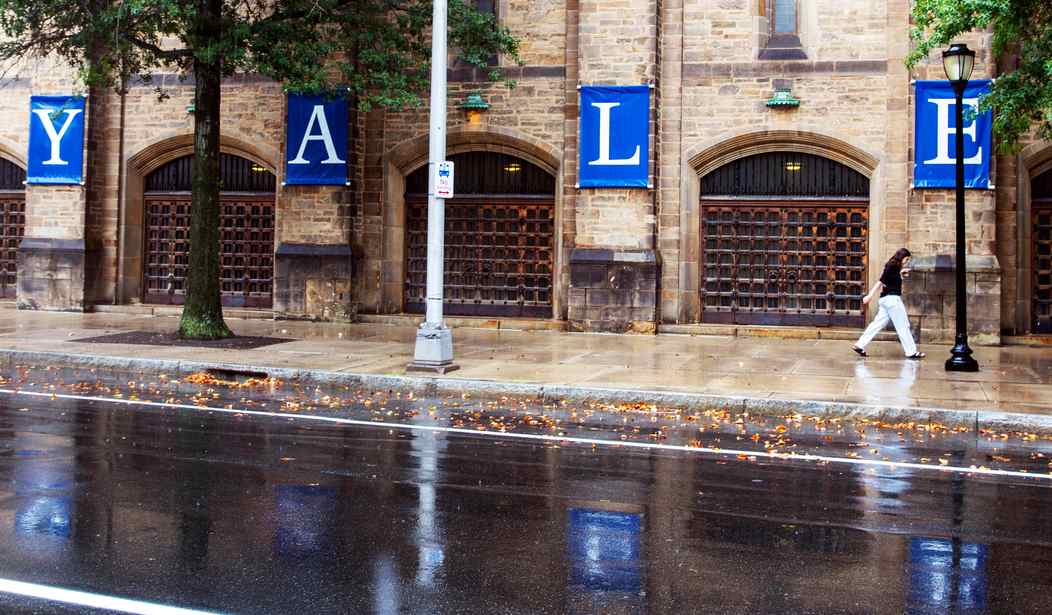
Yale University has long enjoyed a prestigious reputation as an Ivy League institution of higher learning. But that is the glory of former days, not the present reality.
Usually, at any given university, there is a handful of degrees which are still worth earning, but most of them — especially if they’re considered “liberal arts” — are little more than leftist indoctrination courses. I was fortunate to go to one of the few colleges that still had decent liberal arts courses, but at Yale, the History Department mixes real history courses with ridiculous nonsense. Alongside courses about Chinese history, the Crusades, and Greek wars, there are courses on framing pagan gods as extraterrestrials, studying plants through the lens of colonialism, and “environmental insurgency.”
Incidentally, Yale University's tuition for the upcoming school year is $72,500, and if you add in housing and food, it's $94,100. That's a hell of a lot of money to pay to learn to hate Zionism and invent "queer history."
I’m going to look at a handful of the upcoming (2026-2027) courses available on Yale’s catalog for the history major. For example, we have “HIST 2510a Environmental Insurgency, Dispossession, and Slavery in Latin America.” The course description includes the following ineluctable sentence: “Therefore, this course adopts various scales of analysis, from local and regional to hemispheric, to approach key themes of colonial Latin American history (15th-19th centuries) from an environmental lens to adress [sic] policies and social mobilization over colonization, dispossession, enslavement, environmental degradation, but also adaptive usages of emancipatory technical knowledge to navigate exploitation and unfreedom regimes.” Whatever that means.
One of the wokest courses is "Botanical Bodies: Plants, Medicine and Colonial Science," which tries to transform the scientific study of plants into a course on racial and sexual propaganda:
Plants weave their way into every aspect of our lives. From the food that we eat to our growing obsession with houseplants, from the pharmaceutical industry to recent meditations on queerness and reproductive freedom, plants are inescapable, offering both practical and metaphoric roots, tendrils, and blossoming ideas about our own bodies and our engagement within changing social, political, and cultural structures. This course considers the ways that plants (and fungi) have shaped ideas about gender, sexuality, race, health, medicine, capitalism, power, and consciousness from the early modern period to the present, moving chronologically to examine our complicated relationships with the natural world. Working within the (broadly construed and ongoing) colonial context, we follow plants and their collectors, cultivators, and stewards across oceans and continents, charting the rise of plantation agriculture and specious ways of classifying species to twentieth-century focuses on breeding and genetics, attempts to patent plants as medicines, and, in recent years, calls to use plants as models for new (or, perhaps, very old) models for kinship that upturn these very systems of power.
The course "Extraterrestrials in History" sounds like a Netflix show instead of a university course, because we don't actually have any evidence of aliens traveling to Earth to interfere in our history. To solve this lack of evidence, the course apparently interprets ancient myths about pagan "gods" as stories about extraterrestrial visitors while somehow claiming a connection between "angels, freaks, [and] native Americans."
Recommended: SPLC Boss Had a Neo-Nazi Lover She Funded With Donor Cash?
Another course on fake history uses an "intersectional lens" to provide "a critical overview of queer history in the United States from the colonial era to the present." The American colonists would surely be shocked to hear that they had "queers" of the 21st century definition living amongst them.
Then there’s “HIST 2705b Writing from the Archive: Imagining the Real,” which is cross-listed across four departments. Don’t be fooled by the title — there is a lot more imagination than reality in this course:
Where do the dry, who-what-which details set down on a census form meet the far messier and richer reality of the people whose names are scrawled there? And how might a writer bring that meeting about? What can a shoebox of doodle-filled letters tell us about the ways that friendship, art, war, sex, and politics struck a couple of New York novelists, c. 1941? How do we respond as writers and as a culture when faced with the lack of such inky particulars?
It all sounds so silly. Speaking of silly, there’s “Sexual Minorities from Plato to the Enlightenment,” which uses “contexts where homosexuality and sodomy were categorized, regulated, and persecuted and examine ancient and medieval constructions of same-sex desire in light of post-modern developments, challenging ideas around what is considered normal and/or natural.” Plato, of course, did in fact glorify sodomy (that’s an aspect of Greek philosophy a lot of traditional classicists don’t want to admit), but then again that was relatively ubiquitous in the Greek society of his time. Sodomites usually weren’t persecuted in Ancient Greece. Modern wokies assume they were because Judeo-Christianity has since condemned sodomy as a perversion. Without diving into too many details on the large span of time covered in this Yale course, I would say it is seriously deceptive.
Another deceptive course, “Fetal Histories,” asks, “How, then, has the fetus come to carry the cultural significance that it does? Are there other ways one might think of the fetus?” I respond, yes. A fetus is actually a baby, from the moment of conception, as science has proved. But if the course referred to “unborn babies,” it would have to admit right off the inherent inhumanity of abortion.