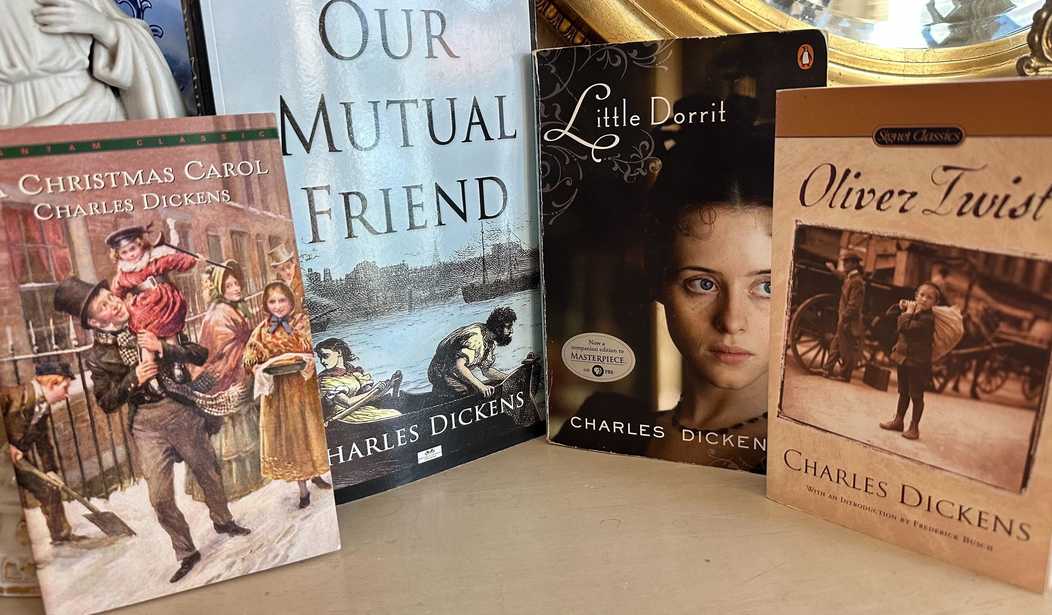
Ebenezer Scrooge, Oliver Twist, Little Dorrit, David Copperfield, Sydney Carton, Jacob Marley, the Artful Dodger, Samuel Pickwick, Miss Havisham, Uriah Heep, Bob Cratchit, Jenny Wren, Jerry Cruncher, Tattycoram, and Little Nell... the list of iconic characters from Charles Dickens' novels could not possibly be contained in a single article.
Saturday is the anniversary of the 1812 birth of Charles Dickens, one of the greatest writers in the English language. Few writers in all history can boast such a diverse and motley throng of characters as Dickens did. The marvelous talent of Dickens was that, in every book he created, there is an entire cast of characters so unique, fascinating, and complex that it is difficult to believe they are not real. His books changed not only English-language literature, but our whole culture forever.
In honor of Dickens today, I will look at just a few of his countless unforgettable characters. If your favorite isn't on the list, share it below.
My favorite Dickens novel is Our Mutual Friend, his last completed and arguably his best work. The characters I love in this novel are too many to mention in detail, including John Harmon, Lizzie Hexam, Mr. Riah, and Mr. Venus, but one central character who proves unexpectedly complex and clever is Nicodemus "Noddy" Boffin (alert: spoilers ahead). Mr. Boffin is important firstly as a dustman inheriting his employer's massive fortune when the natural heir is wrongly presumed drowned. To begin with, we see Mr. Boffin present the aspect of a very good-natured and generous man who is easily fooled. Then, as the story progresses, his fortune appears to make him crafty, distrustful, and grossly unjust to his long-suffering secretary and others.
But towards the end of the book, a shocking revelation emerges. Mr. Boffin was neither so stupid nor so corrupted as he appeared. He has been, in fact, with consummate skill and perennial watchfulness in a scheme with his wife and the secretary — who turns out to be John Harmon — to fool quite a number of individuals who either were trying to swindle him or were in danger of being corrupted by wealth themselves. In fact, I believe one can appreciate the book more on a second reading than on the first, because when one already knows the ending and the secrets, Mr. Boffin's many apparent changes and sudden surprises become an object of admiration. One feels as if one has been let in on the most hilarious and glorious joke. I truly believe Mr. Boffin is one of Dickens' most interesting characters, and Peter Vaughan's portrayal of Boffin in the 1998 miniseries is as masterful as the most ardent Dickens fan could wish.
Read Also: Ronald Reagan, Champion of Freedom
Sometimes calling Dickens' creations "secondary" characters almost seems insulting. Pancks is a key character in directing the storyline of Little Dorrit, but technically speaking he is not one of the "stars," as Hollywood would put it. And yet Pancks has any many layers to his personality and as many hidden virtues as Mr. Boffin, though Pancks is a very different sort of person. In short, Pancks chafes in his job of rent collector for Mr. Casby, a mean, greedy, and deceptive man who nevertheless appears to be highly benevolent. It is a classic case of judging a book by its cover, for everyone assumes Pancks is cruel because he does the dirty work and his face and mannerisms are off-putting, while Casby gets away practically with murder, because he looks and smiles rather like Santa Claus.
In trying to help the Dorrit family, Arthur Clennam, and others, however, and at last in exposing his employer, Pancks shows that he truly has a heart of gold. As a sharp detective, an unsuccessful financial speculator, a humorous observer, and the most loyal of friends, Pancks proves that he is anything but a stereotype or a stock character. And in the 2008 BBC miniseries of Little Dorrit, Eddie Marsan puts in what ought to have been an award-winning performance as Pancks.
Finally, we turn to Oliver Twist and one of the most unlikely heroines of British literature, Nancy. Her story of moral redemption is one of the most moving parts of a perpetually heart-wrenching novel. A professional thief, an alcoholic, and mistress to the brutal and bestial criminal Bill Sikes, Nancy first appears in the novel as just another of the numerous human riff-raff and ne'er-do-wells collected around the infamous Fagin. But as Nancy becomes attached to the innocent and much-abused orphan Oliver in spite of her herself, she becomes more and more human. Twice she puts herself in serious physical danger to protect him, and the second time stakes everything on rescuing Oliver from the life of crime and suffering to which Fagin and Monks doom him.
This heroic sacrifice costs Nancy her life. Throughout all her aid to Oliver, she has always remained loyal and affectionate to Bill Sikes, despite his awful treatment of her. But when Sikes finds out that Nancy was the one who helped Oliver escape, he murders her. Even as he kills her, Nancy begs him to let her help him to a better and nobler life, and at the last prays to God to have mercy on her soul. One cannot help but think of Christ's words in Matthew 21:31: "Amen I say to you, that the publicans and the harlots shall go into the kingdom of God before you." Nancy managed to rise about her debased life and past sins to die a truly self-sacrificial and noble death. For the best movie depiction of Nancy, watch the 1968 musical version Oliver!.
And so, as Tiny Tim and Charles Dickens would say, God bless you, every one.