







We have known for decades about the threat of liberal extremism on college campuses, but right-leaning students still pay tens of thousands of dollars to endure indoctrination attempts for that coveted piece of paper called a diploma. I was a sophomore at Baylor University in 2003 and distinctly remember my first day of Intro to Political Science; the professor asking for a show of hands: Who here identifies as a Democrat? You all will do well here. Who is a Republican? Congratulations, you all are almost certainly getting Cs.
My first clue should have been his use of "you all" instead of "y'all" — that ain't Texan. I had to claw and fight my way to a B. Thankfully, that was my only encounter of the kind, so imagine the pressure exerted at a place like Berkeley.
Taxpayers have multiple reasons to distrust higher education in America. From students getting uninvited to a class they paid to attend because they disagree with the LGBTQIA+ agenda to conservatives getting mocked for mourning Charlie Kirk's assassination, why would reasonable people have any faith in their motives?
🚨 BREAKING: Gov. Greg Abbott demands the immediate expulsion of this student who imitated the assassination of Charlie Kirk at Texas State University, slapping his neck and pretending to collapse at a Charlie memorial.
— Eric Daugherty (@EricLDaugh) September 16, 2025
"Expel this student immediately." pic.twitter.com/yWKK27RsmT
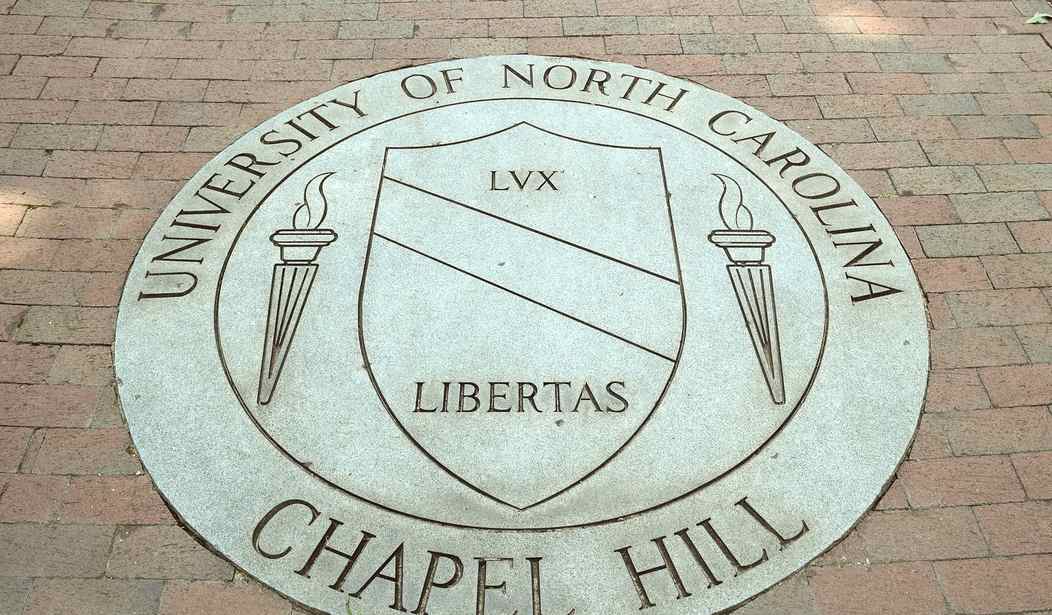
To confront the public skepticism of higher education, the president of the University of North Carolina System, Peter Hans, declared that UNC professors must post their syllabi online starting in August 2026.
We are living through an age of dangerously low trust in some of society’s most important institutions. While support for North Carolina’s public universities remains strong and bipartisan, confidence in higher education generally has dropped in recent years, driven by concerns about value and a perception that some colleges and universities have drifted from their core mission.
The State of North Carolina is still realizing waves of first-generation college students. I am nearing my collective fifth year living in the Tar Heel State. I taught North Carolina History and can explain precisely why the state was and still is divided by education access, but that's another column for another day. The fact is that North Carolina universities desperately want to scoop up the thousands of high school students (and their tuition dollars), discerning between a bachelor's degree and the trades.
Opponents of the transparency claim syllabi are the intellectual property of the creating professors; public access would expose these academics to theft and fraud. Those in favor of the move claim North Carolinians have a right to know how their tax dollars are being spent. Even as a purple state, folks see the problem with the blatant bias in publicly funded lecture halls.
The fight, almost certainly organized by a few tenured faculty, generated a petition signed by 2,800 employees and students for Hans to reconsider his decision.
Transparency, accountability accessibility – these are important aspects of a public university system, but that's not what this is about...This is about capitulating to pressure at the state level and at the federal level to scrutinize faculty and intimidate faculty who are teaching unpopular subjects right now.
—Michael Palm, the president of UNC-Chapel Hill's AAUP Chapter, to WUNC North Carolina Public Radio
What is fascinating is the intentional disregard for why those subjects are unpopular: political agendas, lack of academic integrity, failure to employ science or common sense, the insistence that students regurgitate talking points instead of thinking independently.
Social media has a sea of content proving ridiculous majors and enormous student debt are nothing but regrets. New graduates take to the internet to lament their inability to land the six-figure job their Puppetry Arts academic advisors promised. (Yes, that's real at the University of Connecticut, the University of Washington, and other taxpayer-funded campuses.) Faced with hundreds of thousands of dollars of debt, graduates come face-to-face with the rude reality that they were duped. The University of Hawaii at Manoa is more than $50,000 per year for out-of-state undergrads. No one talks about the loan interest that accrues while still earning that degree in Women, Gender, and Sexuality Studies.
The $1.5 trillion student loan debt crisis explained.
— Wall Street Mav (@WallStreetMav) December 13, 2025
They have zero economic value in the job market. These are your future baristas crying about their $100,000 in student loan debt.
Anyone with a pulse can borrow student loans, that is the problem.pic.twitter.com/7N25DuWkQq
Hans' solution to public scrutiny is a searchable online database that displays class syllabi, grading rubrics, all materials students are expected to buy, and learning objectives. Not only will this prove professors peddling their annually revised textbooks, but it should also level the grading playing field for students with conflicting values. Of course, it is not a perfect solution, but it is a big step in the right direction.
The academic professionals distraught over this mandate remind me of the gaggle of children in our neighborhood when they were caught playing in the creek we parents told them not to play in for weeks. We don't keep them out to be mean, but because of the dangers that come with snakes, ticks, quicksand, and rotten logs. "But we've been playing here all week and we're fine!" they cried. They stomped their feet and shouted about how "unfair" it was when we supervised their play the next day. They were doing something they knew they shouldn't be doing and were only mad they were caught.
Tenured university professors are the most coddled professionals this side of the government bureaucracy line. Their leashes are being shortened, and they don't like it. Unlike Texas A&M's culture of student exclusion, Peter Hans has drawn a hard line for his UNC employees to walk, and that is good news.
Here's to another common sense victory, y'all, and let's keep 'em comin'!


Join the Conversation
VIP members get the ability to comment on articles.