Note: Most Thursdays, I take readers on a deep dive into a topic I hope you'll find interesting, important, or at least amusing. This week, we'll examine Trump's massive military spending proposal, and whether it's really all that. These essays are made possible by — and are exclusive to — our VIP supporters. If you'd like to join us, take advantage of our 60% off promotion.
“We know only too well that war comes not when the forces of freedom are strong, but when they are weak. It is then that tyrants are tempted.” —Ronald Reagan, from his 1981 inaugural address
Peace through strength is a winning formula. It has been for millennia. Even the ancient Romans had a saying for it: Si vis pacem, para bellum.
"If you want peace, prepare for war."
That doesn't just mean buying ships and planes — or triremes and gladii, as the Romans did — but really preparing for war. The hard training, the discipline, deployments, and maintaining the traditions and esprit de corps that make the difference between an armed gang that evaporates at the first sign of organized resistance and a seasoned military that fights.
Or, at the absolute unchallengeable height of your military power, you can indulge in one reckless "peace dividend" after another.
Which is exactly how we spent the '90s.
Shirking Reagan's (and Rome's) conservative "peace through strength" principles began under President George H.W. Bush. Although to be fair, abandoning conservatism was kind of his thing.
Around the time of our back-to-back victories in the Cold War and Desert Storm, Bush was determined to shrink the military. As early as 1990, Bush and Defense Secretary Dick Cheney committed the U.S. to a "Base Force" structure 25% smaller than Reagan-era highs. The cuts included giving up Reagan's 600-ship Navy, with a new ceiling of 450-470 ships. The immediate threat posed by the Russian navy had passed, but as some sharp critics noted, the oceans had not shrunk.
Maybe this part made military sense — opinions differ — but Bush retired the four Iowa-class battleships so painstakingly modernized under Reagan.
Base Force set in motion the elimination of nine of the Air Force's 24 active-duty fighter wings, capped B-2 Spirit stealth bomber production at 20 (from a planned 132), and reduced our total bomber force by more than a third.
The idea was that the Base Force would be big enough to deal with regional contingencies, and if we'd had the shrug emoji in 1991, I guess that was Bush's plan for anything bigger. Maybe I'm being unnecessarily harsh on Bush, but he was a decorated World War II naval aviator who should have known better.
This next example is almost enough to make a grown man cry.
And Another Thing: The decision to reduce Army active divisions from 18 to 12 and bring most of our forces home from Europe was both wise and prudent. I've said for decades that when the Soviet Union fell, NATO should have thrown itself one helluva victory party and then promptly disbanded. Western Europe might be much stronger today without a permanent American security guarantee. Besides, we are by geography and inclination primarily a naval and air power. And unlike navies and air forces, armies can be raised more quickly, should the terrible need arise.
Part of Gen. George S. Patton's fabled Third Army in WWII, the U.S. VII Corps stood watch against the Warsaw Pact in West Germany for four decades during the Cold War, a collection of heavy divisions and other Army assets representing enough firepower to impress the guy who designed the Death Star. For Desert Storm, we reinforced VII Corps and lifted the whole damn organization to Saudi Arabia — a logistical feat we couldn't come close to reenacting today.
China tends to notice such things, but I digress.
Then Gen. Norman Schwarzkopf turned VII Corps loose on the Iraqi Army, and the results were unlike anything in history. The Corps' divisions — 1st Infantry, 1st Armored, 3rd Armored, and 1st Cavalry (plus the "all teeth, no tail" 2nd Armored Cavalry Regiment) — advanced faster than any heavy force in history, and obliterated everything in their path while taking hardly any casualties.
VII Corps' "left hook" celebrated in that famous Schwarzkopf press briefing was the stuff of legend.
Following the ceasefire, the Army ordered VII Corps headquarters back to the United States, and almost immediately disbanded it. The men who carried its institutional knowledge were sent elsewhere or RIFed out.
The first Bush administration didn't merely order a drawdown. It ordered a quarter-cut force, slashed procurement nearly in half, forced maintenance cuts, and took a chainsaw to training and operations budgets — all on the assumption, as Francis Fukuyama so shortsightedly put it, that we'd reached "the end of history."
Then in 1993, Bill Clinton took a look at what Bush had done and said, "Hold my cigar."
(Just don't ask where.)
Clinton cut the Army by two more divisions, down to 10, reduced the active Air Force to just 20 fighter wings, and turned the "peace dividend" into a virtual procurement holiday. New programs were delayed or canceled, modernization efforts extended out to infinity, defense contractors consolidated into a few "too big to fail" behemoths, and Clinton's trade policies initiated our out-sourcing to China.
Perhaps worst of all — and you probably already figured this is something about my beloved Navy — Clinton shrank the Navy to just 330 overworked ships and subs. The nation's first and oldest line of defense was (and today still is) to borrow J.R.R. Tolkien's phrase, "thin, sort of stretched, like butter scraped over too much bread."
Meanwhile, Clinton involved us in Bosnia, Kosovo, Haiti, Somalia, and increased air operations over Iraq. It all added up to a higher operational tempo for a smaller military.
We also closed far too many bases during the '90s. The ones remaining are large and tempting targets, like our planes lined up neatly on the tarmac as the Imperial Japanese Navy secretly approached Pearl Harbor.
I should also mention President George W. Bush made two terrible decisions (later doubled down on by Barack Obama) in the wake of 9/11. The first was trying to build a nation in Afghanistan where there had never been one and would never be one. The Taliban and al Qaeda had to be dispensed with, of course, but two decades spent there was far too long. The other mistake was Operation Iraqi Freedom. While a detailed discussion of those operations doesn't fit the scope of this essay, we spent too long asking too much of too few.
Were prudent cuts called for following our victory in the Cold War? Certainly. But Bush's and particularly Clinton's cuts were far from prudent.
If we had stuck to more reasonable cuts — mostly to the Army — and kept the Navy and Air Force at (almost) Cold War size and readiness, I truly believe the world might be a more orderly and peaceful place today. After the dissolution of the Soviet Union, the world couldn't have asked for a more benevolent hegemon.
Or a stupider one. We frittered away our tremendous advantages and tempted the tyrants.
What I'm trying to say with all this is quite simple. The U.S. spent 25 years since 9/11 putting unexpected wear and tear on a force that's just too small. We've watched four-plus years of the Russo-Ukraine War that blew away even our worst-case estimates for how quickly modern battles run through munitions and weapons — and men. Stupidly, we outsourced our defense industrial base to China. Stupidest of all, we enabled the rise of a rich and powerful rival on the other side of the vast Pacific, while allowing our Navy to atrophy to fewer than 300 ships and subs.
The bill for 35 years of bad and short-sighted decisions is due.
And Another Thing: The situation with the Navy is even worse than you might know. We don't just have too few ships, we have too few shipyards to service the ones we do have. A billion-dollar attack submarine — the USS Boise — was forced into early retirement last week with years of service life left in her because the Navy couldn't perform scheduled maintenance. Boise sat in one shipyard after another for 11 years (and at a cost of $800 million) until the Navy finally gave up with barely a quarter of her repairs complete. Imagine what would happen in a war with China when the Navy suddenly needed to perform a whole lot of unscheduled maintenance.
Going back to Reagan's Cold War budgets, spending peaked at a little over 6% of GDP during the mid-'80s. Today, that would be $1.7 trillion, give or take — or a significant fraction higher than Trump's proposal.
The devil is always in the details, as I reminded you last month, so let's look at the vitals.
Navy procurement includes an order for 18 warships and 16 support ships, the largest single order since 1962, according to the administration. And, thank goodness, that includes expanded shipyards and training for more workers. Naturally, there's $18 billion to complete development and procure the first Trump-class battleship.
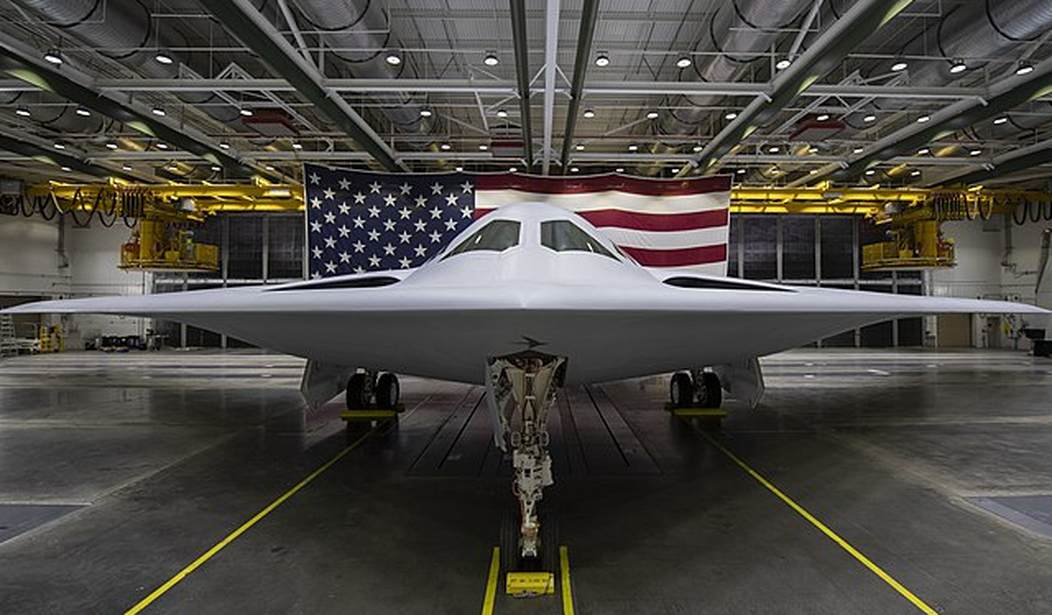
"The budget ramps up Lockheed Martin F-35 procurement to 85 aircraft per year and includes $102 billion for aircraft procurement and research and development, a 26% increase over the prior year," according to Reuters. "Development of next-generation systems like the Boeing F-47 fighter jet is also a priority, while $6.1 billion is requested for Northrop Grumman's B-21 bomber," including a second production line for quicker availability.
Most importantly, Trump's budget includes over $100 billion dedicated to Defense Industrial Base (DIB) investments to re-shore or expand production of strategic materials, microelectronics, batteries, casting/forging, and other choke points. The goal is to double or triple defense manufacturing capability, particularly in shipbuilding and munitions.
Munitions likely require a tenfold increase. I'm as excited as the next hawk to see the Islamic Republic getting what it deserves, but Operation Epic Fury leaves our cupboards dangerously bare for longer than you might believe. That's one reason why this new budget includes funds for 785 Tomahawk cruise missiles in 2027, up from just 88 (can that be right?) over the last two years.
Trump's proposal even includes $54 billion for drone development, procurement, and training, or roughly as much as Ukraine's entire defense budget. And I'm not joking when I tell you that based on everything we've seen, $54 billion won't buy enough drones. Not even the cheap ones.
There's also a 5-7% pay raise for our servicemen and women, weighted toward junior enlisted ranks, to aid recruitment and retention.
But by and large — and I do mean large — this is a proper and serious proposal that works to correct our major deficiencies, and restore the Fear of God and the United States Military into tyrants everywhere.
So today's One Point Five Trillion Dollar Question is this: Does Trump's budget make the proper down payment on what is owed? Not "Is his proposal big enough?" but "Does it make wise use of our tax dollars?"
Near as I can tell from this week's reports, however, there is at least one place where the budget proposal falls short:
There are the $2,500 soap dispensers, $1,300 coffee cups, and a leather chair that cost $9,341. A 2016 Inspector General report revealed that approximately $6.5 trillion vanished into thin air because the Pentagon’s books were riddled with accounting adjustments. The Pentagon, in fact, can’t even pass a basic audit, including its latest review in November 2024. They failed seven straight times.
We took a holiday from history. Now the bill is due, with interest. But the American taxpayer can't be the only one asked to pay up. Defense contractors must be salivating at new shipyards, more keels, more airframes, and drones by the jillions.
I mean, I am, and I don't even get a cut.
But here's the deal that everyone from the lowliest acquisition officer to the highest-paid executive at Northrop Grumman needs to understand: If you want the second B-21 Raider production line, you give up the $9,000 leather chair.
War Secretary Pete Hegseth and his team have done an impressive job of cutting the cultural rot from the military. Now they've got to scrape the financial barnacles off the Pentagon.
And Another Thing: In recent years, we also threw away decades of cultural supremacy in favor of girl bosses, wokism, deconstructionism, weaponized transgenderism, hamstringing innovation with massive Human Resources departments, off-shoring traditional male jobs, and the general emasculation of a formerly testosterone-fueled nation. But that's an essay for another week, if anyone is interested.
I've watched Washington long enough to know when a President dangles a trillion-dollar proposal before Congress, representatives of both parties will, after the obligatory protests, line up to get their share of the pork — pretty much ensuring Trump gets most of what he wants.
But in the hustle, let's not forget the people who pay for it, and the value we deserve for our tax dollars.
Disciplina praesidium civitatis, the Romans said. "Discipline is the safeguard of the state." That's a dictum that applies every bit as much to spending as it does to the military.
Last Thursday: The Trump Doctrine, Defined