
Note: Most Thursdays, I take readers on a deep dive into a topic I hope you'll find interesting, important, or at least amusing. Christmas comes early this year with a Thursday Essay on Tuesday! These essays are made possible by — and are exclusive to — our VIP supporters. If you'd like to join us, take advantage of our 74% off (!!!) promotion.
“Fear God and dread nought.” —Admiral Sir John "Jacky" Fisher
Ah... battleships! Big guns, thick armor, and the thunderous majesty of lobbing massive shells at enemy formations miles and miles away — all part of a highly choreographed ballet involving flanking battlecruisers, scouting cruisers, and fast-moving torpedo boats.
Before we get to why battleships are suddenly back in vogue with President Donald Trump's announcement this week of America's first new class in over 80 years, we need to see why they went out of fashion in the first place — and why battleship theory never matched battleship reality.
By the time the Great War broke out in Europe in 1914, naval theorists believed they had solved the problem of fleet warfare, and their theories centered on the "all big gun" battleship revolution begun in 1906 with the HMS Dreadnought and her 10 12-inch guns — paired up in five twin armored turrets, on a ship that demanded over 700 officers and men to keep her steaming and fighting.
Dreadnought had been in service barely eight years when German troops marched into neutral Belgium, and British Foreign Secretary Sir Edward Grey confided to a friend that "The lamps are going out all over Europe." Yet already the first modern battleship was outclassed by newer models with even bigger guns and thicker armor.
Still, nearly two full years of war passed before the mighty Royal Navy Grand Fleet and Imperial Germany's Hochseeflotte (High Seas Fleet) would put the navalists' theories to the test at the Battle of Jutland.
According to theories derived by men pushing little wooden warships around big maps, the large navies of the world would clash in orderly battle lines. Mighty battleships with their long-range guns would trade blows against one another, while quicker battlecruisers waited on the flanks for targets of opportunity. Even faster-moving cruisers would serve in the reconnaissance role, darting ahead to find enemy ships and radio back what they'd found. Finally, high-speed destroyers and torpedo boats were seagoing assassins, launching waves of torpedoes to force enemy battleships out of formation and finish off damaged ships.
Communications being what they were, maneuver would be determined by both flag signals and well-drilled doctrine, with each fleet acting on clear information, moving in clean formations, and forcing predictable responses.
If you're thinking, "I bet it didn't work out that way," pat yourself on the back.
Here's what happened when theory hit hard against reality, starting with all the smoke produced by all those coal-burning ships.
Ships lost visual contact constantly, spotting of enemy ships and where friendly shots fell was unreliable, and friend could not always be distinguished from foe.
And precious information was incomplete, late, and sometimes just plain wrong.
Britain's battlecruisers — built with a "speed is armor" mentality — proved that speed was not indeed armor. Three of them were sunk in nothing flat with massive loss of life. Torpedoes from both sides were actually too effective, in a sense, scattering those pristine battle lines and turning the admirals' choreography into chaos.
In the end, the Hochseeflotte scurried off to safety after suffering far fewer losses than the Royal Navy did, and while the Royal Navy took one on the chin, Britain proved that it could react quickly enough to German moves that the Hochseeflotte never seriously contested the seas again.
Kaiser Wilhelm II had built a fleet powerful enough to shock London into a previously unthinkable alliance with France, but still too weak to challenge Britain's naval hegemony. The Royal Navy would slowly strangle the German economy, as envisioned a quarter century earlier by American seapower expert Alfred Thayer Mahan.
Imperial Germany's Hochseeflotte was, to corrupt a phrase, the worst of all possible fleets. But pretty ships were what the Kaiser's ego wanted, instead of enough extra army divisions for the quick war Germany required.
More to the point, Jutland put to the test the "decisive battle" theory also proposed by Mahan, whom historian John Keegan called "the most important American strategist of the nineteenth century."
Mahan was largely correct in his two Influence of Sea Power books, but those decisive battles proved elusive. Neither the British nor German navies could force one on each other in WWI, and while the Imperial Japanese Navy remained wedded to the concept until the bitter end of World War II, the U.S. Navy for the most part went about the more practical business of sinking whatever Japanese ships it could find, wherever they could be found, and with whatever means were available.
That isn't to say the U.S. Navy and IJN didn't fight major battles, because we surely did. But never anything like the theories said we were supposed to.
Still, after a postwar "holiday" from building capital ships, battleships kept growing. Even under the limits of the 1930 London Naval Treaty, battleships got bigger guns, thicker armor, and ever-faster speeds. When the London agreements collapsed in the late '30s, ships got really quite seriously big.
The last two battleships built for the Imperial Japanese Navy were the Yamato class ships, Yamato and Musashi, each displacing a gulp-worthy 65,000 tons — and nearly 72,000 under full load. Those beasts had a top speed of 27 knots and sported nine 18.1-inch guns so powerful that the ships risked minor damage to themselves every time the big guns fired.
They were also the wrong ships. The Yamatos chugged so much oil that fuel-starved Japan could rarely sortie them. The Yamato's last mission was a suicide run with just enough fuel to arrive at Okinawa, where she was supposed to beach herself and serve as an unsinkable gun platform against invading American forces. Instead, she was sunk by American air and submarine forces along the way.
For my money, the height of battleship technology was the 48,000-ton Iowa-class — Iowa, Missouri, Wisconsin, and New Jersey — ordered in 1939-40, and commissioned beginning in 1944. While not as heavily armed as the Yamatos, an Iowa's nine 16-inch guns enjoyed better fire-control and better-designed shells capable of punching above their weight. The Iowas were also faster. With a top speed of 33 knots under load, they could easily keep up with the Navy's aircraft carrier task forces.
Maybe this is where I should mention that Trump's "battleship" has no big guns and displaces roughly the same tonnage as one of our treaty-limited battleships of the 1930s.
Despite all the money, manpower, and resources devoted to battleship construction and deployment, they almost never actually served their intended role in orderly lines of battle.
So if these ships are so out-of-date that nobody has built one since 1944, and they never served their intended role, why does President Trump want to build a fleet of two dozen battleships — and even stick his name on them?
And is that ship he showed the world on Monday even a battleship?
I should start by admitting that battleships never went completely out of style. Although the Navy retired all of its battleships between 1946 and 1955, the Iowas would come back into service at various times to serve in the Korean War, Vietnam, and again in the 1980s and early '90s as a still-impressive part of President Ronald Reagan's impressive 600-ship Navy. There's something to be said (starting with "Yes, please!") for a fast-moving surface combatant capable of dishing out and taking lots of punishment.
Yet we haven't built any surface combatants (a definition that excludes carriers and amphibious assault ships) bigger than the 15,700-ton Zumwalt-class destroyers in 80 years — and we only built three of those because they're ridiculous ships without a mission. The Navy could never even settle on a replacement for the aging Ticonderoga-class cruisers, having failed at designing new CG(X) and DDG(X) ships before settling on a slightly larger version of our existing Arleigh Burke-class destroyers.
Enter, stage right, Donald Trump.
Monday night, Trump, War Secretary Pete Hegseth, and Navy Secretary John Phelan introduced a 35,000-plus-ton 21st-century battleship — the Trump-class BBG-1 USS Defiant.
("BB" is Navy nomenclature for battleships; "G" means its primary weapons are guided missiles. "Trump-class" because, well, Donald Trump. Naming a class of ship after yourself is a bit gauche — but the Navy basically tossed its naming conventions overboard years ago, so I give up.)
Large numbers of large guns defined 20th-century battleships, but as you've already seen, those big guns were rarely put to their intended use. Missiles — anti-ship, anti-air, sometimes even antisubmarine (really!) — are deadlier and far smarter than any 16-inch shell. If the Battle of Midway happened today, it would be fought in 90 minutes instead of over two days.
USNI News reported:
They will field the AN/SPY-6 air search radar, 128 MK-41 vertical launch system cells, 12 Conventional Prompt Strike long-range hypersonic missiles and five-inch guns, two sources familiar with the plans told USNI News. The design will also leave margin to add additional weapons, including directed energy, the nuclear-armed sea-launched cruise missile and potentially a 32 Megajoule rail gun, according to Navy data.
The design also includes two standard five-inch guns because some things never go out of style.
Whatever you want to call it, that's more firepower than an old-school battleship ever put to sea, and with fully modern radar and battle management systems. Nevertheless, thanks (I presume) to increased automation, BBG-1 and her sister ships will require a crew a third the size of an Iowa's.
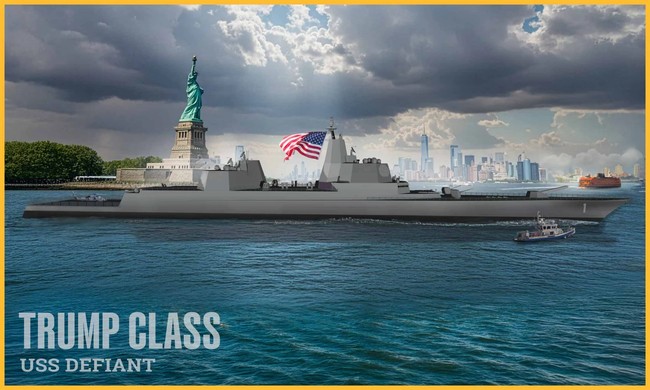
The Trump-class leverages proven and exciting new weapons in a hull large enough to put the fear of God into anything else at sea. I also couldn't help but notice a sizable helicopter deck. That's smart, because in addition to sub-hunting helicopters, that deck could provide plenty of real estate for tomorrow's weapons — drones and counter-drones.
“The future Trump-class battleship – the USS Defiant – will be the largest, deadliest and most versatile and best-looking warship anywhere on the world’s oceans,” Phelan said Monday with Trumpian aplomb. The ship's command, control, and communications systems give it a God's-eye view extending from far beyond visual range, all the way to low Earth orbit. No one has said it outright, but I strongly suspect powerful offensive cyber components are baked into the platform's battle systems.
Trump wants an initial order of two, with an eventual purchase of 20-25 ships.
And Another Thing: I have but two complaints about the Trump-class, aside from the name. First, it ought to be a nuclear-powered BBGN with 50 years' worth of fuel in its reactors. But that's just wishful thinking. Second — and completely realistically — we have GOT to perfect at-sea replenishment of those missile tubes. As things stand now, any guided-missile ship must return hundreds or thousands of miles to port after its missiles are expended. And those missiles get expended in a big hurry when things get serious.
Trumpian boats aside, the Trump-class BBG represents something vital: an American re-commitment to seapower. How vital? Milblogger CDR Salamander explained that last week, while writing on a related topic:
We have not been selling the largest benefits of American sea power and the fact that it is a strengthening thread woven through everything the West assumes is part of the natural order. Nothing is granted. Each generation must ensure a stewardship of those positive things previous generations have bequeathed to the future. We are failing at that, and I don’t think we fully appreciate the second and third order effects.
Emphasis added.
So is the proposed Trump-class really a battleship? In terms of being able to take on all comers in true battleship fashion, it sure gives that impression. And its robust electrical systems ought to future-proof it against coming developments in lasers and railguns.
As a down payment on Trump's "Golden Fleet," there's much to like here.
The naval theorist might believe they understand how a multidomain guided-missile battleship will fight and survive in the real world, but they — like us — will just have to wait and see.
Recommended: CUBA: Is Trump About to Do What No Other President Could?