Note: Most Thursdays, I take readers on a deep dive into a topic I hope you'll find interesting, important, or at least amusing. These essays are made possible by — and are exclusive to — our VIP supporters. If you'd like to join us, take advantage of our 60% off promotion.
The weirdest thing started happening in Ukraine several weeks ago, but I hesitated to report on it in case it was a one-time thing. After all, this was the war whose fast-moving early months required an update once or twice a week, then once every couple of weeks... and now every month or two at most. But the weird new thing has gone on now for almost two months, so it's time to give it a look.
Ukraine Army forces are advancing.
I told you it was weird.
Not everywhere all at once, or anything like that. These are local advances, purely tactical in scope and hardly threatening Russian lines with an operational-level breakthrough. And I don't bring this up because the gains are large — they aren’t — but because something in the underlying balance may have shifted, however temporarily.
Black Bird Group did such an excellent job of summarizing what happened in February that I'll just embed it here, rather than trying to recreate what they did, but worse.
This is mainly due to the Ukrainian counterattacks on the Southern Front, which managed to push the Russians out of 213 km² of territory.
— Black Bird Group (@Black_BirdGroup) March 2, 2026
Most of these Ukrainian gains were made around Hulijaipole where Russia lost 192 km².
2/
Ukraine actually took back more territory than it lost in February, a feat not achieved in almost three years.
A Financial Times reported deflated Kyiv's claim of having recaptured "400 square kilometers of territory, including eight settlements," reminding readers that net gains amounted to "just 37 sq km." There's a push-me/pull-you effort along the frontlines, where each Ukrainian gain is nearly matched by Russian gains elsewhere.
That might not sound like much, and in terms of territory recaptured, it really isn't. Still, additional perspective is helpful, and I'll come back to that momentarily.
Then again, even small advances beat withdrawing everywhere, which is what Ukraine spent last year doing, however slowly.
And Another Thing: All the news reports use kilometers, and rather than risk doing the math wrong, I'll use them, too.
Don't get too excited/angry/whatever. This is nothing like 2022, when Russian offenses toward Kyiv, Kharkiv, and Kherson all collapsed under pressure.
Things continue along those lines here in the third week of March.
Maybe Kyiv's ability to advance is a temporary thing, enabled by Russia's loss of Starlink access on Feb. 1, and doomed to sputter out as soon as Russian forces figure out a workaround. Maybe sheer numbers of drones, combined with new tactics, are the reason:
Russians at the front are complaining that Ukrainian forces over overwhelming them with swarms of 300-400 drones which are then followed by mobile infantry that advance through their positions. pic.twitter.com/GReiWBbmb4
— Jay in Kyiv (@JayinKyiv) March 13, 2026
Whatever the case, while the situation remains slow-moving, it's still fluid. Advantages tend to be short-lived.
But rather than ponder the imponderable, let's look at last year's grim casualties to give you that perspective I mentioned earlier.
Russia conquered approximately 4,500 sq km of Ukraine in 2025 — that's a rough midpoint between the low- and high-end claims — or about 0.75% of the country. Yes, less than 1% of ground gained. Another midpoint figure is 415,000 for Russian casualties in 2025.
For Western forces, the typical wounded-to-dead ratio is 3:1. That is, three men wounded for each man killed. But for various reasons outside the scope of this essay, Russian forces fare much worse, with a 2023 report concluding that the Russian military in Ukraine suffers closer to just 1.8 wounded for each man killed. If that held true in 2025, then breakdown for Russian losses last year would be about 146,600 killed and 268,400 wounded.
Again, these are estimates and guesstimates based on Western intelligence, in some cases backed up by open Russian sources like grave registrations.
The results, approximate as they are, ought to be sobering.
Russia gained about 4,500 square kilometers last year at a cost of roughly 415,000 casualties—something like 90 men, including 25–35 dead, for every square kilometer of blasted fields, shattered villages, and mined tree lines.
Now imagine having to do that 400 times... just to break even.
But I digress.
Earlier this week, Ukraine President Vladimir Zelensky claimed that Russia's spring offensive campaign "has already failed," adding, "The spring campaign, as it had been planned, has drowned in this spring — they were unable to advance."
Of course, Zelensky is hardly a disinterested source.
Still though, let's take a closer look to one of those Russian attacks that "drowned," because if that shift is real, we might have already seen the first test.
It's fair to assume that Moscow wasn't too concerned with territorial losses in a few smaller places because maybe they had held back forces for the inevitable spring/summer offensive somewhere more important. Although it would also be fair to wonder why the side with four times the population of the other couldn't maintain strong defenses across the entire front.
Well, we might already have seen the start of Offensivepalooza '26, and if so, the start isn't exactly auspicious. Russian forces on Tuesday attacked to the northwest along a 60-mile-wide front, roughly between Pokrovsk to Hulyaipole. Moscow committed heavily, and OSINT Intuit posted that "intent appears to have been a coordinated spring offensive opening across the full southeastern axis."
For reference, this is generally the same area as Kyiv's failed 2023 Zaporizhzhia counteroffensive toward the Sea of Azov, and represents Moscow's current best hope for capturing the rest of the Donetsk region officially "annexed" but never fully occupied.
Ukraine's "414th Unmanned Systems Forces," known as Magyar's Birds, along with "allied drone units tracked and struck the assault groups on approach before they could consolidate."
414th commander Robert Brovd reported 900-plus Russian killed and wounded while forcing Ukraine to give up exactly zero positions. Ukraine broke the attack in less than two days of heavy combat, fighting almost entirely by drone.
𝗙𝗮𝗶𝗹𝗲𝗱 𝗥𝘂𝘀𝘀𝗶𝗮𝗻 𝗦𝗽𝗿𝗶𝗻𝗴 𝗢𝗳𝗳𝗲𝗻𝘀𝗶𝘃𝗲 𝗔𝗹𝗼𝗻𝗴 𝟭𝟬𝟬-𝗸𝗺 𝗙𝗿𝗼𝗻𝘁
— OSINT Intuit™ (@UKikaski) March 18, 2026
During 17-18 March, RF assault groups moved simultaneously across the Pokrovsk to Hulyaipole directions using infantry (Storm Z), mechanized, quad bikes, and horseback in some sectors.… pic.twitter.com/LoQbk0qeSd
"Failed Russian Spring Offensive" is much stronger language than I use for a 36-hour push in a war now in its fifth year. But the Russian attack's failure — with some units reporting 90% casualty rates — is surely indicative of the difficulties advancing against a country that now produces something like seven million drones annually.
March 18 is also worth noting because it marked what appears to be a one-day high for Russian losses, at 1,710 men killed, wounded, or missing.
In 2025, Russia held the upper hand in the drone war. What little gains Russian forces made last year generally followed the same "infiltration" attack model:
- Longer-range drones to degrade Ukrainian logistics and hamper reinforcements.
- Large numbers of Russian soldiers move forward under drone/artillery cover.
- Any men that make it forward (losses were staggering — sometimes only a handful out of a hundred made it forward) establish a new forward position.
- Repeat.
This worked in part because Kyiv is so short on manpower that there are barely any men along the front.
But in this week's "spring offensive" launch, if that is indeed what it was, Russian forces never even made it to Ukraine's thinly held lines. Maybe the balance of drone power has shifted back to the defenders. Maybe the failed Pokrovsk-Hulyaipole offensive was a one-time thing. There's no rushing to judgment in a war this long and depressingly slow-moving.
All this goes back to something Kyiv learned the hard way more than two years ago during the Zaporizhzhia counteroffensive.
2022 was a heady year for Ukraine, forcing Russia to abandon three lines of attack on three major Ukrainian cities, including Kyiv. In case you'd forgotten what that was like, here's the Wikipedia Commons map.
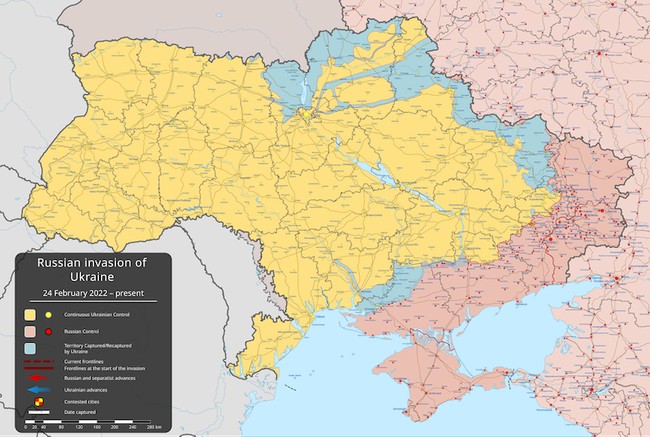
All the blue represents territory taken back from Russia in 2022 — which I remind you of because of what's happened (or rather not happened) since.
Russian forces had just taken those lands and hadn't dug in. Rooting them out was comparatively easy, not that I'm being glib about the lives lost or the severity of the fighting. But when Kyiv tried a similar counteroffensive in the south in 2023, where Russians had dug in, they slammed into a brick wall.
In what's loosely known as the Zaporizhzhia counteroffensive, Kyiv suffered an estimated 70,000-100,000 casualties for nothing. Yet in the last several weeks, they've essentially slowed Russian forces to a stop, including local gains into entrenched positions, for comparatively few losses. That's new.
What hasn't happened in 2023-2026 is the kind of fast-moving maneuver warfare (first by Russia, then Ukraine) that we saw in 2022. It's just been one long, stupid, high-casualty slog.
At least until something changed in February, whether it was Russia losing Starlink, Ukraine regaining the upper hand in drones, or whatever. I don't pretend to know. But Ukraine has made some small advances with light casualties in the last two months, and Russia has made some small advances with the now-usual heavy casualties.
It isn't as though the Kremlin is out of options, but it could be when things get seriously unpredictable for everyone involved. For starters, Putin could order full mobilization of the economy, complete with mandatory conscription to take full advantage — at long last — of Russia's manpower advantage.
But there's no telling how the Russian public might react.
Again, who knows? Maybe Russian forces will do what they've done since 2023, and just keep grinding forward at terrible cost, hoping something snaps.
My PJ Media colleague Richard Fernandez had a warning on Wednesday about Operation Epic Fury against Iran, but there are lessons in his post that apply more broadly — and ought to be seen by the White House. "People and fanatic states do not expire without a fight, especially if they are comprised of brave men," Richard wrote. "As they lose their grip they will become desperate in a way that people who have not been in that situation cannot grasp."
As the war grinds on, now with the added frustration of Ukraine's drone advances and the loss of Starlink, you do wonder if there's any growing sense of desperation in the Kremlin. Perhaps there's a lesson in that for the people of Russia, too. But even after four-plus years of increasingly pointless and wasteful fighting, complacency seems to rule them just as much as Putin does.
Until that complacency shifts, tactical battlefield shifts at 90 Russians per square kilometer might be the best anyone can expect.
Last Thursday: Nationalism Sucks. Britain Might Need Some Anyway.