







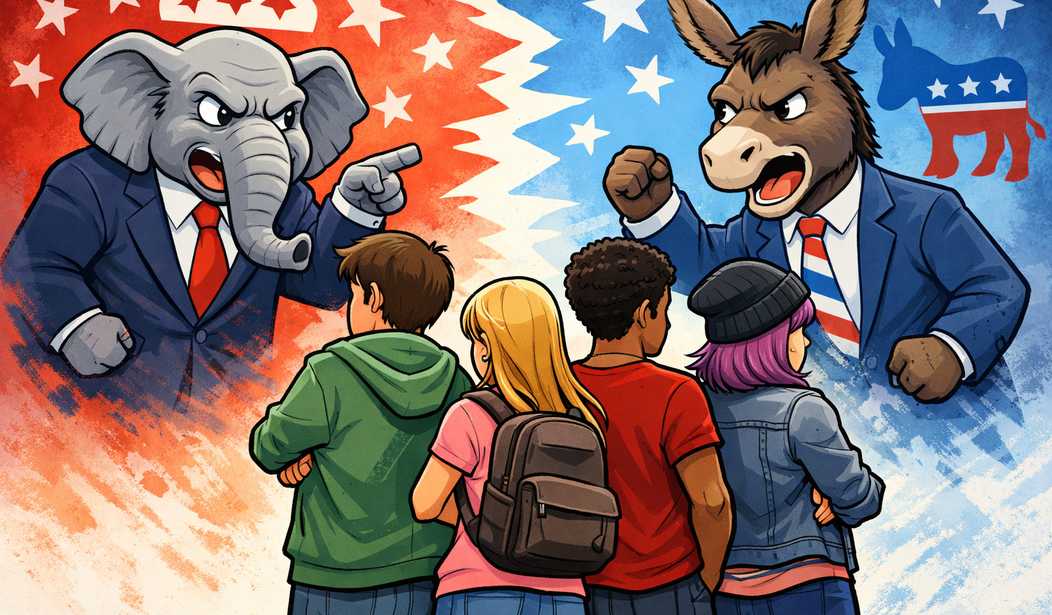
At a Tea Party-era CPAC conference in Washington, my PJTV colleague Bill Whittle joked at an event he hosted, "It's nice to see so many young faces at a conservative event. The average age at these things is usually 'deceased.'"
Jokes aside, attendance at youth-oriented CPAC is down significantly since 2009, but if you want to see just how badly both parties do with younger voters these days, look no further than Gallup's new Political Party Identification numbers.
Whatever it means to be a Republican or a Democrat, Gallup's survey shows that it means less than ever — particularly to the young generations displacing the Boomers, the Silent Generation, and (eventually) my brother and sister GenXers.
If Millennials decided that old-fashioned D or R affiliations were, well, old-fashioned, GenZ coming up behind them just told Gallup, "Hold our White Claws while we register as independents in record numbers." In fact, Gen Z is the first generation where a majority is registered with neither political party.
And the trendline from one generation to the next is clear: Neither party does much to attract younger voters. Hell, both parties seem to be actively turning off young voters.
Usual Disclaimer: Short-term, political polls generally aren't good for very much, except to generate a snapshot image of a fast-moving event. But Gallup began conducting its Political Party Identification poll almost 40 years ago, and its latest figures "are based on interviews with more than 13,000 U.S. adults throughout the year."
Where we are now is that a "record-high 45% of U.S. adults identified as political independents in 2025, surpassing the 43% measured in 2014, 2023 and 2024," according to Gallup. "Meanwhile, equal shares of U.S. adults — 27% each — identified as either Democrats or Republicans."
GenX-Boomer-Silent identification with the Republican party ranges from 31% at the Gen X young end, to 34% for the Boomers, and 37% for the Silents. That same run goes 25%-32% for Democrat self-ID.
Take a moment to ponder that slightly more Boomers now call themselves Republicans than Democrats. Woodstock was a long time and millions of knee replacements ago.
Democrats hold an advantage with younger voters, as usual, but it's just a three-point advantage with Millennials (born 1981-1996). I suspect the spread is so narrow because the sheen has worn off Barack Obama, and Millennials entered their 40s and had to get serious about grown-up stuff. And yet, only 21% of them ID as Republicans and just 24% as Democrats.
Here's the strongest indicator of the health of our political parties. Only about a third or less of the two older cohorts are independents. There's a huge jump among Gen X to 42% who are neither R nor D.
But there's another huge jump when you get to the Millennials, 54% of whom told Gallup they belong to neither party — and it's 56% for Gen Z.
Gallup reminded readers that "older generations of Americans have been less likely to identify as independents over time," and that Gen Z, "like previous generations before them when they were young, identify disproportionately as political independents."
But disproportionality isn't what it used to be; otherwise, the percentage of independents wouldn't have increased by 50% since 1990, while the percentage of young voters has remained more or less the same.
Democrat, Republican... it doesn't matter — neither party connects with young voters the way it once did. I suspect it's a self-reinforcing trend, too. The most important indicator for which party a young person will identify with as they get older is which party their parents identified with.
I don't have any grandkids (that I know of!), but that generation — sometimes known as Generation Alpha — will be largely raised by parents with no party ID. That's a first in Gallup's Political Party Identification poll going back to 1988, and likely a first in American history.
In the headline, I wrote, "What's Next?"
I phrased it as a question instead of "Here's What Happens Next" because I honestly have no idea.
But I do know that a forward-looking party would take those numbers as an opportunity to win over undecided young voters and cement their position for the next generation or three.
Does anyone out there know any forward-looking parties?
Recommended: Trump Says 'You'll Find Out Pretty Soon' What He'll Do for Iranian Protestors
Like what you’re reading? There’s a lot more where that came from.
PJ Media VIP members get deeper dives, exclusive columns, and commentary you won’t see on the public side. Best of all, you can get 60% off right now with the promo code FIGHT.
Sign up for PJ Media VIP and help us keep telling the stories that matter.

Join the Conversation
VIP members get the ability to comment on articles.