





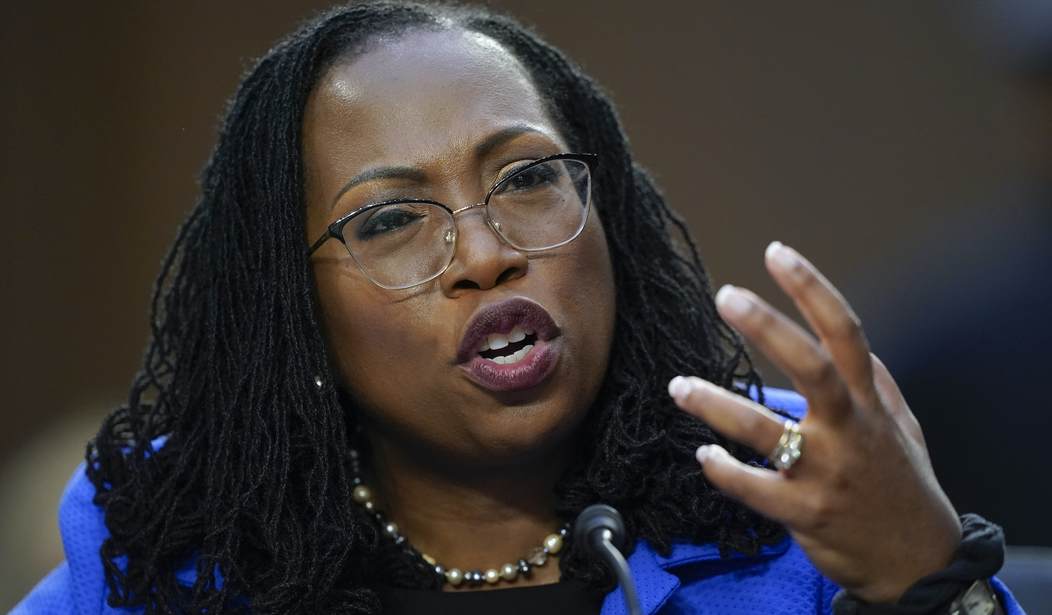
Justice Ketanji Brown Jackson is distinguishing herself on the U.S. Supreme Court — and not in a positive way. It’s as though she’s positioned on an island defined by woke ideology, racial justice, and equity, while the other eight justices remain on the mainland of restraint.
For proper context, it’s important to know about a case that was in front of her and the other members of the court.
The case centered on an early morning police stop in Washington, D.C., where a Metropolitan Police officer responded to a call about what was described as a suspicious vehicle. At around 2 a.m., the officer approached the car, and immediately—without any further provocation—two individuals fled the vehicle. A third person remained inside with the door open. That individual, identified only as J.W., slowly backed the car out of the parking lot.
The officer ordered the driver to put his hands up while drawing his service weapon.
The lower court, in this case the District of Columbia Court of Appeals (DCCA), ruled that the officer stopped R.W. without reasonable suspicion and concluded that this violated the Fourth Amendment. That amendment states:
The right of the people to be secure in their persons, houses, papers, and effects, against unreasonable searches and seizures, shall not be violated, and no Warrants shall issue, but upon probable cause, supported by Oath or affirmation, and particularly describing the place to be searched, and the persons or things to be seized.
The Supreme Court heard the case and reversed the DCCA’s ruling in a 7-2 decision. Leftist Justice Elena Kagan joined the majority. Justice Sonia Sotomayor and Justice Ketanji Brown Jackson were in the minority on this one, though Sotomayor said she would not have agreed to hear the case.
In the end, the majority on the court upheld law enforcement’s authority to make a stop based on "the totality of the circumstances" involved.
Now that you have the context, let’s turn to one of our foremost legal minds, none other than Jonathan Turley, to lay it out with clarity. On the X platform, Turley posted, “Justice Ketanji Brown Jackson has issued another sole stinging dissent…Jackson wrote that ‘I cannot fathom’ how the seven justices could second-guess the lower court in rejecting the police claims. She accused her colleagues of mere ‘wordsmithing.’”
Justice Ketanji Brown Jackson has issued another sole stinging dissent. In a 7-2 decision (with liberal justice Elena Kagan joining the majority), the Court upheld the authority of police to make a stop based on the totality of the circumstances...
— Jonathan Turley (@JonathanTurley) April 20, 2026
Here’s the full quote from Jackson's written dissent: "If, finally, the Court's decision to intervene reflects disapproval of the DCCA's assessment of which particular facts to weigh and to what extent, I cannot fathom why that kind of factbound determination warranted correction by this Court."
While Sotomayor voted with Jackson in this case, she declined to join in the dissent Jackson wrote. I wonder why.
What Jackson was trying to say was that the Supreme Court never should have taken the case, and that the DCCA nailed it. Her only problem with the DCCA was that she felt it could have worded things better.
Turley’s point in a thread on X was that both Jackson and Sotomayor “felt that those facts were not sufficient for the requisite suspicion needed for the stop. That seems a tad more than ‘wordsmithing.’”
So, to recap, in Jackson’s view, the police had no basis to make a stop when an officer saw two passengers flee a vehicle simply at the sight of police, and then observed a third person attempt to drive away so hastily that the car door was left open. That, apparently, is not suspicious at all.
According to Newsweek, on the morning of the traffic stop, the “District of Columbia charged R.W. (who was a minor at the time) with unauthorized use of a motor vehicle, felony receipt of stolen property, unlawful entry of a motor vehicle and operating a vehicle in the District of Columbia without a permit, ‘largely based’ on evidence found after District of Columbia Metropolitan Police Officer Clifford Vanterpool told R.W. to put his hands up.”
Vanterpool noticed something suspicious, checked it out, and lo and behold, found several crimes along with the suspected perpetrator. Jackson seems to think the world would be a better place if the officer had not done any of what he did, and that the criminal suspect should have been left alone.
More to the point, in court, lawyers pointed to four facts that justified the police officer's “reasonable suspicion.” Newsweek listed them as: “The officer receiving a radio dispatch call regarding a suspicious vehicle, the officer seeing two people flee from the vehicle, the officer's time of arrival at around 2 a.m. and that as the officer approached the car, it began ‘backing out of the parking space…while the rear driver’s side door [was] still open.’”
The Newsweek report added that the “trial court found R. W. delinquent on all counts and assigned him one year of probation with conditions.”
It was only on appeal that R.W.’s attorneys effectively maintained that the police officer "lacked reasonable articulable suspicion sufficient to justify the seizure." Even so, the Supreme Court overturned this and brought sanity back into the judicial process, at least for this moment.
The kicker for me is something Turley wrote about last July. He linked to it in his X rant about this latest dissent from KJB, but it’s what he seems to believe is the fundamental problem with Jackson.
He quoted Jackson’s comments to ABC News where she said, “I just feel that I have a wonderful opportunity to tell people in my opinions how I feel about the issues, and that’s what I try to do.”
“The histrionic and hyperbolic rhetoric has increased in Jackson’s opinions, which at times portray her colleagues as abandoning not just the Constitution but democracy itself,” Turley wrote. “Jackson, however, clearly feels that opinions are a way for her to opine on issues of the day. She is not alone. Across the country, liberal judges have been adding their own commentary to decisions in condemning Trump, his supporters, and his policies.”
In other words, Jackson appears to see herself less as a justice who decides cases based on the law and the U.S. Constitution, and more as someone who gets to share her opinions on issues.
Seriously, if that’s all she wants, I’m sure The Atlantic could use another leftist writer. That would free up a slot on the Supreme Court, where Trump could appoint a real legal mind.
Find out what you’re missing behind the members-only wall. It’s time for you to take advantage of the full catalogue of common sense thinking that comes with a PJ Media VIP membership. You’ll get access to content you didn’t even know you wanted, and you’ll be hooked. The good news is, PJ Media VIP memberships are on sale! Get 60% off of an annual VIP, VIP Gold, or VIP Platinum membership! Use promo code FIGHT to get 60% off a VIP membership!

Join the Conversation
VIP members get the ability to comment on articles.