


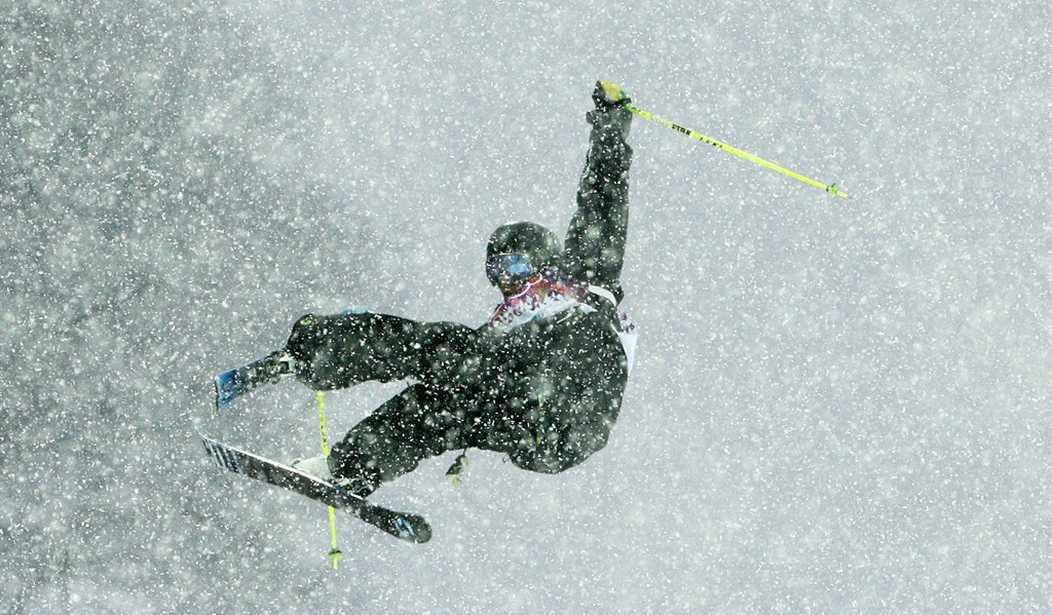
It’s been a few days now since Team USA freestyle skier Hunter Hess set the unpatriotic tone among some American athletes at the 2026 Winter Olympics in Milan and Cortina, Italy.
Hunter Hess has every right to voice his hatred of America.
— Rudy W. Giuliani (@RudyGiuliani) February 10, 2026
He doesn't have the right to represent Team USA.
A place on Team USA is earned, and while he may be a phenomenal athlete, he's clearly ungrateful to the country that has allowed him to succeed.
Pull him off the team. https://t.co/P5w4JotfeK pic.twitter.com/TskvPfpddT
Hess was joined at that presser by his teammate Chris Lillis, and since then, a number of other Team USA members have weighed in on the same issues.
Because of how I’ve made my living the past few decades, something about those comments bugged me in ways beyond just their content. They’re all using very consistent wording and phrasing. This suggests to me that these weren’t off-the-cuff comments to unanticipated questions.
As I wrote on Saturday, many, if not most, Olympic athletes receive pretty intense media training and media coaching. PR teams develop key messaging, talking points, and Q&A reference documents for use by trainees. The Q&A documents list the most likely questions they may get, and also the ones that are likely to be the most hostile. Having this in advance is hugely important to the preparation process.
In coaching sessions, trainees role-play interview scenarios in advance and work out the kinks in their responses. All of this so that when they sit in front of cameras and lights and reporters, they have their answers to the most likely questions at the ready.
If I were conducting the training for these athletes, it would have been a no-brainer to anticipate questions about what’s happening in American politics and on American streets.
I can’t know for certain which athletes were media-trained in this way, but the thing I can’t unsee is the pattern in their responses. There are some suspiciously non-coincidental consistencies in their messaging.
When Hess spoke, he made the comment that “If it aligns with my moral values, I feel like I’m representing it” as part of his answer about how he feels about representing the United States. Seconds later, he added, "I think, for me, it's more I'm representing my friends and family back home and the people that represented before me and all the things that I believe are good about the U.S."
That’s twice where he stated and reiterated that he felt he was representing his values, not the values of a nation. In the process, as we all now know, he blew off any mention of being proud of or grateful to the nation he was selected to represent.
Hess’s teammate Lillis followed with his answer to the same question, saying, “I think that, as a country, we need to focus on respecting everybody's rights and making sure that we're treating our citizens, as well as anybody, with love and respect. And I hope that when people look at athletes competing in the Olympics, they realize that's the America that we're trying to represent.”
Like Hess, Lillis clearly inferred that he was not representing all of America, only a portion of it, when he drew a clear distinction between his country and “the America that we’re trying to represent.” This is consistent with Hess saying he represents primarily his own values and not those of the country.
Lillis also introduced into the altruistic narrative the need for “love and respect.” As with any good narrative, this isn’t the last time you’ll hear that messaging.
If you watch skier Mikaela Shiffrin’s response to the same question, you can see she not only tried to prepare for it, but she kept her notes on her phone at the ready.
🚨 JUST IN: Growing calls from Americans to send Team USA athletes home from the Winter Olympics in Italy if they disparage the United States on the world stage.pic.twitter.com/ES75BuJEkO
— Derrick Evans (@DerrickEvans4WV) February 8, 2026
Because she talked about world peace, and she mentioned the quote from Nelson Mandela that was featured in the previous evening’s opening ceremonies, it’s understandable that she might want to refer to her phone for that. What’s interesting is just how prepared for the question she was.
Equally interesting to me is that after she reads the Mandela quote, she continues to refer to her phone for notes, which suggests that’s the one question she specifically prepared to answer this carefully.
"For me, as this relates to the Olympics, I really hope to show up and represent my own values. Of diversity, and kindness and sharing."
There it is again. Just like Hess and Lillis, she made it a point, in so many words, to say she was representing her values, not the values of a nation. Her version of Lillis’s “love and respect” message came from her as “diversity and kindness, and sharing.”
Already, you can see an almost inorganic uniformity to these messages. And a uniform exclusion of patriotic pride and gratitude.
Related: Figure Skater Amber Glenn Joins the Trend of U.S. Athletes Getting Political
Chloe Kim, another freestyle skier, made her comments to the media on all of this after President Donald Trump skewered the athletes who have been bashful about their pride in the U.S. at this year’s winter games.
“We need to lead with love and compassion, and I’d love to see more of that,” she said.
Once again, a Team USA member inserts “love and compassion” into the narrative without paying homage to her sponsoring nation.
Are kindness, love, compassion, and respect bad things? Of course not. By inserting these concepts into the narrative, while carefully omitting any respect due to the U.S., the crafters of these messages cynically laid a trap. If you criticize these athletes for not saying what they should have said, their leftist defenders will say you’re criticizing the altruistic comments they did make. Why are you conservatives against love, compassion, kindness, and world peace?
To be sure, conservatives and American normies aren’t criticizing world peace and kindness; they are criticizing athletes who clearly appear to be embarrassed to be representing the United States of America.
In fairness to Kim, by Monday, she was starting to read the room, so when she made her comments to the New York Times, she made sure to include the patriotic messaging we all expect from Team USA Olympians.
“It’s important in moments like these for us to unite and kind of stand up for one another with what’s going on,” Kim said. “I’m really proud to represent the United States. The U.S. has given my family so much opportunity, but I also think we are allowed to voice our opinions on what’s going on.”
I should have said that Kim almost read the room. Of course you can voice your opinion on “what’s going on,” but as an athletic ambassador for the U.S., that’s not your role for a couple of weeks, while that flag is on your shoulder.
Maddie Mastro, a native Californian and a snowboarder, internalized the patriotic messaging and paired it with that nagging detractive messaging we’ve seen throughout. She said, “I’m proud to represent Team USA and my country… I’m also saddened about what’s happening at home. It’s really tough, and I feel like we can’t turn a blind eye to that. At the same time, I represent a country that has the same values as mine, kindness and compassion, and we come together in times of injustice.”
Mastro checked all of the narrative boxes. She included pride in country, but also “same values as mine,” “kindness,” and “compassion.” She added the need to “come together in times of injustice,” which is a not-so-subtle attack on the White House, and it undermines her comments about being proud of representing the U.S.
Not to be outdone by the kids, Rich Ruohonen, a middle-aged curler and lawyer, decided to use his platform to speak out on something other than curling.
NEW: American curler Rich Ruohonen criticizes ICE at the Winter Olympics, says it has been a really “tough” time for people in Minnesota.
— Collin Rugg (@CollinRugg) February 10, 2026
“We'd be remiss if we didn't at least mention what's going on in Minnesota…”
“I am a lawyer, as you know, and we have a constitution… and… pic.twitter.com/nsnItO9Y1C
As a lawyer and a Minnesotan, his comments were largely his own, but even so, when people speak from the heart, propaganda can still seep into the discussion, and it did with him.
After railing against ICE without mentioning ICE, he said, “I really love what’s been happening there now, with people coming out, showing the love, the compassion, integrity and respect for others that they don’t know and helping them out.”
There you go. More “love,” “compassion,” “integrity,” and “respect” messaging, while at the same time disparaging the internal affairs of his sponsoring country. Does he have a right to say it? Sure he does, legally. But should he? No.
Even a curler found a way to incorporate a narrative that came from some messaging lab somewhere and found its way to the lips of Team USA athletes. They either were coached and trained to say it, or they received reference materials that contained it, or they heard other athletes say it and now they’re parroting it. Regardless, it looks and feels very much like a scripted and planned narrative
This is how it works. Plant some altruistic comments in your messaging. Craft some passive-aggressive language to use against your target – in this case, the U.S.A. So when people complain to you, you can counter with a defense of your altruistic language, while passive-aggressively ignoring the very intentional jabs you took at your country.
Since it seems obvious, at least to me, that someone crafted the narrative that’s now spreading, thanks to some members of Team USA, I wonder who is behind it. Is it their management companies? Probably not. Different athletes have different management companies. Is it the U.S. Olympic and Paralympic Organization (USOPO)? Is it an activist or advocacy group?
I can’t prove it, but I have learned that when messaging is this precise and this consistent, there’s a script on someone’s computer.
Find out what you’re missing behind the members-only paywall. It’s time for you to take advantage of the full catalogue of common-sense thinking that comes with a PJ Media VIP membership. You’ll get access to content you didn’t even know you wanted, and you’ll be hooked. The good news is, PJ Media VIP memberships are on sale! Use promo code FIGHT to get 60% off an annual VIP, VIP Gold, or VIP Platinum membership!





Join the conversation as a VIP Member