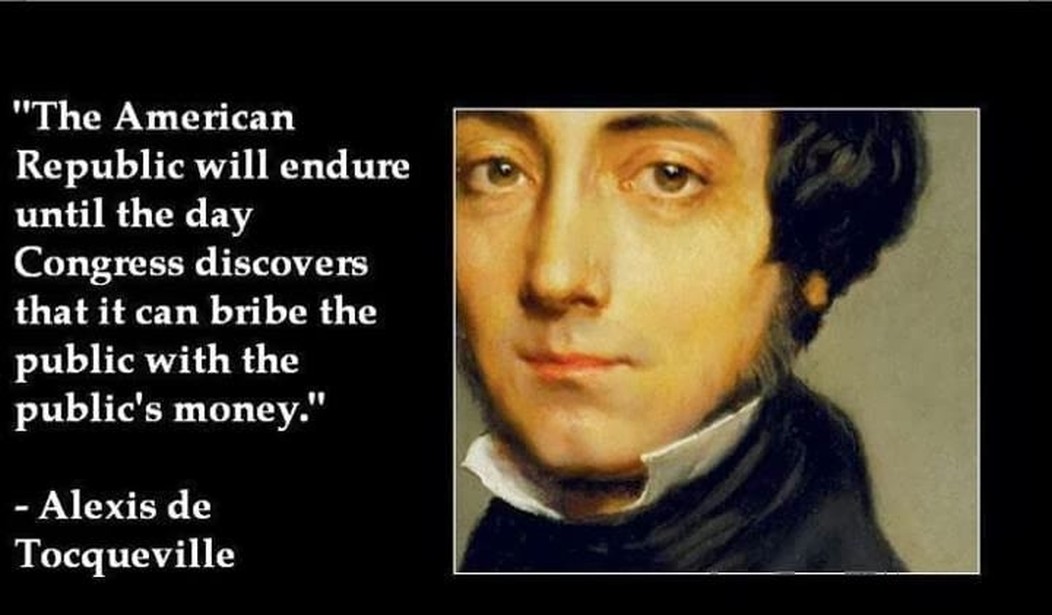

Sometimes, when seeking to learn and appreciate what our founding fathers did and sacrificed, and in the end created, we need to look beyond their specific stories. Sometimes, we need to find the best storytellers. The people who have created the American story. On the matter of America’s founding and why it is so special, look no further than Alexis de Tocqueville.
De Tocqueville was a French political writer and historian. He was born in 1805, after the founding of the United States of America, and he lived until 1859, just before the American Civil War broke out. He is best known for his study of American government, culture, and society, which is detailed in his volumes, Democracy in America. His two volumes under that title were so powerful and influential that not only did they capture the American society that existed, but they also served to help perpetuate it in future generations.
Today, they are as relevant as ever. In his writings about America, he sought to find out just what made American society function and perform so differently than anywhere else in the world. He was captivated by this country’s embrace of liberty and equality in their most pure forms.
To conduct his research and form his insights into America, he traveled throughout the country during the early 1830s. The official reason for his travels was to study the American prison system, but in reality, he was thinking much more broadly. He wanted to understand how democracy functioned in practice.
So when he traveled, he talked to everyone and read everything he could find on government and governing, commerce, economics, our justice and election systems, and something even more. He was a student of the American spirit as expressed to him verbally and nonverbally through everyone he met.
That’s the high-level view. To more fully appreciate him, I thought I’d share a little more detail from one of my favorite chapters in his book. Chapter IV, “The Principle of the Sovereignty of the People in America.”
De Tocqueville makes it clear that he believes you can’t discuss any of America’s political laws without first discussing the country’s “doctrine of the sovereignty of the people.” He points out that in most countries, lip service is paid to “the will of the nation,” mostly to pacify the masses. But in the United States, it’s different.
In America the principle of the sovereignty of the people is not either barren or concealed, as it is with some other nations; it is recognized by the customs and proclaimed by the laws; it spreads freely, and arrives without impediment at its most remote consequences. If there be a country in the world where the doctrine of the sovereignty of the people can be fairly appreciated, where it can be studied in its application to the affairs of society, and where its dangers and its advantages may be foreseen, that country is assuredly America,” he wrote.
The author said that this cultural appreciation for freedom and self-governance had long brewed throughout the colonies. Still, he said, power was in the hands of the few – of those who controlled the wealth, and in the hands of New England intelligentsia.
But once the American Revolutionary War broke out, “the doctrine of the sovereignty of the people, which had been nurtured in the townships and municipalities, took possession of the State: every class was enlisted in its cause; battles were fought, and victories obtained for it, until it became the law of laws.”
In effect, what he is saying is that America’s revolution was not just against the British crown, but also against the new country’s former hierarchy. No longer were just the elite in charge of everything.
But once the concept of self-governance by and for all of the people took hold, there was no turning back. In fact, some of the most privileged in society were the same ones who voted against their own self-interest to share democratic power with people from all classes.
De Tocqueville explained, “The most democratic laws were consequently voted by the very men whose interests they impaired; and thus, although the higher classes did not excite the passions of the people against their order, they accelerated the triumph of the new state of things; so that by a singular change the democratic impulse was found to be most irresistible in the very States where the aristocracy had the firmest hold.”
Then the author digs into something that takes on new meaning even today as we see a rise in populism in America and around the world. de Tocqueville writes that the more people experience democracy, the more they want more of it. Once given a voice and a say in the country’s affairs, they collectively want a greater say in their own destiny.
There is no more invariable rule in the history of society: the further electoral rights are extended, the greater is the need of extending them; for after each concession the strength of the democracy increases, and its demands increase with its strength. The ambition of those who are below the appointed rate is irritated in exact proportion to the great number of those who are above it.
The author reminds his reader that even in countries that allow for a certain amount of self-governance, it’s always a sort of guided self-governance, but not in America. In the United States, “society governs itself for itself. All power centres in its bosom; and scarcely an individual is to be meet with who would venture to conceive, or, still less, to express, the idea of seeking it elsewhere. The nation participates in the making of its laws by the choice of its legislators, and in the execution of them by the choice of the agents of the executive government; it may almost be said to govern itself, so feeble and so restricted is the share left to the administration, so little do the authorities forget their popular origin and the power from which they emanate.”
Much has changed in America since de Tocqueville penned those words, but their spirit is not dead. If it were, Donald Trump never could have defied all of the odds and obstacles placed in his path in 2024.
Looking ahead, we will need to preserve and foster this notion of a truly sovereign, self-governing people so that together, we can meet head-on those who would take it away from us.