







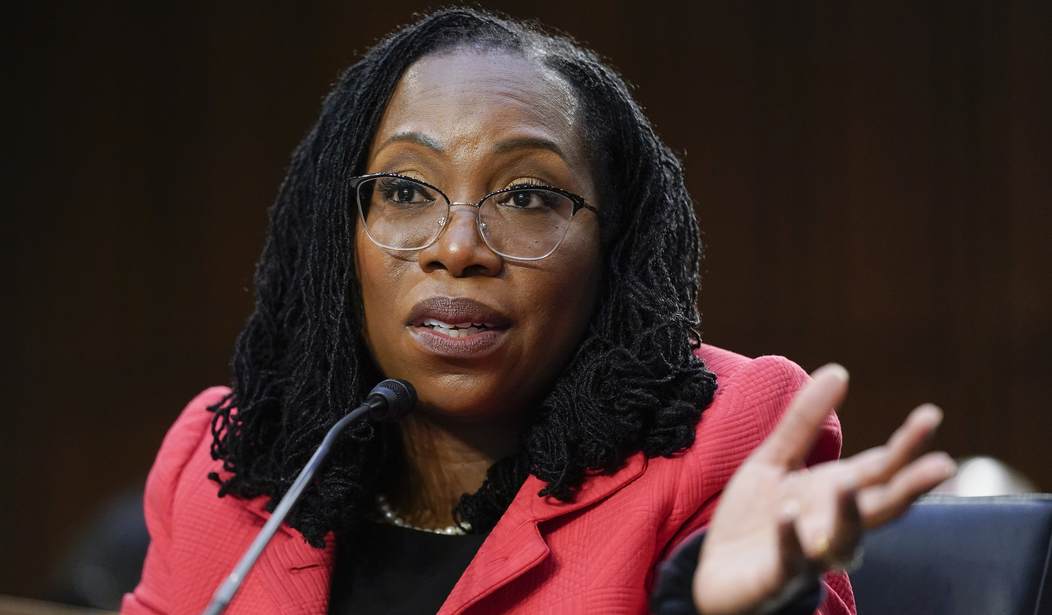
U.S. Supreme Court Justice Ketanji Brown Jackson never seems to disappoint if you’re a PJ Media writer looking for the next thing to investigate. In the media business, you could say she’s “good copy.” And so today, during oral arguments in a Second Amendment case, Wolford v. Lopez, she did it again.
For background, the case itself centers on a Hawaiian law that does not allow people with public carry licenses to have their handguns on them when they are on private property that is open to the public, unless they have prior permission from the owner.
I wrote in more detail about today’s arguments earlier. But one item from the day's events at the Supreme Court simply demanded special attention.
The subject of “Black Codes” came up when Justice Neil Gorsuch first weighed in.
Black Codes were laws enacted in the southern states after the Civil War, most notably an 1865 Louisiana law. From the outset, their intent was to control and restrict the freedoms of newly emancipated slaves. These codes were designed to limit black Americans’ economic, social, and political freedoms. They involved forced labor contracts, which, if violated by the former slave, could lead to the arrest of said former slave. Limits were placed on travel and there were even curfews on black people.
The obvious intent of the Black Codes was to deny and restrict basic freedoms to a segment of the population for the purposes of finding another way to maintain a large underclass.
It appears that Hawaii relied to some extent on the Black Codes to justify placing restrictions on public carry. To be sure, the Black Codes expressly restricted gun ownership among black people and prohibited them from carrying guns on plantations, which were private property, without the plantation owner’s consent.
Stick with me. We’re about to get to the mind-blowing part.
Gorsuch told Neal Katyal, the lawyer for Hawaii, that he wanted to “understand how you think Black Codes should inform this court’s decision-making. It’s quite an astonishing claim to me.”
Gorsuch then pointed out the hypocrisy of the gun control side of the aisle in cynically trying to use a 19th century racist law that was struck down long ago as a means to restrict gun ownership in 2026.
He called the Black Codes example an “outlier” and then told Katyal directly that for the “people (who) like to cite the Black Codes” as a means to restrict gun ownership, the laws “otherwise … would be garlic in front of a vampire.”
For the back of the classroom, that simply means that if you are against slavery and placing unconstitutional restrictions on blacks now or retrospectively, there is no point to trying to use those post-Civil War restrictions to inform today’s law.
Justice Samuel Alito chimed in, saying that the Black Codes were intended to prevent black people from defending themselves against the Ku Klux Klan and “racist law enforcement officers.”
Katyal agreed that the Black Codes “are undoubtedly a shameful part of our history.” However, he said, “that doesn’t at all mean that this particular law is irrelevant to Second Amendment analysis.”
Wait. What?
Not to be left out, Jackson had her say, and if you can believe this, she appeared to come out in defense of the Black Codes.
Things I didn’t have on my bingo card today: Justice Jackson defending the racist Black Codes as precedent for what we should consider constitutional. pic.twitter.com/I9yxcMsDrf
— Carrie Severino (@JCNSeverino) January 20, 2026
She pointed out that the Black Codes “were being offered under the Bruen test.”
The Bruen test is the legal standard the Supreme Court created in New York State Rifle & Pistol Association v. Bruen (2022) for evaluating whether a gun law violates the Second Amendment. According to this test, a gun regulation is constitutional only if the government can show that it is consistent with the nation’s historical tradition of firearm regulation.
Her point was that since racial discrimination against former slaves through restrictions of gun ownership is part of America’s historical tradition of firearm regulation, shouldn’t it be considered here?
Please get your face out of your palm. I’m trying to write for you here.
Jackson said that the Black Codes should be considered as part of the country’s “history and tradition.”
“The fact that the Black Codes were at some later point determined themselves to be unconstitutional doesn’t seem to me to be relevant to the assessment that Bruen is asking us to make,” she said to U.S. Principal Deputy Solicitor General Sarah Harris.
In her response, Harris sounded like a kid who studied all night for just this question on a test, only to find out the teacher never read the book.
“Black Codes were unconstitutional from the moment of their inception because they are pretextual laws that are designed to ensure that newly freed slaves are returned to a condition of share-cropping.”
Jackson talked over Harris and stopped her when it appeared Harris might make an effective argument against the Black Codes.
Jackson said, “They were not deemed unconstitutional at the time that they were enacted. They are part of the history and tradition of the country. And when we have a test now that’s asking us to look at what people were doing back then, I don’t understand why they should be excluded.”
She really said that.
Harris did her best to bite her lip and change her tone. She firmly told Jackson what the justice clearly wasn’t understanding (by her own admission): that the Black Codes were outliers. They are “by definition unconstitutional.”
Jackson rephrased and pushed the same question again.
Obviously frustrated with Jackson’s inability to follow basic logic, Harris said, “Respectfully, a law is always unconstitutional if from its inception it was (unconstitutional).”
Jackson cut her off again before she could totally embarrass the Biden-appointed justice.
Harris then went back to give a tutorial to the justice on the Bruen test, finishing with an almost admonishment to the justice that she should understand that, because the Black Codes were unconstitutional, they are outliers. In other words, they fall outside the bounds of the Bruen test.
When you hear Jackson speak you have to feel for the other justices on the court who have to endure what she’s doing to a third co-equal branch of our government. You have to feel for the entire judiciary. But at the end of this day, you have to feel for Harris, who was placed in the unenviable position of having to school a Supreme Court justice whose favorite catch phrase is “I don’t understand.”
Find out what you’re missing behind the members-only wall. It’s time for you to take advantage of the full catalogue of common sense thinking that comes with a PJ Media VIP membership. You’ll get access to content you didn’t even know you wanted, and you’ll be hooked. The good news is, PJ Media VIP memberships are on sale! Get 60% off of an annual VIP, VIP Gold, or VIP Platinum membership! Use promo code FIGHT to get 60% off a VIP membership!


Join the Conversation
VIP members get the ability to comment on articles.