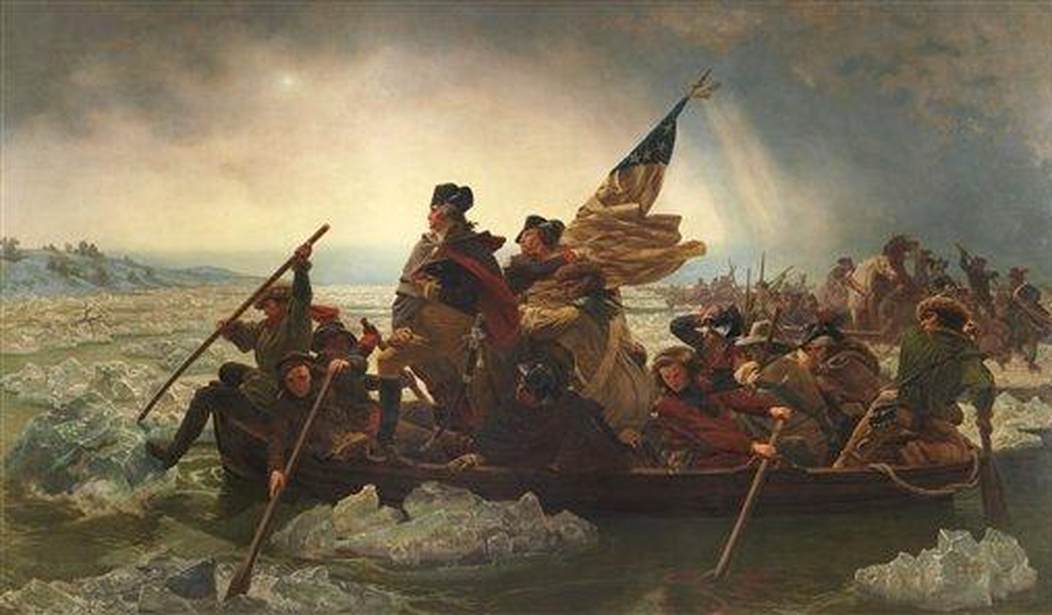

German-American Emanuel Leutze created an iconic painting of Gen. George Washington crossing the Delaware River in 1849. In a historical twist, the original painting was destroyed in 1942 by British bombers over Nazi Germany. An iconic painting commemorating America’s war against Great Britain was destroyed by our ally, Great Britain, in a war against a fascist dictator in Germany, where the painting was housed. A second, more famous version of the painting was created in 1951, and it now hangs in New York’s Metropolitan Museum of Art.
It features a proud Washington standing tall, stoic even, left boot on the port side gunwale (yes, I had to look that up) of the boat, as his troops row through ice-filled waters. In the painting, it’s not very dark outside, and from the looks of it, Washington is not braced for the cold weather he likely faced during the actual crossing.
Like so many depictions of Washington, he looks more like a mythical, larger-than-life figure than a mere mortal who faced uncertainties as any man would. Also lost in these depictions is how much of a bada*s he was.
It’s easy, almost 250 years later, to lull yourself into feeling American independence was pre-ordained, and the actions Washington took were standard warfare of the day, and all he had to do was check all the boxes, and free America would be.
The true story of Washington crossing the Delaware in December 1776 is nothing like that. Not even six months after the signing of the Declaration of Independence, Washington’s army had suffered a string of humiliating defeats. The British drove Washington’s Continental Army from New York. He and his troops had to retreat across New Jersey and into Pennsylvania. British and Hessian forces were on their heels the whole way.
His army was tired, beaten down, and soldiers were dying one by one simply from the conditions they had to endure. It gets very cold in Pennsylvania in winter. The troops didn’t have the right clothing for the weather. They needed shoes and blankets. Morale couldn’t get any worse. Supplies were almost depleted. The rate of desertions was climbing by the day. In a letter, Washington wrote, “The game is pretty near up.”
Washington’s back was against the wall, and he knew he had to do something to turn the momentum of the war back in his favor.
Washington Plans the Unthinkable
That’s when Washington devised a plan that would turn that tide, put the British on the defensive, and improve the morale of his own troops, while shoring up the confidence in his army on the part of the Continental Congress and the states.
He decided to catch the British and the Hessians by surprise on Christmas, and his approach was as unconventional as his timing.
He decided to transport his 2,400 troops under the cover of darkness, across a frozen river on Christmas night. The British didn’t anticipate any part of this plan.
Washington’s target was a British garrison in and around Trenton, N.J. The crown saw it as isolated enough that it wasn’t a likely candidate for attack. And it never thought Washington had it in him to attack at night on Christmas.
Washington understood all of this. He also knew that both Hessian and British officers had dropped their guard a bit due to the harsh winter weather.
Three Crossings, Not One
Washington’s crossing was actually three simultaneous crossings, not one. Washington led the main column of the army. Two columns supported him, and they crossed further south, which was to block enemy reinforcements from entering the planned battle and to provide cover for the main attack.
So on the evening of December 25 and into the wee hours of the 26th, Washington’s army embarked near McConkey’s and Johnson’s ferries. The flotilla carried men, horses, artillery, and supplies.
The crossing was brutal for the men. They could barely see; the water was ice cold. They went numb. They couldn’t feel their hands and feet. Freezing rain, sleet, and snow came down upon them as strong gusts of wind beat their faces and any exposed skin with even more torture.
Washington’s main column, under his leadership, made it across the river by 3 a.m. The other two columns, under the other generals, were beaten back by the darkness, the wind, the cold, and the ice.
The troops got out of the boats, covered with ice and wet. They were fatigued by the journey, and still, they had a bloody battle ahead. Washington doubled down and pushed his army forward.
On to Trenton
The army marched roughly nine miles in the dark, on that miserable winter night, to Trenton. The soldiers were quiet and disciplined. Historians say the Continental Army’s officers were surprised at the resilience of the troops, some of whom marched barefoot, covered with ice.
With the sun coming up by 8 a.m., Washington was nearing Trenton. He split his army into multiple columns, each with a general taking the lead.
The attack was going to be instant. Strike the town, surround it, and seize the Hessian garrison before they could mount a defense.
The garrison housed about 1,400-1,500 Hessian soldiers under the command of Johann Rall. Washington had caught them totally by surprise. Washington’s victory was swift and decisive.
He took captive most of the Hessians, roughly 900, with another 80-100 killed or wounded.
Continental Army casualties were few. Less than ten were reported as killed, and even there, they blamed the harsh weather and conditions more than the battle itself.
The Battle of Trenton gave Washington the victory he needed. It provided supplies, clothing, and ammunition that he needed as well. Morale among the troops was restored. The men started to reenlist. The army had an enhanced sense of confidence and will to keep the fight going.
Historians frame the Battle of Trenton as the first in a series of critical events over ten days that turned the war around for Washington. After Trenton, within days, he crossed again to launch further attacks — including the second engagement at Trenton and another key victory at the Battle of Princeton.
Almost 249 years ago, about 2,400 men put themselves through the most miserable and horrific conditions on one Christmas night to survive yet another day in a war against the world’s biggest superpower. And they won. In turn, they set the course for victory after victory that would amount to full independence from the British Empire.
In the coming weeks, you may have the opportunity to raise your glass and give a toast in gratitude for all of your blessings. I’d humbly suggest that, as you do that, you consider at least one toast for those men who froze and fought on Christmas for the cause of freedom.