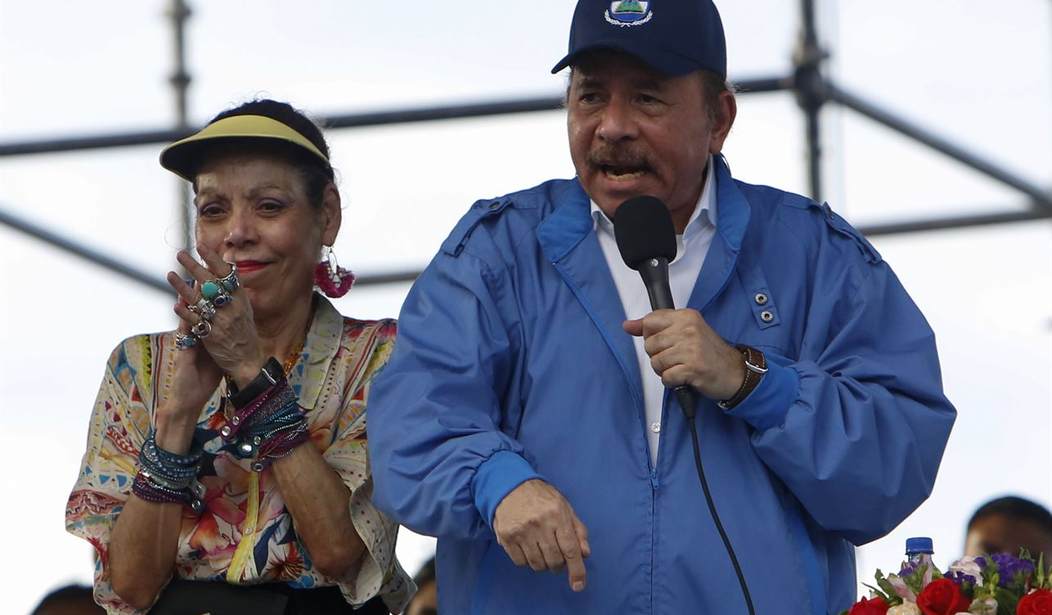

On Tuesday, the 80-year-old Nicaraguan dictator Daniel Ortega made a rare public appearance — his first since coming out about a month ago and announcing that the country would no longer hold elections.
He didn't look or sound too good. Ortega spoke slowly and incoherently, stammered, paused often, and appeared to have some difficulty breathing. He's obviously declined in just the last 30 days.
The modern-day despot reportedly suffers from lupus and end-stage renal failure, and is supposedly on dialysis, though his regime has never confirmed any of this. He even reportedly has his own private VIP suite at the National Police’s Carlos Roberto Huembes Hospital, where he receives regular weekly treatments, but it looks like reality is catching up with him.
Here's a sample from his speech:
🇳🇮‼️ | Luego de 29 días de ausencia pública, Daniel Ortega, dictador nicaragüense, reapareció. En un acto oficialista, el tirano mostró un deterioro mental y físico importante al no poder dar un discurso de corrido, balbucear, quedarse sin aire y por momentos, mostrarse… pic.twitter.com/JlC18PQdwG
— UHN Plus (@UHN_Plus) August 18, 2026
Currently and publicly, Ortega's wife and "co-president" Rosario Murillo is running the show, but she doesn't quite have the chops Ortega has. Even among the die-hard Sandinistas, she's not exactly respected. For this reason, we're seeing crackdowns on dissenters growing, including the Catholic Church. Long-time advisors have been removed from their positions and/or jailed. More citizens are detained or exiled.
The couple has spent the last couple of years consolidating their power, providing their numerous children with key government positions, especially their son Laureano Ortega Murillo, who is emerging as the heir to the seized throne.
In recent years, Laureano has built strong relationships with Russia, Iran, and China. When Nicaragua backed out of its relationship with Taiwan in 2021, it was he who began courting Beijing. In 2025, he walked behind Xi Jinping, Vladimir Putin, and Kim Jong-un in a parade commemorating the end of World War II. Sources say he's a lot more personable and outgoing than some of his siblings; he has a knack for incorporating anti-United States rhetoric into everything he does, and he's become his mother's favorite child. He currently holds dozens of authorizations that already allow him to sign and make decisions on behalf of the country.
As I mentioned, in July, the co-presidents announced there would be no more elections held in Nicaragua, and their fully controlled National Assembly worked quickly to ensure that became constitutional. It should be finalized next month. The biggest reform to come from that is that "traitors," "coup plotters," and opposition figures are barred from political participation. Of course, the regime itself gets to determine what those words mean and to whom they apply.
While I don't see anything specific on the horizon to stop any of this, international pressure is growing. The biggest moves are currently coming from the Organization of American States (OAS), the international regional organization that promotes democracy, human rights, security, and economic development within North and South America.
Shortly after the Ortega-Murillo dictatorship announced the end of elections in July of this year, the United States called for a stronger OAS response, claiming Nicaragua has increasingly become a challenge to hemispheric peace and stability. Earlier this month, the OAS Permanent Council held a special meeting and the United States, along with some of its closest regional allies — Argentina, Costa Rica, Panama, and Paraguay — presented a draft resolution calling for a Meeting of Consultation of Ministers of Foreign Affairs.
The State Department said there was a "need for urgent action" and that the United States could no longer act alone to prevent it.
On Wednesday, August 19, the Permanent Council held a vote to convene that Meeting of Consultation of Ministers of Foreign Affairs as soon as practical regarding the situation in Nicaragua. The vote sent a strong message — 29 member states voted in favor. Haiti and Venezuela were not represented. Mexico abstained from voting. Brazil voted against the meeting. Commies gotta stick together.
#LoÚltimo @OEA_oficial decide con 29 votos a favor resolución que convoca a reunión de cancilleres. #Brasil votó en contra y México se abstuvo. https://t.co/gv8EUlcfaf pic.twitter.com/CeFgw7XlgB
— 100% NOTICIAS (@100noticiastv) August 19, 2026
The ministers will now convene as soon as possible and consider "appropriate actions consistent with the OAS Charter, the Inter-American Democratic Charter, and international law."
OAS Secretary General Albert R. Ramdin posted the following on X on Wednesday:
This high-level meeting will provide an opportunity for Member States to continue their dialogue and to discuss, responsibly and constructively, appropriate actions consistent with the OAS Charter, the Inter-American Democratic Charter, and international law, always prioritizing the well-being of the Nicaraguan people.
Our common objective remains clear: to contribute to the restoration of representative democracy in Nicaragua, with full respect for the human rights and fundamental freedoms of all Nicaraguans.
It should be noted that Nicaragua is no longer a member of OAS (it withdrew itself in 2021 when OAS declared the country's elections a sham and was officially removed in 2023), but because the political situation in the country causes transnational effects, like mass migration, security threats, and human rights abuses, the OAS Charter and Inter-American Democratic Charter allow member states to discuss and respond to what's happening there.
It should also be noted that this meeting doesn't authorize the use of military force against Nicaragua, nor does it lead to a reversal of the constitutional changes in the country. Nicaragua generally ignores the OAS anyway. It does, however, allow the member states' governments to coordinate diplomatic, institutional, economic, and other collective measures against the country, leading to further isolation and more united restrictions on everything from humanitarian aid to international financial institutions that do business with the regime.
Most importantly, it shows that most countries in the region are taking the problem that is Nicaragua seriously and are largely united in doing so. What happens next is anyone's guess, especially with Ortega obviously in bad shape, but it's worth keeping an eye on.