





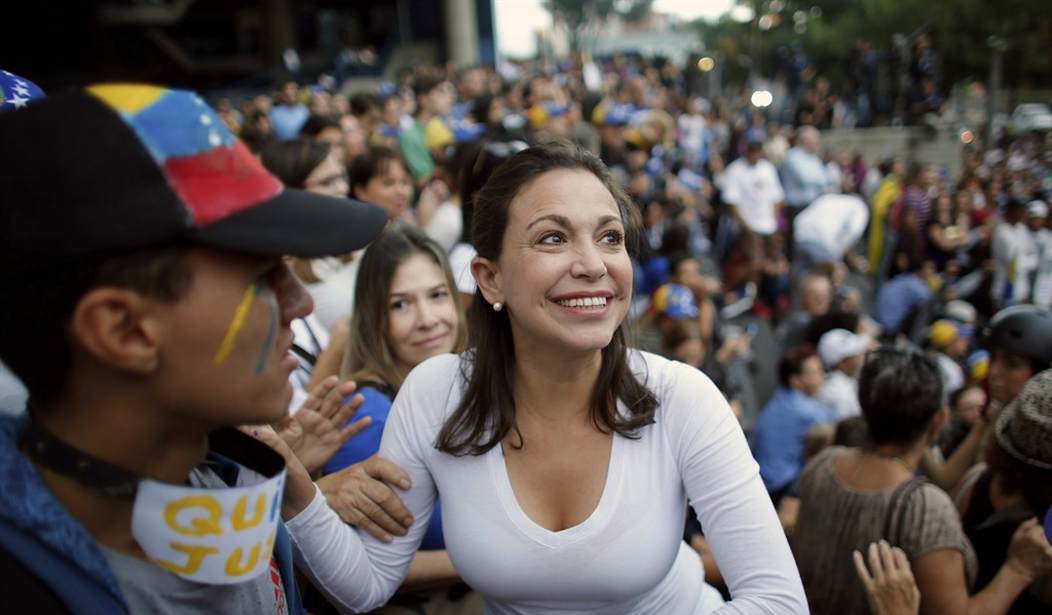
In a post-Nicolás Maduro world, Marco Rubio laid out three phases to create a stable and democratic Venezuela.
1. Stability. (Avoid civil unrest, mass migration, etc.)
2. Recovery. (Recover the economy.)
3. Transition to Democracy. (Create a path to and hold real elections.)
Monday marks exactly seven months since this process started, since we plucked Maduro in his pajamas from his bed and flew him to New York, where he now sits in a Brooklyn detention center. The three-phase plan was going mostly well. We've learned that Rubio largely controls the Donald Trump administration's Venezuela Project, and we've learned that "interim president" Delcy Rodríguez only acts — mostly — with his permission. The Venezuelan people have been grateful and have tried to be patient because they trust Rubio almost more than any other politician on the planet.
But as I've written in recent weeks, the late June double earthquakes threw a wrench in the process, and suddenly, a three-phase plan that worked on paper had to face some real-world challenges: a holdover regime that wouldn't and couldn't respond properly to a natural disaster that killed thousands; preventable deaths; shoddy infrastructure worse than anyone could imagine due to years of neglect and mismanagement; and some of the most prominent people in the country being kept away, unable to help the rescue efforts because of politics.
As Rubio has introduced this plan to the American public, he's made it clear that some phases would overlap. And, to be fair, I seriously doubt he had any idea one of the worst natural disasters in Venezuelan history would strike in the midst of it, but it did, and suddenly, he had to pivot or he'd be back at square one. What the earthquake revealed about the country's systems still in place after decades of Chavismo nearly led to civil unrest. People were rightfully angry and upset, especially when the woman who so many want to be in charge was kept out of the country (though I can attest to the fact that even though she's not in Venezuela, María Corina Machado and her team have been and are still doing a great deal of work to help those who are).
So, as I wrote last month, "the State Department announced that on August 1, a formal transition-to-democracy phase will begin. This will start with talks between two factions, one led by Jorge [Rodríguez] and one led by Dinorah Figuera, who represents the last democratically elected National Assembly that the United States recognized as the legitimate government. The agenda will be rebuilding democratic institutions — a new National Electoral Council (CNE) and Supreme Court not stacked with regime loyalists, new basic rules, and a concrete path toward elections that isn't just 'someday.'"
For those of you unfamiliar, Jorge is Delcy's brother and the current head of the fake National Assembly, which is filled with pro-Chavismo types, including Maduro's own son.
Well, August 1 has come and gone. What happened? Not much. There was no big in-person meeting, just a phone call between Jorge and Figuera. Both issued statements afterward, promising that in-person talks would begin this week in Caracas. They claimed they agreed on starting with three things: helping earthquake victims, "strengthening of democracy," and political rights and guarantees. Figuera also named her team and thanked the United States and Rubio for support.
On Monday, the State Department also released the following statement:
The U.S. welcomes the August 1 statements from Venezuela’s 2015 National Assembly, led by Dinorah Figuera, and the interim government.
We support the launching of Venezuelan‑led efforts to address the urgent needs of those affected by the June 24 earthquakes, strengthen democratic institutions, expand political freedoms, and advance a more stable and prosperous future for the Venezuelan people. This process contributes significantly to the three phase plan the United States supports to bring about stabilization, economic recovery and political reconciliation and a transition to democratic elections.
We are confident this work can deliver tangible results for Venezuelans.
It was all super vague, lacked any kind of excitement, and left the Venezuelan people who are watching every move warily feeling pretty disappointed.
Of course, this is, hopefully, only the beginning of a process that will bring about real change. Most people realize you can't just hold elections tomorrow, but a big announcement, followed by a phone call that led to a proposed potential meeting about nonspecific topics, isn't all that reassuring, especially when that was all that happened across the span of two weeks.
Rubio appeared on Fox News Channel’s My View with Lara Trump on Saturday, and he addressed the situation by stating that, "I know we’re not in the era of patience and persistence, but these things take time."
"You’re dealing with a system that’s been in place for over a quarter-century, so those are deep roots that you have to deal with," he added, acknowledging that the earthquake made things a bit more complex, but adding, "You’ve got to have a functioning economy. You need to have laws and rules and regulations in place so that investors from America and around the world can go in and safely invest and create prosperity."
True, but many people are wondering how you can have any of that without first having real leaders in place who can manage it. Investing in a country that still has most factions of a corrupt regime in place is pretty risky.
"Ultimately, you have to have transition," Rubio continued. "At some point in time there has to be legitimate elections at every level so that people know that the government that’s there is a legitimate government chosen by their people. Step one towards that is a national reconciliation. This is a people that have been divided politically for a very long time against each other, and you’re going to have to look at models like what you saw happen in Eastern Europe after the fall of the Soviet Union. I think the role the U.S. government can continue to play is as a facilitator of all of this."
Again, true, but I don't think the people are quite as divided as he states. A recent Politico article points out that the United States was initially seen as a hero in January — taking out Maduro was something the people inside couldn't do on their own, though they've tried mightily, led largely by Machado and her team. But everything that has followed — U.S. diplomats working with the regime still in place, the response to the earthquake disaster, Trump's praise of Delcy, talk of nothing but oil — is shifting public perception.
Politico says that preliminary polling from July suggests that the people remain grateful for the U.S., especially for the aid and efforts it led following the earthquakes, but "politically active segments of the population are troubled by Washington’s undisguised support for an increasingly unpopular government." Delcy, who was already incredibly unpopular, is rejected by 90% of the country.
It also points out that the survey conducted for Bloomberg by the Brazilian pollster AtlasIntel shows Rubio's favorability slipping. He's dropped about 15 points since February. None of this is a great indicator that these three phases will continue to be linear. The fact that Machado is not involved in the transition talks is another — the Venezuelans I talk to are not happy about that at all.
For what it's worth, Machado and Venezuela's actual president-elect, Edmundo González, put out a statement last week confirming they are not involved in these talks and have no plans to obstruct them. They say they will judge them by concrete outcomes, such as the release of the remaining political prisoners, dismantling of repression systems, electoral guarantees, etc.
Machado also sat down for an interview with Luis Olavarrieta on Saturday and reiterated these statements. In a way, she made Rubio's point that this transition will take more time than people are currently willing to give it. She said there is so much in place that must change to make it a true transition to democracy, including a free press, no more torture centers, and a calendar with dates for presidential, parliamentary, and regional elections.
But she also said that this is not the time for meetings. It's the time for actions that bring about real results. I think that's what the Venezuelan people are asking for, and I don't think that's too much. If we have the leverage everyone claims we do, let's get to work.
On her relationship with Rubio, Trump, and the U.S., she confirmed, once again, that despite all of the online chatter, it's fine. She said sure, there are some disagreements, mostly about timelines, which we already knew, but otherwise, she remains in contact — both Trump and Rubio have her number and use it — and will continue to push toward her ultimate goal of a free, safe, and prosperous Venezuela with real leadership.
Over the last couple of months, I've maintained that she may not be at the table at this moment, at least not visibly, but I still believe she is the endgame. Rubio has made it clear that even though the U.S. is truly managing most of this, it is ultimately up to the people of Venezuela to decide who will run their country in the end. His and Delcy's polling numbers may be slipping, but Machado is the one woman whose poll numbers aren't budging. She remains beloved and admired, and when the day for elections comes, I have no doubt she'll be on the ballot and probably win. I also believe that Rubio knows it every time he says "it's up to the people."
We'll see what this week's talks bring — I believe that even if the process is slow, having something actionable and concrete to show for it and keeping that in the public dialogue will go a long way in maintaining stability and giving the people of Venezuela hope that their time for freedom is coming.
Editor’s Note: Here at PJ Media, we’ve been dealing with real government suppression of free speech for YEARS. Despite the threats and consequences, we refuse to go silent and remain committed to delivering the truth.
Help us fight back against government censorship by joining PJ Media VIP and using promo code FIGHT to receive 60% off your membership.
Join the Conversation
VIP members get the ability to comment on articles.