





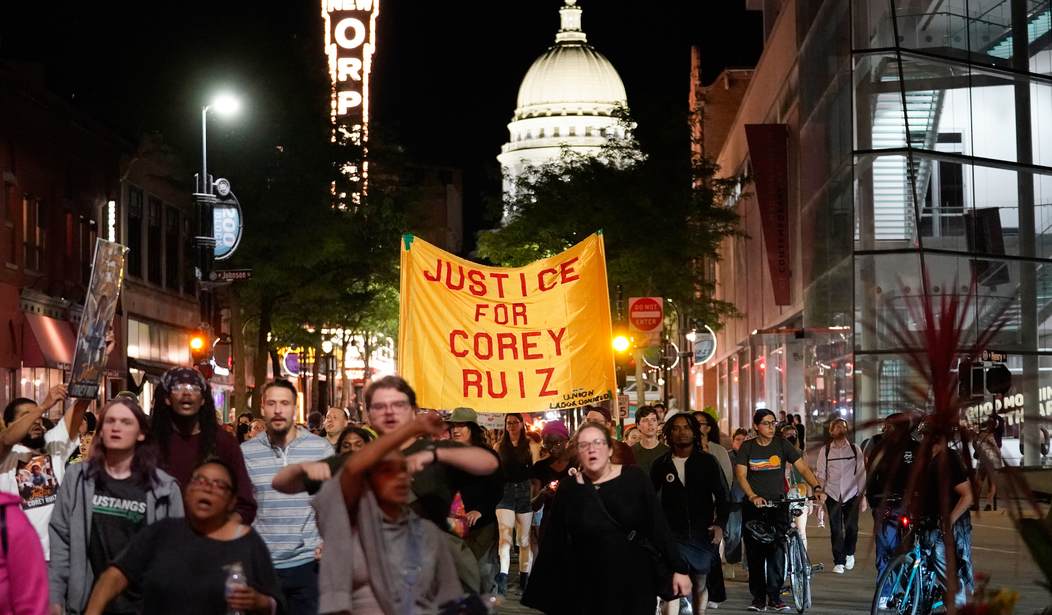
Madison activists reached a verdict before Wisconsin investigators finished gathering evidence. Civil rights attorney Ben Crump called Corey Ruiz's death an "execution," while protestors demanded the arrest of the officer who fired.
The officer's name hadn't been released, and the independent investigation was barely underway.
The preliminary police account tells a harder story. Officers responded July 22 to reports of a man stealing bicycles and checking vehicle doors. Police say that Ruiz fled, struggled with four officers, pulled a fixed-blade knife, and injured one of them.
A report from the city of Madison:
Officers were dispatched to the Marquette Neighborhood on Wednesday afternoon for a person who was stealing bicycles and checking vehicle doors.
Officers located the man, but he rode away on a bicycle and traveled through backyards to get away.
They connected with the man again in the intersection of S. Baldwin and Williamson Streets around 1:35 p.m. on a bicycle.
The man either fell or was pulled off the bicycle, this is still being determined, and a struggle ensued with officers in the middle of the intersection.
During the struggle, the man pulled out a fix-blade knife and injured an officer.
Officers continued to try to get the man into custody and a less lethal device, a taser, was used but it was unsuccessful.
The officer injured by the knife is the one who fired his weapon. A second officer was also injured, but it is not clear how that occurred. At this time, we do not think it was from the knife.
In all, four officers were involved or witnessed this shooting. Only one officer fired his weapon.
Officers at the scene provided life-saving measures. The man, who is in his thirties, was transported and pronounced dead at the hospital.
The officer who fired his weapon is considered a veteran officer.
All those involved will be placed on administrative leave.
A taser failed, and the wounded officer then fled.
Wisconsin's Division of Criminal Investigation is reviewing the shooting because Madison police were involved. Its findings will help determine whether the officer's use of force was lawful. Protesters were free to demand transparency, body cameras, and a complete review.
Declaring murder and demanding handcuffs before the evidence was collected replaced justice with political theater.
And it's an easy challenge to recognize what group relishes political theater.
Within days, the intersection became the Corey Ruiz Autonomous Zone Encampment, called CRAZE or CRAZ, and Resist the Mainstream reported that old hands at "mostly peaceful" protests were on the scene.
Independent reporter Nick Sortor was covering unrest on the ground when activists blocked his path to his vehicle and issued direct threats against his life. Sortor documented the encounter in real time, posting details of the confrontation on the social media platform X.
“Black Lives Matter rioters in the new ‘Autonomous Zone’ in Madison, Wisconsin tell me they will KlLL ME if I don’t immediately leave. Only problem is, they were BLOCKING me from getting into my vehicle. THIS IS NOT AMERICA,” Sortor wrote.
The zone Sortor referenced did not exist a month ago. It sprang up after Madison police shot and killed Corey Ruiz on July 22. Officers opened fire on Ruiz, a convicted felon, after he allegedly attacked an officer with a knife during the encounter.
In the aftermath, activists rebranded a stretch of downtown Madison as the “Corey Ruiz Autonomous Zone,” shortened by occupiers to “CRAZ.” Protesters barricaded streets using couches, chairs, spike strips, and stacked wooden pallets pulled from nearby construction sites.
For Sortor, the danger came directly from the protesters themselves rather than from any breakdown in the broader environment. He said a group of activists surrounded him and issued a specific warning as he attempted to leave the scene.
According to Sortor, the group told him, “Hurry up and leave before your life ends out here. There’s a whole team of us.”
Sortor described the ordeal as representative of a larger pattern facing reporters who cover unrest in cities run by Democratic leadership.
“I can’t think of a better example of what it’s like being an independent reporter in a blue city nowadays. I literally have to beg for mercy while people threaten to kiII me,” Sortor wrote.
Even as he condemned the protesters who threatened him, Sortor took care to separate their conduct from that of Madison’s police department. He offered praise for how officers handled the tense scene.
“And for the record: Madison, Wisconsin police have been INCREDIBLY helpful tonight. MUCH better than any other blue city police force I’ve ever dealt with. So this isn’t on them. They need additional resources. Which is why I’m calling for federal government to get involved,” Sortor wrote.
The sight of Ben Crump in front of reporters speaks more for the goals of the left than any sense of seeking justice. Crump was involved in previous racially charged cases like those of Trayvon Martin, Obama's favorite son, and Saint George Floyd.
Activists renamed South Baldwin Street "Corey Street," built barricades, and placed a raised black fist from George Floyd Square at the memorial.
Their demands include arresting the officer, placing officers on unpaid leave, expanding civilian disciplinary power, and defunding the police.
The city's early response gave the occupation room to grow. Salt trucks were used as barriers, the intersection remained closed, and officials tried to manage access rather than restore it.
Tents, food preparation, vehicles, and an expanding homeless encampment soon replaced the original memorial.
The cost fell on people who had nothing to do with the shooting. Madison Mayor Satya Rhodes-Conway said residents couldn't sleep or safely move through their neighborhood. Businesses lost income, workers faced layoffs, emergency vehicles had to detour, and city officials received complaints about threats from protestors and neighbors.
By Sunday, Rhodes-Conway had enough. Tow notices went onto vehicles blocking the streets. She ordered the barricades removed, called for tents and food preparation to leave the intersection, and said the occupation "needs to end now."
The Washington Times:
Mayor Satya Rhodes-Conway said the city is preparing to tow vehicles that activists have used to block off the intersection at Williamson Street and Baldwin Street in protest of the police killing of 38-year-old Corey Durell Ruiz.
Authorities said officers shot and killed Ruiz, an ex-felon, while he was resisting arrest on July 22 in the state’s capital city. Madison Police Chief John Patterson said Ruiz pulled out a knife during the altercation and wounded an officer before police fired the fatal shots.
“There is real harm being done to local businesses and residents in the Marquette Neighborhood. We are hearing from neighbors who are losing income and even jobs, and who will not be able to make rent. We are hearing from employees who are being laid off and businesses that are on the verge of closing permanently,” Ms. Rhodes-Conway said in a statement Sunday.
“Those who are dismissing or downplaying these concerns are not helping to advance a just cause; they are dividing our city at a time when we need to come together more than ever,” she said.
Ms. Rhodes-Conway also rebutted social media chatter that city officials were offering porta-potties, dumpsters and other handouts to the protesters to keep the autonomous zone up and running.
Council member Tag Evers called the autonomous zone “revolutionary cosplay” in his own statement discussing the potential dangers of letting the encampment persist.
He referenced how Seattle’s autonomous zone six years ago soon became the scene of several shootings and two killings in the 23 days it was allowed to operate.
As weak as it is, Rhodes-Conway deserves credit for finally drawing a line, something her counterparts in the Pacific Northwest never did, but Madison took more than a week to reach an obvious conclusion.
Grief doesn't grant control over public streets; political anger doesn't give activists authority to damage businesses, delay emergency response, or demand criminal charges on their timetable.
Ruiz's family has every right to mourn him, while the actions of the officer should face a full and independent review. The known facts still include a knife, an injured officer, and a failed attempt to use less-lethal force.
Those facts don't support the ready-made story activists tried to impose on Madison.
The activist left wanted another George Floyd moment. Madison got an occupation, a wounded police officer, angry neighbors, struggling businesses, and a mayor forced to restore basic order.
Political activists count on emotions moving faster than facts. PJ Media VIP slows the story down, follows the evidence, and asks who benefits from the outrage. Join today and save 60% with promo code FIGHT.

Join the Conversation
VIP members get the ability to comment on articles.