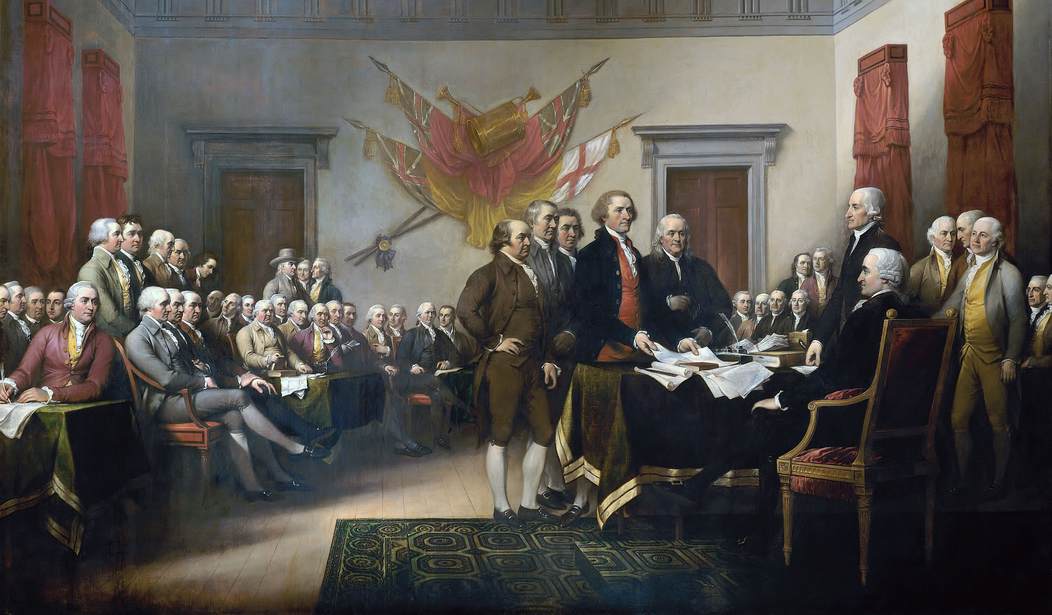
On this date, August 2, back in 1776, exactly two and a half centuries ago, delegates to the Continental Congress began the official signing of the Declaration of Independence. And besides recalling the facts of this historic event, we should reflect on what the signers would want us to learn from their example and how to apply those lessons going forward.
While the Continental Congress voted for independence on July 2 and approved a draft of the Declaration on July 4, the official copy engrossed on parchment was not immediately available. Hence, not until August 2 did the delegates (some of whom signed even later) begin to affix their names to the document.
[National Archives] On August 2nd John Hancock, the President of the Congress, signed the engrossed copy with a bold signature. The other delegates, following custom, signed beginning at the right with the signatures arranged by states from northernmost New Hampshire to southernmost Georgia. Although all delegates were not present on August 2nd, 56 delegates eventually signed the document. Late signers were Elbridge Gerry, Oliver Wolcott, Lewis Morris, Thomas McKean, and Matthew Thornton, who was unable to place his signature with the other New Hampshire delegates due to a lack of space. Some delegates, including Robert R. Livingston of New York, a member of the drafting committee, never signed the Declaration.
America's independence was official, yet it would be years of war before the fledgling nation could force Great Britain to recognize it. And we must never forget the Founders’ sacrifices.
While every year the pre-Halloween and pre-Christmas sales seasons seem to get longer and longer, America's 250th birthday, which ought to have been by far the biggest celebration of the year, seemed minor by comparison. True, many towns had fireworks displays as usual, and a few big cities, including Washington, D.C., had major events. But even some of the biggest U.S. cities like Philadelphia and New York scaled back original plans or even moved the Independence Day celebrations to a different day in order to prioritize the World Cup. Some U.S. companies ran America250 ads, and some did only World Cup ads. Most of the people I know, including some I usually think of as quite patriotic, seemed surprised that they might make any extra effort this year for July 4.
Yes, the towns and historical monuments that did have events found them very heavily attended, which is encouraging. And my personal experiences with the July 2 events in Philadelphia and the July 4 events at Mount Vernon, Va., were that everyone in attendance was excited for Independence Day. The sad part is that such patriots are still a minority in this country. Then again, the Revolutionary generation were the minority in their day, as estimates indicate a third of late-18th-century American colonists were Loyalists, a third were relatively indifferent, and only a third were ardent Patriots.
Read Also: A Poem Honoring Fallen Heroes From a Soldier Who Died in Battle
Therefore, we do have hope for the future, even if we have a lot of work to do renewing patriotism. A summer Cato Institute survey found, for instance, that 46% of Americans don't know what "America250" means, but that 86% of Americans are grateful to live in this country, 55% say the Constitution should be the limit on government, and 70% say our Founding principles are relevant today. This shows that Americans are ignorant, but not unreceptive. Conservatives need to focus on school reform, increasing the number of public patriotic events, and fundraising to erect monuments or hold programs honoring past heroes.
That's a major lesson I think the Declaration's signers would want us to learn. But they would also remind us that freedom is always in peril, that fighting for freedom requires taking risks, and that tyrants will always be trying to trample God-given rights. Arcanum Wayne Trail Historical Society states:
Five signers were captured by the British as traitors, and tortured before they died. Twelve had their homes ransacked and burned. Two lost their sons in the revolutionary army, another had two sons captured. Nine of the 56 fought and died from wounds or hardships of the revolutionary war.
Even those who survived the war and had homes intact had suffered various privations and long periods away from family, or had invested a great deal of money, in order to bring about independence. But they understood that there are some causes worth dying for, especially the cause of freedom. And until we can recapture that zeal, we will continue to see petty domestic tyrants as arrogant as King George III encroach ever more on our rights and liberties.