What could be more poignant than a poem honoring fallen American troops by a man who ended up dying while fighting for freedom?
Alfred Joyce Kilmer died on July 30, 1918, while fighting in Aisne, France, during World War I. A devout Catholic, a devoted family man, and a lover of nature, he was also fervently patriotic. Not long before his death, the American soldier-poet wrote to his wife, "Now I'm doing work I love — and work you may be proud of." Unlike many poets throughout history, he was not afraid to risk his life for the causes he preached. The U.S. did draft many Americans during WWI, but Kilmer signed up willingly as soon as the U.S. entered the conflict, enthusiastic to fight for his country. That makes it all the more tragic that he died as one of the more than 9 million military casualties of the global conflict. But he died bravely, fighting for what he believed in.
I think poetry honoring fallen troops is also especially poignant for Americans right now as we have lost 18 military men and women since the beginning of Operation Epic Fury this year against Iran. When we speak of soldiers fighting evil regimes and championing freedom, this is a very real and present situation, not part of a misty past.
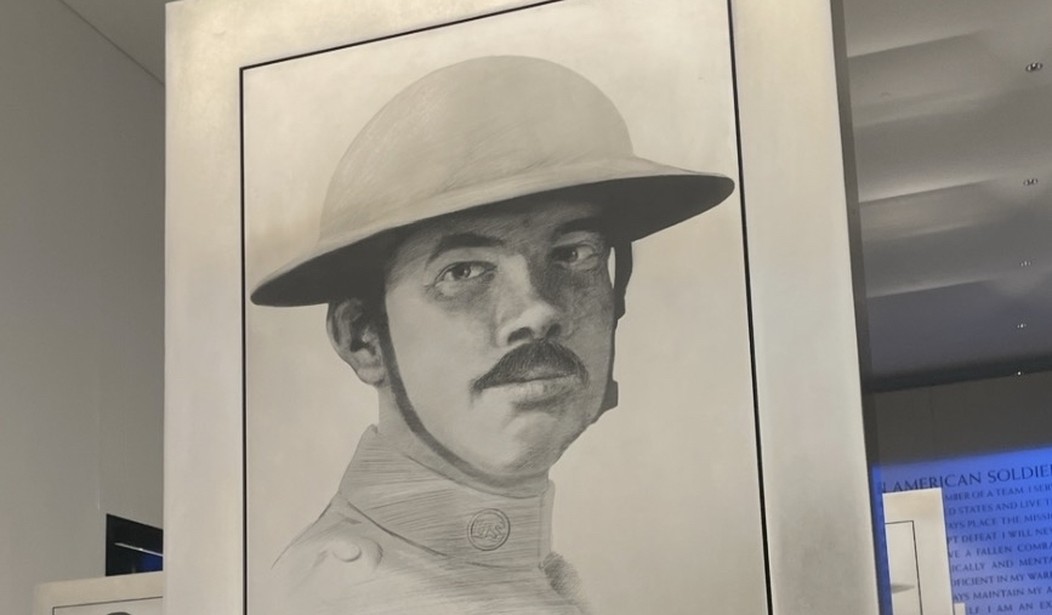
The National Museum of the United States Army features Sgt. Kilmer among several dozen Army heroes in its entrance hall. The quote above from Kilmer to his wife comes from that marker. Below is a very brief biography of him, courtesy of the museum:
Kilmer was a poet working for the New York Times Sunday Magazine when he wrote Trees, his best-known poem in 1913. When the United States declared war on Germany in 1917, he enlisted in the New York National Guard. While serving in France, he was promoted to sergeant and assigned to scout for enemy intelligence. He was killed on 30 July 1918, while looking for enemy machine guns during the Second Battle of the Marne. Sergeant Kilmer was posthumously awarded the French Croix de Guerre for bravery.
The Second Battle of the Marne had around 288,000 casualties, every one of them a man with family, friends, and future hopes.
Related: America250: Trump Honors Alexis de Tocqueville
Several years before he went to war, the poem "Memorial Day" appeared in Joyce Kilmer's 1914 collection Trees and Other Poems. The poem takes on a particularly moving aspect when one reads it knowing the writer will eventually be in one of the "tombs where weary soldiers lie." Many a poet has written about war, and many a poet has written patriotic verses for his country, but not many have actually taken up arms to follow in the footsteps of the heroes they eulogize.
So I give you Kilmer's poem, a heartfelt tribute to every brave American soldier, sailor, airman, Marine, or guardsman who died wearing the uniform over 250 years, and an insight into the patriotic passion that sent Kilmer to France:
“THE bugle echoes shrill and sweet,
But not of war it sings to-day.
The road is rhythmic with the feet
Of men-at-arms who come to pray.
The roses blossom white and red
On tombs where weary soldiers lie;
Flags wave above the honored dead
And martial music cleaves the sky.
Above their wreath-strewn graves we kneel,
They kept the faith and fought the fight.
Through flying lead and crimson steel
They plunged for Freedom and the Right.
May we, their grateful children, learn
Their strength, who lie beneath this sod,
Who went through fire and death to earn
At last the accolade of God.
In shining rank on rank arrayed
They march, the legions of the Lord;
He is their Captain unafraid,
The Prince of Peace . . .
Who brought a sword.”