







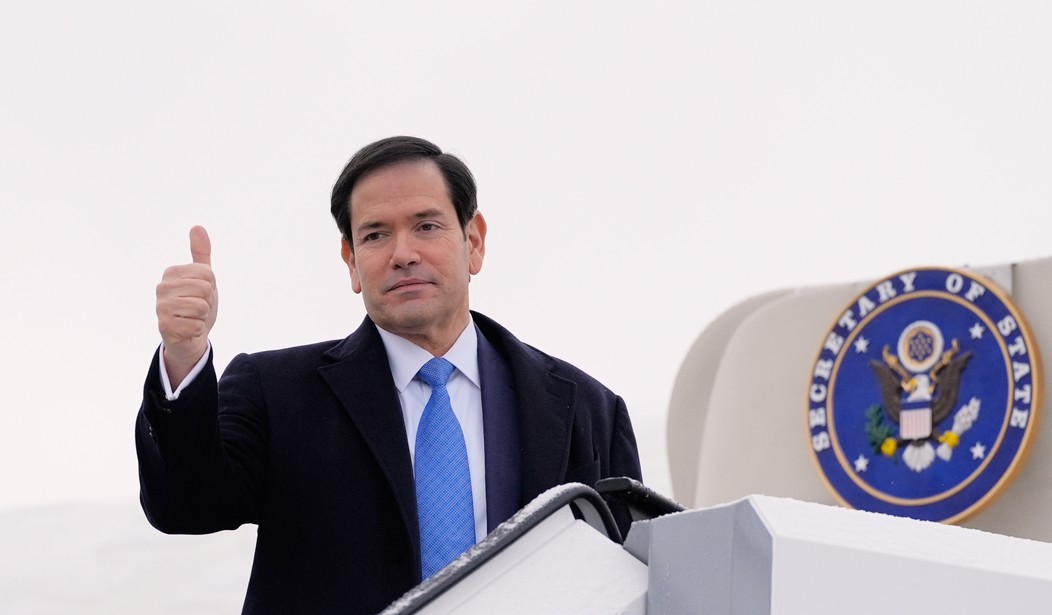
The Cuban regime is just embarrassing itself.
At some point in the last day or so, a rumor spread that the Russian Ministry of Foreign Affairs announced that it was sending Cuba a tanker full of oil accompanied by a Russian Navy destroyer to keep the United States military from stopping it from reaching the island. The rumor was big on social media, largely growing through pro-Cuban regime accounts, and, while I can't verify this, it was possibly even mentioned in state media.
There was no direct statement from the regime itself, but there was no denial either — it's desperate for the world, and mostly Donald Trump, to think that Russia has its back, so it just let the rumors fester.
Russia, on the other hand, felt the need to correct the matter.
The Russian Embassy in Cuba came out with an official statement, saying that the information is false and reminded people to only get their information from official Russian channels.
That said, while it may not have a Russian destroyer escort, a tanker with about 200,000 barrels of Russian oil is likely headed toward Cuba. Moscow calls it "humanitarian aid." The Sea Horse is part of Russia's shadow fleet and it keeps changing its exact destination. It's expected to arrive in Cuba in early March.
The big question is: What will Trump do? He's threatened secondary tariffs on countries that provide Cuba with oil. That was enough to get Mexico to stop. Colombia has admitted that it tried to send some earlier this month, but the U.S. Coast Guard intercepted the ship and sent it to the Bahamas instead. Colombia didn't try again.
But the stakes with Russia are higher. Does Trump give Vladimir Putin the same treatment he gives Claudia Sheinbaum and Gustavo Petro, who have been threatened and subdued into compliance? Does he show Vladimir Putin that the Western Hemisphere is no longer his playground? It will be interesting to see what happens.
Either way, Trump's not playing around with Cuba. Russia's "humanitarian aid" would only just delay the endgame.
Spanish reporter David Alandete came out with an article on Monday, claiming that Trump's plan for doubling down on Cuba was taken out of his Venezuela playbook. We're watching that in real time.
We've seen him isolate the Communist nation by tightening sanctions and threatening tariffs on anyone who offers to help the country gain access to oil. As I wrote a couple of weeks ago, some of its allies, particularly Russia and China, talk a good game, but all they really have to offer are verbal condemnation and... a random shipment of oil playing AIS roulette that may or may not even get to the island, apparently.
Related: All Cuba’s Allies Have Left? Good Vibes
We've also seen him cut Venezuela and Cuba's symbiotic relationship that it's had for two decades. That started by insisting that the remaining regime members in Venezuela stop sending oil to Cuba several weeks ago. More recently, we've learned that Venezuela is also sending Cuban security and intelligence officers back home, as well as the medical personnel from its forced labor programs. (That was the deal between the Castro and Chávez/Maduro regimes: Venezuela sends Cuba oil, which it either uses or mostly resells, and Cuba sends Venezuela labor and security in human form.)
The difference here is that Cuba's "president," Miguel Díaz-Canel, is not wanted in the United States. There is no military plan to swoop in and take him out of his bed in the middle of the night. Instead, the Trump administration is attempting to negotiate with members inside the regime. Here's what Alandete said about that:
Unlike what happened in Venezuela, the priority in Cuba is not to arrest Miguel Díaz-Canel, who is not facing any charges in the United States, but rather to explore compromise solutions that would allow for a negotiated resolution. Díaz-Canel himself has acknowledged in recent statements the need to introduce economic changes and adjustments given the severity of the crisis, although he insists that any dialogue must take place without external 'pressure or interference.'
So far, we've heard rumors that Marco Rubio has been chatting with Raúl Castro's 41-year-old grandson, Raúl Guillermo Rodríguez Castro, who goes by Raúlito or El Cangrejo ("The Crab"). Not only is he his grandfather's caregiver and confidant, but he is also involved in running "GAESA, the military conglomerate that controls a large part of the economy and foreign exchange earnings, from tourism to foreign trade."
For what it's worth, Rep. Carlos A. Giménez (R-Fla.), who was born in Cuba, said recently that he didn't think Rubio was actually talking to the younger Castro, but there has been no other confirmation from either side.
The strategy is to "identify someone within the system with the capacity for decision-making and implementation in a potential transitional period, someone who can guarantee internal discipline and administrative continuity in the event of changes" — Cuba's own Delcy Rodriguez, in a sense. The Trump administration is also reportedly talking to opposition leaders living in and outside of Cuba, Alandete notes. However, Cuba's opposition isn't nearly as cohesive as Venezuela's.
U.S. chargé d'affaires of the U.S. Embassy in Havana Mike Hammer also confirms that there are talks between the Trump administration and people inside the regime. In a recent interview with the Spanish newspaper ABC, he wouldn't give many details, but he double downed on the idea that change is coming in 2026. Here's more (emphasis mine):
Regarding the negotiations and contacts that President Trump has spoken about publicly, naturally, as a diplomat, I can't go into details. I'll just repeat what the president has said: there are communications with certain people. Some members of the Cuban regime say there's nothing going on; perhaps they're not informed, perhaps it's not with them… The fact is that within the Cuban system, there are individuals who realize that the project is nearing its end and who may be interested in making a change they see as necessary. And that's what we're seeking: a peaceful solution without bloodshed, where the people can live in peace. Obviously, we insist on the release of all political prisoners. And we hope other European countries will join us in insisting that these opportunities be made possible.
Hammer, who was a Joe Biden appointee, has been in Cuba for about 15 months — even though the regime has tried its best to deter him — and he said one of his biggest observations is that the Cuban people are "losing their fear," and he believes "it's because of what's coming."
Hammer added:
We need to listen to what Secretary of State Marco Rubio has said when asked these kinds of questions. We want the aspirations of the Cuban people to be fulfilled, for there to be an economic opening and a political opening. We'll see how it can be done. I'm not going to go into details about which people or individuals will carry out or allow this change, but we see it coming; it's approaching. When I arrived in November 2024, no one was talking about this. After 2025 and these past few months of 2026, people are already asking me, 'When?' Not if it's going to happen, but when will the change come? The perspective of the population has already changed, and also internationally. I see it in the discussions we have with other governments and diplomats, who affirm that the situation is unsustainable.
I'll add that if Venezuela was any indicator, the people in the country felt it too in the weeks and months leading up to Maduro's capture — they understood it more so than anyone in the United States did. Watching their optimism rise was something I used as a source for my own predictions and assessments throughout the fall. They knew. Somehow, they knew. And while the Cuban people aren't as organized, they know now too. There will be a free Cuba in 2026.
Want to support conservative media? You can do so by becoming a PJ Media VIP member. It's less than $20 for the entire year, and you get some cool perks too. We'll see you in the comments section!

Join the Conversation
VIP members get the ability to comment on articles.